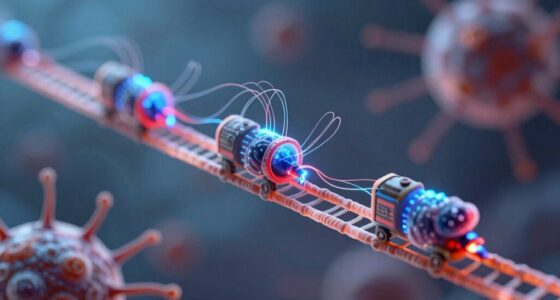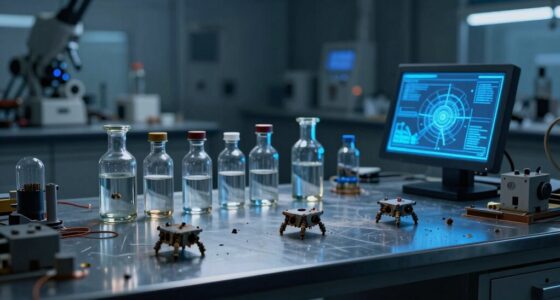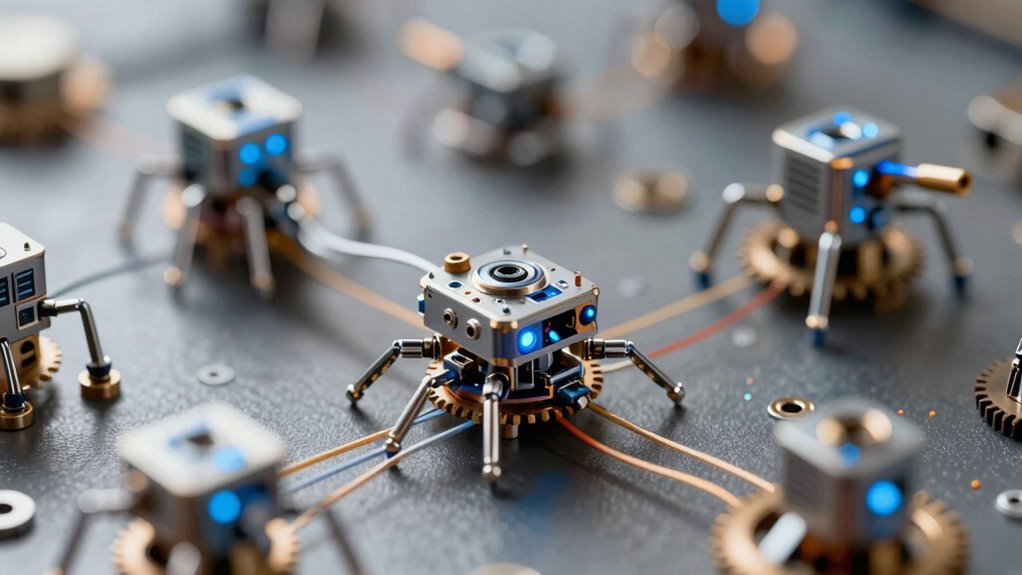

Nanomachines are tiny robots operating at the atomic or molecular level, designed to manipulate matter with high precision. They respond to stimuli like light or chemicals and use principles from physics, chemistry, and biology to perform tasks such as targeted drug delivery or energy efficiency. These microscopic machines are revolutionizing medicine, electronics, and energy industries. If you keep exploring, you’ll discover how these innovations could shape the future of technology and healthcare.
Key Takeaways
- Nanomachines are ultra-small robots operating at the atomic or molecular level to manipulate matter precisely.
- They respond to stimuli like light or chemicals, enabling targeted actions such as drug delivery inside the body.
- Fabrication techniques include self-assembly and DNA origami for creating complex, functional nanostructures.
- Applications span medicine, energy, electronics, and manufacturing, revolutionizing industries with new capabilities.
- Key challenges involve scaling production, ensuring safety, precise control, and managing environmental impacts.
nanomachines for medical research
As an affiliate, we earn on qualifying purchases.
As an affiliate, we earn on qualifying purchases.
What Are Nanomachines and How Do They Work?
Nanomachines are tiny devices that operate at the scale of nanometers—one billionth of a meter—allowing you to manipulate matter at the atomic and molecular levels. They function by moving, assembling, or altering individual atoms and molecules with incredible precision. These machines often consist of molecular components designed to respond to specific stimuli, like light, chemical signals, or electric fields. You can think of them as microscopic tools that perform tasks impossible for larger devices, such as repairing cells or delivering drugs directly to cancerous tissues. Their small size means they can navigate through biological systems or materials without causing damage. By harnessing principles from physics, chemistry, and biology, nanomachines work seamlessly at a scale where traditional machinery simply can’t operate. Energy-efficient design enables them to function effectively within biological environments and contribute to advancements in medicine and manufacturing. Additionally, ongoing research focuses on improving precision control to enhance their effectiveness and safety in various applications. Their ability to operate at such a small scale also allows for targeted interventions, reducing side effects and increasing efficiency in medical treatments. Understanding the interdisciplinary science behind these devices helps us appreciate their potential and future applications. For example, advances in molecular engineering are paving the way for more sophisticated and adaptable nanomachines that can perform complex tasks autonomously.

A Handbook of Artificial Intelligence in Drug Delivery
As an affiliate, we earn on qualifying purchases.
As an affiliate, we earn on qualifying purchases.
The Science Behind Tiny Robots
At the core of tiny robots’ operation is their ability to control and manipulate matter at the atomic and molecular levels with remarkable precision. This precision relies on understanding and harnessing physics, chemistry, and biology at nanoscales. Tiny robots use molecular forces, chemical reactions, and quantum effects to move, assemble, or alter materials. They can be programmed to respond to specific stimuli, such as light or chemicals, enabling targeted actions inside the body or in materials. Advanced fabrication techniques, like self-assembly and DNA origami, help create these machines with exact structures. By combining these scientific principles, tiny robots achieve functions impossible at larger scales, making them powerful tools across medicine, energy, and electronics. Their operation depends on mastering interactions at the smallest dimensions in nature. Additionally, recent AI discoveries have opened new possibilities for designing more efficient and adaptable nanomachines. Moreover, understanding biological interactions is crucial for developing nanobots capable of functioning seamlessly within living organisms. Ongoing research continues to explore material properties at the nanoscale, which is vital for optimizing their performance and durability. Researchers are also investigating energy transfer mechanisms to improve the efficiency and functionality of these tiny machines.

3D DNA Nanostructure: Methods and Protocols (Methods in Molecular Biology, 1500)
As an affiliate, we earn on qualifying purchases.
As an affiliate, we earn on qualifying purchases.
Types of Nanomachines and Their Functions
Different types of nanomachines serve specialized functions across various fields, from medicine to energy. You’ll find them designed for specific tasks, each with unique capabilities. For example:
- Nano-optics manipulate light to develop tiny antennas and optical fibers. Advances in nano-optics enable more efficient communication systems and sensors.
- Nanomedicine creates particles for diagnosis and targeted drug delivery inside the body.
- Nano-energy improves efficiency in solar cells, batteries, and fuel cells.
- Nano-robotics build machines for assembly, repair, and medical procedures at microscopic scales.
These nanomachines are tailored to solve problems and enhance technology in their respective areas. They work at atomic and molecular levels, enabling precise control and innovative solutions. Each type plays a vital role in advancing science and improving everyday applications. The reliance on cloud services in many applications underscores the importance of developing resilient nanotechnologies to prevent disruptions.

Deshionew Hair Extension Pliers 3-Hole Mini Pliers for Micro and Nano Ring Hair Extensions Opener and Removal Tool (Pink)
This hair extension pliers adopts three-hole design, can easily add and remove different sizes of hair extension rings….
As an affiliate, we earn on qualifying purchases.
As an affiliate, we earn on qualifying purchases.
Medical Uses of Nanorobots
Nanorobots are revolutionizing medicine by performing precise tasks inside the body, such as diagnosing diseases early and delivering drugs directly to affected cells. They can navigate through bloodstreams, identify abnormal cells, and release treatment exactly where needed. This targeted approach minimizes side effects and increases effectiveness. For example, nanorobots detect cancer biomarkers and deliver chemotherapy precisely to tumors. Their ability to monitor health in real-time also improves early diagnosis and treatment. Here’s a quick overview:
| Application | Benefit |
|---|---|
| Early disease detection | Faster diagnosis, better outcomes |
| Targeted drug delivery | Reduced side effects, increased efficiency |
| Cellular monitoring | Real-time health insights |
Advancements in nanorobot design continue to expand their potential uses in personalized medicine.
Nanomachines in Energy and Materials
Nanomachines are transforming energy and materials industries by enabling the development of more efficient and compact technologies. They improve solar cells, batteries, and fuel cells by increasing energy conversion efficiency and reducing size. In materials, nanomachines enhance lightweight composites, improve thermal management, and enable advanced coatings. You can see their impact in:
Nanomachines revolutionize energy and materials, making devices lighter, more efficient, and eco-friendly.
- Nano-solar cells and batteries with higher power output
- Graphene nanoparticles in supercapacitors for rapid energy storage
- Carbon nanotubes used in electromagnetic shielding and heat dissipation
- Nanoparticles boosting catalysis, reducing pollutant emissions
- The use of Free Floating techniques to optimize the design and deployment of nanomachines for various applications. These energy-efficient innovations help reduce waste and improve sustainability across industries. Additionally, advancements in nanomachine control allow for more precise and adaptable functionalities in complex environments. The integration of smart nanomachines is opening new avenues for autonomous operation and responsive behavior, further enhancing their utility. These innovations make energy systems more sustainable and materials lighter, stronger, and more functional. Moreover, ongoing research into scalable fabrication methods is crucial to bring nanomachine technology from laboratory to real-world applications. As a result, nanomachines help create eco-friendly solutions and drive progress in renewable energy, transportation, and manufacturing.
Impact on Electronics and Computing
How have nanomachines transformed electronics and computing? They’ve enabled the development of smaller, faster, and more efficient devices. You now benefit from transistors that are only a few nanometers wide, allowing for more powerful processors in smartphones and computers. Nanoparticles improve conductivity and enable flexible, lightweight circuits, expanding device design possibilities. Conductive inks and nanomaterials are used in RFID tags, smart cards, and foldable displays, making electronics more versatile. Additionally, nanotechnology in memory chips, like flash storage, delivers higher capacity and faster data access. Advanced manufacturing techniques are also made possible through nanomaterials, leading to safer, more sustainable methods such as replacing lead solder with nanoparticle copper. The miniaturization of components continues to push the boundaries of what’s possible in electronics and computing, making your devices smaller, smarter, and more reliable. This ongoing integration of nanomaterials is transforming the electronics industry at a fundamental level, with ongoing innovations in device fabrication fueling the next generation of electronics.
Companies Innovating in Nano-robotics
You’ll want to keep an eye on leading companies like NanoDimension, which is pushing the boundaries of 3D-printed nanoelectronics, and CarbonCure Technologies, known for integrating nanomaterials into construction. These firms are at the forefront of developing tiny robots and molecular machines that could revolutionize medicine, energy, and manufacturing. As industry innovators, they’re shaping the future of nano-robotics and opening new possibilities across multiple fields. Advances in essential oils for health and other nanotechnology applications are also contributing to this rapidly evolving field. Additionally, understanding effective email marketing strategies can help these companies better communicate their innovations to a broader audience. In particular, the development of vetted products for safety and efficacy in the nano-robotics industry ensures responsible innovation and public trust. Moreover, staying informed about regulatory changes is essential for guiding responsible development and deployment of these tiny machines.
Innovative Nano-robotic Firms
Innovative firms in nano-robotics are pushing the boundaries of what tiny machines can achieve, integrating cutting-edge science with practical applications. These companies develop groundbreaking technologies that influence medicine, energy, electronics, and materials. For example, NanoDimension creates advanced 3D-printed nano-electronics, enabling miniature circuit designs. CarbonCure Technologies reduces the carbon footprint of concrete using nanomaterials. Nanogirl Labs engineers nano-filters, storage devices, and imaging tools for medical and industrial use. Rice University’s team built a single-molecule car with buckyball wheels, demonstrating nanoscale mobility. These firms are shaping the future by combining nanotech with real-world solutions, accelerating progress across sectors, and opening new possibilities for tiny robotic devices. Their innovations are vital for advancing medical treatments, sustainable energy, and smarter electronics.
Leading Industry Players
Several leading companies are at the forefront of nano-robotics innovation, pushing the boundaries of what tiny machines can achieve. They develop groundbreaking tools and technologies that transform medicine, energy, and electronics. Imagine a table showcasing their focus areas:
| Company | Innovation | Application |
|---|---|---|
| NanoDimension | 3D nano-electronics printing | Tiny circuits in medical devices |
| CarbonCure | Carbon reduction in concrete | Sustainable construction |
| Nanogirl Labs | Material development | Filtration, imaging |
| Rice University | Molecular machines | Drug delivery, diagnostics |
| DNA Nubots | DNA-based nanobots | Targeted therapies |
These companies lead the way, making tiny, powerful robots a reality across multiple industries.
Future Prospects and Challenges of Nanomachines
The future of nanomachines holds immense promise for revolutionizing medicine, energy, and electronics, but it also faces significant hurdles. You must address challenges like manufacturing precision, ensuring safety, and controlling behavior at atomic scales. As you develop these tiny robots, consider these key issues:
- Scaling production while maintaining reliability
- Preventing unintended environmental or biological impacts
- Overcoming power supply limitations within nanosystems
- Developing robust control and communication methods
Despite these obstacles, progress continues. Advances in materials science, such as graphene and DNA-based nubots, offer exciting solutions. Your task is to balance innovation with responsibility, ensuring nanomachines become safe, effective tools for future applications.
Frequently Asked Questions
What Are the Ethical Concerns Surrounding Nanorobots in Medicine?
You might worry about nanorobots in medicine invading your privacy or causing unintended harm. Ethical concerns include potential misuse, lack of regulation, and long-term effects on health and the environment. You could also be concerned about informed consent, as these tiny devices operate at cellular levels, making it hard to know if you’re fully aware of their risks. Ensuring safety, transparency, and proper oversight is essential to address these issues.
How Long Can Nanomachines Operate Inside the Human Body?
Nanomachines can operate inside your body from a few hours up to several weeks, depending on their design and purpose. For example, some nanorobots used in drug delivery are engineered to function for about a week before naturally dissolving or being removed. Advances aim to extend their lifespan, but factors like immune response and environmental conditions inside the body influence how long they can reliably perform their tasks.
Are Nanomachines Safe for Environmental Release?
You might wonder if nanomachines are safe for environmental release. While they offer incredible benefits, risks include unintended interactions with ecosystems and potential toxicity. Scientists are actively researching and developing safety protocols, including biocompatibility and containment measures. If properly controlled and tested, nanomachines could be safely released, but ongoing regulation and risk assessment are essential to prevent environmental harm. Always stay informed about developments and safety standards.
What Are the Current Limitations of Nanorobot Manufacturing?
You face limitations in nanorobot manufacturing primarily due to precision challenges at such a tiny scale. Achieving consistent control over atomic and molecular assembly remains difficult, and current techniques often lack scalability. Additionally, energy supply and power management for nanorobots pose hurdles. Material durability and integration with existing systems also limit widespread use. Overcoming these obstacles requires advancements in nanofabrication, better materials, and innovative energy solutions.
How Affordable Will Nanorobotics Become for Everyday Use?
Nanorobotics will become more affordable as technology advances and mass production techniques improve. You can expect costs to drop considerably over the next decade, making these tiny machines accessible for medical treatments, environmental monitoring, and consumer products. As economies of scale kick in, you’ll see nanorobots integrated into everyday items like health devices, cleaning tools, and wearable tech, transforming how you live, work, and stay healthy.
Conclusion
Think of nanomachines as tiny explorers, opening new frontiers in medicine, energy, and technology. As you venture into this world, remember they’re like microscopic builders shaping the future. With each breakthrough, you’re witnessing the dawn of a revolution where these miniature robots could transform your life, much like a small seed grows into a mighty tree. Embrace the journey, because the future of nanomachines is as exciting and vast as the universe itself.