

By harnessing sunlight with advanced nanocatalysts, you can convert abundant atmospheric molecules like CO₂ and water into renewable fuels. Nanostructured materials and plasmonic nanoparticles concentrate light energy, enhancing reactions, while earth-abundant catalysts reduce costs. Designing scalable reactors, optimizing reaction pathways, and utilizing photonic and thermal strategies make certain efficient, sustainable fuel production. If you want to explore how these innovations turn thin air into clean energy, you’ll discover more below.
Key Takeaways
- Nanostructured catalysts enhance solar fuel production by improving light absorption, charge transfer, and reaction selectivity using earth-abundant materials.
- Plasmonic nanoparticles concentrate sunlight and generate hot carriers to activate CO₂ reduction and water splitting processes.
- Photonic structures like crystals and antennas trap broad-spectrum sunlight, increasing photon utilization for solar fuel synthesis.
- Designing scalable reactors with integrated optical, thermal, and catalytic components optimizes sunlight-to-fuel conversion efficiency.
- Advancing stable, cost-effective nanocatalysts enables sustainable, large-scale conversion of solar energy into clean fuels.

Solar Panel Kit,Complete Solar Panel Kit, Complete 4000W/6000W Solar Inverter System Kit, 100W Waterproof Folding Solar Panel, 12V50A Solar Charge Controller with LED Power Display and 2 USB Ports fo
*[LED Green and Red Work Light]: When the 4000W/6000W modified wave inverter is working normally, the green LED…
As an affiliate, we earn on qualifying purchases.
As an affiliate, we earn on qualifying purchases.
Harnessing Light With Plasmonic Nanoparticles

Harnessing light with plasmonic nanoparticles leverages their unique ability to concentrate electromagnetic energy at their surfaces through localized surface plasmon resonances (LSPRs). When exposed to sunlight, these metal nanoparticles—like gold, silver, or copper—absorb specific wavelengths, creating intense localized electromagnetic fields. This effect enhances the generation of hot carriers—electrons and holes—that can transfer directly to reactants like CO2 or H2, activating them for fuel-producing reactions. You can think of plasmonic nanoparticles as tiny antennas that capture and amplify light energy far beyond their size. This concentrated energy boosts catalytic activity, lowers activation barriers, and improves overall efficiency. By tuning nanoparticle size and shape, you optimize their resonance and maximize light absorption, driving more effective solar fuel conversion processes.
Plasmonic Organic Solar Cells: Charge Generation and Recombination (Nanoscience and Nanotechnology)
As an affiliate, we earn on qualifying purchases.
As an affiliate, we earn on qualifying purchases.
Advancements in Earth-Abundant Catalysts for Solar Fuel Production

Recent advances focus on replacing expensive noble metal catalysts with earth-abundant transition-metal compounds, making solar fuel production more scalable and cost-effective. You can now utilize materials like nickel, cobalt, iron, and copper phosphides or oxides, which are cheaper and more abundant. These catalysts perform effectively in photoelectrochemical and photocatalytic systems, driving reactions like CO2 reduction and water splitting. Researchers are optimizing their composition, crystal structure, and surface morphology to enhance activity, selectivity, and stability. Combining these materials with nanostructured semiconductors further improves charge transfer and reaction efficiency. This shift toward sustainable, resource-friendly catalysts aims to lower costs, facilitate large-scale deployment, and reduce reliance on scarce resources, bringing solar fuel technology closer to commercial viability. Innovative European Cloud Servers can support the data processing needs for these advanced catalytic systems, enabling real-time analysis and scalability.

Electrochemical Water Splitting (Materials Research Foundations)
As an affiliate, we earn on qualifying purchases.
As an affiliate, we earn on qualifying purchases.
Engineering Semiconductor Nanostructures for Efficient CO2 Reduction

Engineering semiconductor nanostructures is essential for enhancing CO2 reduction efficiency because their tailored morphology and electronic properties directly influence charge separation and surface reactivity. By controlling size, shape, and crystal facets, you can optimize pathways for efficient electron transfer and minimize recombination losses. Nanostructures like nanorods, nanotubes, and thin films increase surface area, providing more active sites for catalytic reactions. Adjusting band positions allows you to match the energy levels needed for specific reduction products. Incorporating heterojunctions or core-shell architectures extends light absorption and carrier lifetime, boosting overall performance. Precise engineering ensures that charge carriers reach active sites swiftly, enhancing selectivity for desired fuels while suppressing competing reactions like H2 evolution. Additionally, tuning material properties can improve the stability and recyclability of these nanostructures. Employing advanced synthesis techniques can further refine these properties to meet specific application requirements. Furthermore, understanding correlated structure-function relationships plays a crucial role in designing more efficient catalysts. This approach is vital to maximize solar-to-fuel conversion efficiencies in CO2 reduction systems.

PUXIN 15m3 Solar Biogas Anaerobic Biodigestor System, Farm Livestock Animal Waste Poultry Manure Treatment Reactor, Renewable Biogas Fuel Production, for Farm Slaughterhouse Supermarket Hotel
Waste Utilization: Biogas systems can effeciently decompose the large volumes of livestock manure generated in farms through anaerobic…
As an affiliate, we earn on qualifying purchases.
As an affiliate, we earn on qualifying purchases.
Photonic Strategies to Maximize Solar Spectrum Utilization

How can we effectively maximize the utilization of the entire solar spectrum to enhance solar-fuel production? You can achieve this through photonic strategies that optimize light absorption and conversion. Consider these approaches:
- Use broadband optical components like photonic crystals and antennas to trap UV–NIR light, boosting local electromagnetic fields.
- Implement spectral tunable LEDs and concentrators to match catalyst absorption profiles, ensuring continuous operation under varying conditions.
- Design nanostructured catalysts with plasmonic properties that extend their response into NIR, capturing more of the spectrum.
- Develop transparent flow reactors that minimize optical losses and increase irradiated catalyst surface area, maximizing photon utilization.
These strategies work in concert to improve light harvesting, hot-carrier generation, and overall solar-to-fuel efficiency.
Designing Reactors for Scalable Solar Fuel Conversion

Designing reactors capable of scaling solar fuel conversion requires integrating optical, thermal, and catalytic components into a cohesive system that maximizes sunlight utilization while maintaining operational stability. You should focus on optimizing light capture through concentrators, nanostructured materials, and photonic structures that direct photons efficiently to catalysts. Managing heat is equally important; incorporate thermal controls to sustain ideal reaction temperatures without damaging components. Catalysts must be positioned to ensure effective gas-solid contact and minimal light loss, often using transparent flow reactors or packed beds. Consider the reactor’s geometry: plate shapes or tubular designs reduce optical losses and increase surface area. Incorporating advanced materials can enhance durability and efficiency in harsh operational environments. Additionally, integrating safety and maintenance protocols is crucial for reliable, large-scale operation. Implementing monitoring systems can help track performance and identify issues early, ensuring continuous operation. Employing scalable designs that adapt to different energy demands can facilitate broader adoption and commercialization. Balancing these elements ensures high conversion efficiency, durability, and scalability, and implementing robust engineering principles can further improve reactor performance and longevity.
Navigating Reaction Pathways for Selective Fuel Synthesis
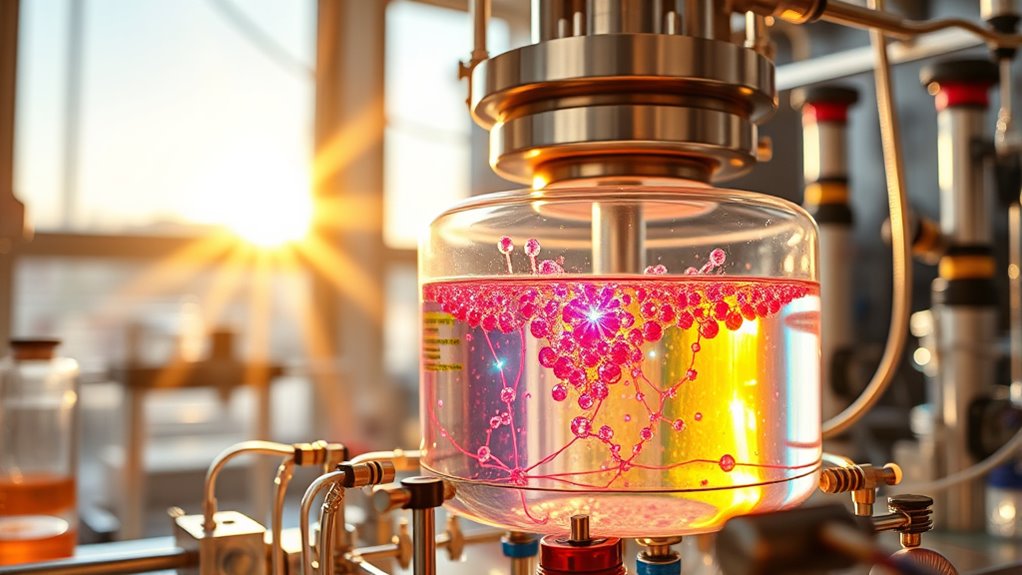
Selecting the right reaction pathways is essential for achieving high selectivity in solar fuel synthesis. To control product distribution, you should focus on:
- Adjusting catalyst surface sites to favor specific bonds and suppress others. Catalyst surface engineering can significantly influence reaction outcomes by modifying active site properties.
- Tuning proton and electron availability to direct reduction toward desired products like CO, methanol, or hydrocarbons.
- Managing water oxidation kinetics to minimize competing H2 evolution and enhance carbon-based product formation.
- Employing tandem or two-step processes to improve overall selectivity, such as converting CO2 to CO, then transforming CO into longer-chain fuels.
- Incorporating precision catalyst engineering techniques to better steer reaction pathways toward targeted fuels.
Metrics and Challenges in Solar-to-Fuel Efficiency

You need to understand that achieving high solar-to-fuel efficiency is vital for making solar fuels commercially viable. While current benchmarks aim for efficiencies above 10%, stability and durability of catalysts remain significant hurdles. Overcoming these challenges is essential to translate laboratory successes into reliable, large-scale systems. Incorporating educational resources can help researchers and investors better understand the complex factors influencing catalyst performance and longevity. A thorough grasp of thermal behavior can also guide the development of more resilient and efficient catalysts capable of withstanding operational stresses. Understanding the importance of high refresh rates can also influence the development of more responsive and durable catalysts. Emphasizing creative storytelling in communicating scientific advances can also enhance stakeholder engagement and support.
Efficiency Benchmarks and Goals
Achieving high solar-to-fuel efficiency remains a central goal in solar fuels research, as it directly determines the viability of converting sunlight into storable chemical energy at scale. You should aim for the following benchmarks:
- Single-step devices targeting efficiencies above 10%, enabling practical applications.
- Tandem systems endeavoring for efficiencies over 20–30% to maximize energy conversion.
- Faradaic efficiencies near 90% or higher, ensuring product-specific electron utilization.
- Catalyst stability lasting thousands of hours under real-world conditions to reduce replacement costs.
Meeting these goals requires overcoming material stability issues, optimizing light absorption, and improving charge separation. The challenge lies in balancing high efficiency with durability, scalability, and cost-effectiveness for commercial deployment.
Durability and Stability Challenges
Maintaining long-term stability of catalysts and photoelectrodes is a major obstacle to reaching high solar-to-fuel efficiencies. You need materials that resist photocorrosion, thermal degradation, and impurity poisoning under harsh operating conditions. Many promising catalysts degrade after only a few hours or days, reducing overall system performance. Protecting layers, alloying, and surface modifications can improve durability but may compromise activity. Stability testing under realistic, fluctuating illumination and temperature conditions is essential to identify failure modes. Additionally, earth-abundant catalysts often lack the robustness of noble metals, posing further challenges. Achieving a balance between activity, selectivity, and stability remains critical. Without durable materials, system longevity and economic viability suffer, stalling progress toward scalable, practical solar-fuel technologies. Developing robust materials that can withstand real-world conditions is crucial for advancing this field. Moreover, ongoing research into material durability testing helps identify potential failure points before large-scale deployment. Incorporating innovative protective coatings can further enhance the resilience of catalytic systems against environmental stressors. Emphasis on material engineering is vital to tailor properties that meet durability requirements without sacrificing performance.
Material Sustainability and the Future of Nanocatalyst Deployment

As the deployment of nanocatalysts for solar fuels advances, ensuring material sustainability becomes increasingly critical to their long-term viability. You need to focus on replacing scarce noble metals with earth-abundant alternatives, such as Ni, Co, and Fe. Additionally, consider these strategies:
- Prioritize scalable synthesis methods that maintain consistent nanostructure quality.
- Develop recycling and end-of-life recovery processes to minimize environmental impact.
- Use non-toxic, environmentally friendly materials to reduce lifecycle hazards.
- Optimize catalyst design for durability, reducing replacement frequency and waste.
- Incorporate field‑of‑view and imaging‑scale examples to better understand how material choices impact overall system performance and material sustainability.
- Implement life cycle assessment techniques to evaluate and improve the environmental footprint of nanocatalysts throughout their lifespan.
Furthermore, integrating material characterization techniques can provide valuable insights into the structural stability and degradation pathways of nanocatalysts, guiding the development of more sustainable materials. Employing advanced imaging methods can help reveal nanoscale interactions that influence catalyst longevity and efficiency.
Integrating Solar Concentration and Storage for Continuous Fuel Generation
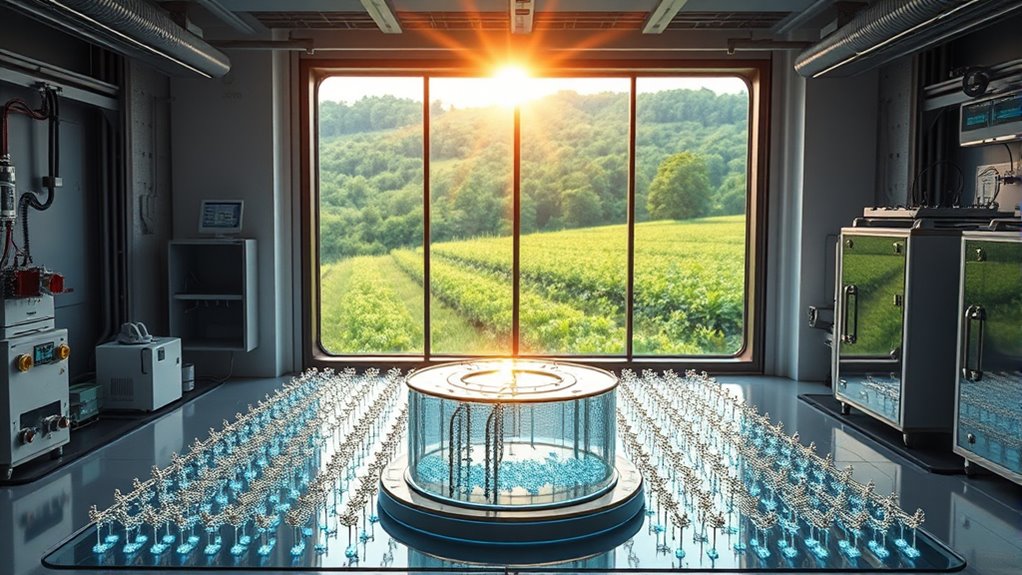
Integrating solar concentration with energy storage systems is essential for enabling continuous solar fuel production, especially given the intermittent nature of sunlight. By focusing sunlight onto catalysts, you can substantially increase photon flux, boosting reaction rates and efficiency. Pairing this with thermal or chemical energy storage allows you to store excess energy during peak sunlight and release it during cloudy periods or at night. This hybrid approach ensures steady fuel synthesis, reducing downtime and maximizing output. You might use molten salts, phase-change materials, or chemical fuels like hydrogen for storage. Incorporating advanced thermal management keeps catalysts within ideal temperature ranges, preventing degradation. Additionally, energy management strategies can optimize the use of stored energy and enhance overall system performance. Overall, combining concentration and storage creates a reliable, scalable pathway toward continuous, renewable fuel generation, bridging the gap between variable sunlight and consistent energy demand.
Frequently Asked Questions
How Do Plasmonic Nanoparticles Influence Hot-Carrier Energy Distribution for CO2 Reduction?
You see plasmonic nanoparticles enhance hot-carrier energy distribution by generating localized surface plasmon resonances when illuminated. These resonances produce energetic electrons (hot carriers) that have a broad energy range, enabling effective CO2 reduction. Your task is to optimize nanoparticle material, size, and shape to control the hot-carrier energies, ensuring they possess enough energy to activate CO2 molecules efficiently while minimizing energy loss through thermalization.
What Are the Main Challenges in Scaling up Earth-Abundant Catalysts for Commercial Solar Fuels?
You face hurdles in scaling up earth-abundant catalysts because reproducibility, phase purity, and nanostructure control are tricky to master. Replacing scarce noble metals requires developing cost-effective, stable materials like transition-metal phosphides or oxides. Manufacturing challenges include maintaining consistent quality, integrating nanostructures into durable reactor beds, and ensuring long-term stability. Until these issues are addressed, it’s like trying to hit a moving target on a windy day.
How Can Semiconductor Nanostructure Design Be Optimized for Multi-Electron Transfer Reactions?
You can optimize semiconductor nanostructure design for multi-electron transfer reactions by increasing surface area and tuning band positions to facilitate charge separation and transfer. Incorporate heterojunctions or core–shell architectures to extend light absorption and prolong carrier lifetimes. Controlling morphology—like nanorods or nanosheets—improves active sites and reduces recombination. Additionally, embedding plasmonic features and engineering surface states can enhance hot-carrier generation and reaction efficiencies, driving multi-electron processes more effectively.
What Photonic Nanostructures Most Effectively Enhance Local Optical Fields at Catalyst Surfaces?
You should focus on plasmonic antennas and photonic crystals, as they can boost local optical fields by over 10 times. These structures concentrate light at catalyst surfaces, increasing hot-carrier generation and reaction rates. By tuning their size and periodicity, you optimize spectral response and field enhancement. This approach markedly improves solar energy absorption, making catalytic processes more efficient and enabling better utilization of the full solar spectrum.
How Do Reactor Design Choices Impact Overall System Durability and Long-Term Stability?
You can improve system durability and stability by selecting reactor designs that optimize light exposure, promote efficient heat dissipation, and minimize mechanical stress. Transparent flow reactors and packed-bed configurations ensure uniform irradiation and better thermal management, reducing catalyst degradation. Incorporating thermal controls, protective coatings, and robust materials helps prevent corrosion and wear. Regular maintenance and real-time monitoring also enable early detection of issues, extending reactor lifespan and maintaining consistent performance over time.
Conclusion
You’re witnessing the dawn of a revolution where nanocatalysts and solar fuels could reshape our world. With every breakthrough in light harnessing, catalyst efficiency, and scalable design, you’re inching closer to a future where clean energy flows as effortlessly as air itself. This isn’t just progress; it’s a seismic shift that promises to turn thin air into boundless energy, fueling a sustainable tomorrow beyond your wildest dreams.