
Nanoparticle-stabilized emulsions, often called Pickering emulsions, are powerful tools in materials synthesis. They stabilize droplets by adsorbing at oil-water interfaces, which prevents coalescence and offers control over internal structure and surface chemistry. You can use them to create advanced materials like composite coatings, porous structures, or drug delivery systems. Their versatility makes them valuable across industries, and exploring further reveals how these emulsions drive innovation in sustainable and functional material design.
Key Takeaways
- Nanoparticle-stabilized emulsions enable the creation of composite materials with enhanced mechanical, chemical, or catalytic properties.
- They facilitate the synthesis of porous structures with controlled internal architectures for applications like filtration and catalysis.
- Surface chemistry tuning of nanoparticles allows tailored stability and functionality in advanced material fabrication.
- Emulsions serve as templates for producing nanostructured materials such as hollow spheres and capsules.
- Integration into material synthesis improves performance in energy storage devices, sensors, and biomedical scaffolds.
Fundamentals of Nanoparticle Stabilization in Emulsions

Nanoparticles stabilize emulsions by adsorbing at the oil-water interface, reducing interfacial tension and preventing droplet coalescence. Their effectiveness depends on particle wettability, which determines how well they spread across the interface. If particles are too hydrophilic or hydrophobic, they won’t stabilize the emulsion efficiently. Ideally, particles have balanced wettability, allowing them to anchor firmly between oil and water phases. This adsorption creates a physical barrier that hinders droplets from merging, maintaining emulsion stability. The reduction in interfacial tension lowers the energy needed for droplet formation, making emulsions more stable over time. Understanding the interplay between interfacial tension and particle wettability is essential for designing effective nanoparticle-stabilized emulsions with desired properties. Additionally, the contrast ratio of the system can influence the visual clarity and detail of the stabilized emulsions.
Techniques for Fabricating Nanoparticle-Stabilized Emulsions

To create nanoparticle-stabilized emulsions, you need to understand the main emulsification methods and how they influence droplet formation. Selecting the right stabilizer particles is vital for ensuring stability and functionality. By mastering these techniques, you can tailor emulsions to suit specific application needs effectively. Incorporating the right comfort solutions can also enhance the handling and processability of these emulsions during fabrication.
Emulsification Methods Overview
Creating nanoparticle-stabilized emulsions involves several techniques designed to efficiently disperse one liquid phase within another and guarantee long-term stability. You can use methods like high-shear mixing, sonication, or microfluidics to achieve uniform droplet sizes and enhance droplet size control. These techniques often serve as surfactant alternatives, reducing reliance on traditional surfactants and improving stability. Microfluidic approaches allow precise control over droplet formation, while high-shear methods enable rapid processing. Sonication disperses particles effectively, creating fine emulsions. The choice depends on your application needs, scale, and desired droplet size. Here’s a quick comparison:
| Method | Pros | Cons |
|---|---|---|
| High-shear | Fast, scalable | Less precise droplet size control |
| Microfluidics | Precise droplet control | Limited scalability |
| Sonication | Effective for small droplets | Potential particle damage |
Stabilizer Particle Selection
How do you choose the right particles to stabilize emulsions effectively? First, consider particle compatibility with your oil and water phases. You want particles that naturally adsorb at the interface without agglomerating or detaching. Surface modification plays a key role here; by tailoring particle surfaces with specific functional groups, you enhance their affinity for either phase, improving stability. For example, silica particles can be modified with hydrophobic coatings to favor oil phases, while other particles might be made hydrophilic for water compatibility. Ensure your particles are uniformly sized and well-dispersed to prevent coalescence. Selecting the right combination of particle compatibility and surface modification techniques ultimately yields a robust, stable emulsion suited for your material synthesis needs.
Enhancing Material Properties Through Pickering Emulsions

Pickering emulsions, stabilized by solid nanoparticles instead of traditional surfactants, offer a promising approach to enhance material properties. Their unique interfacial chemistry allows you to tailor surface characteristics, improving stability and functionality. By controlling colloidal interactions at the interface, you can influence particle adsorption, creating robust barriers that resist coalescence. This stability enables the formation of advanced composite materials with superior mechanical strength, chemical resistance, or thermal stability. You can also manipulate the emulsion’s internal structure to achieve desired porosity and surface area, boosting catalytic activity or permeability. These modifications directly translate into improved performance in applications like coatings, sensors, and drug delivery systems. Overall, leveraging Pickering emulsions release new pathways for customizing material properties at the nanoscale.
Environmental Benefits and Sustainability Aspects
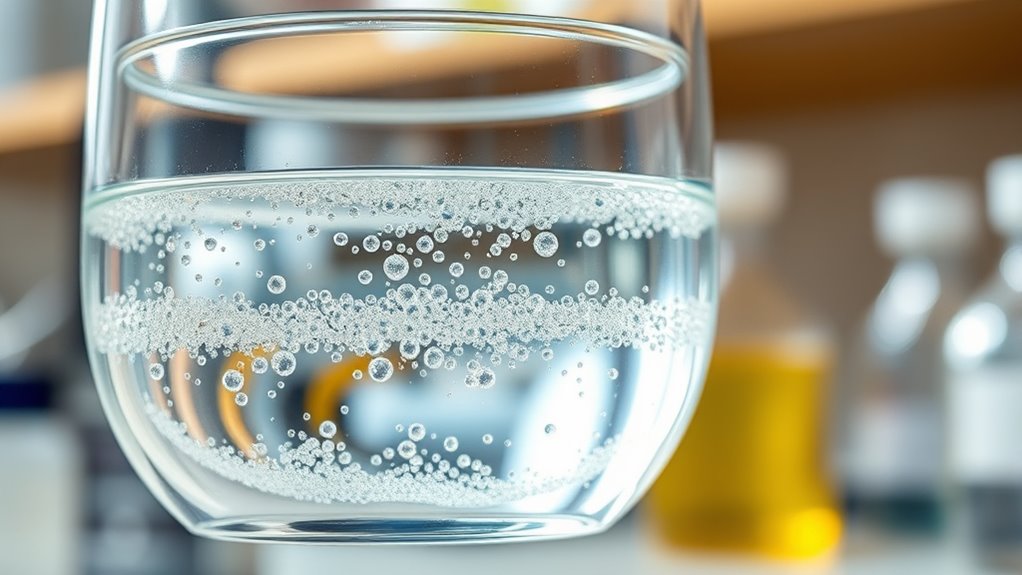
Nanoparticle-stabilized emulsions offer notable environmental advantages by reducing reliance on traditional surfactants, which often pose ecological and health risks. Instead, they utilize eco friendly surfactants and biodegradable stabilizers, making the process safer for ecosystems. These stabilizers break down naturally, minimizing pollution and waste accumulation. By avoiding persistent chemicals, you decrease the carbon footprint associated with manufacturing and disposal. Additionally, nanoparticle stabilization often requires fewer chemicals, leading to less hazardous waste. This approach aligns with sustainable practices, supporting greener production methods. As a result, nanoparticle-stabilized emulsions contribute to environmentally conscious material synthesis, helping you develop safer, more sustainable products while reducing environmental impact. Overall, they promote a cleaner, greener future with less ecological harm. Incorporating sound mixing techniques can further enhance the environmental benefits by optimizing the formulation processes to minimize energy consumption and waste.
Cutting-Edge Applications in Industry and Medicine
The environmentally friendly nature of nanoparticle-stabilized emulsions has opened new frontiers in industry and medicine, enabling innovative solutions that were previously unattainable. In biomedical innovations, these emulsions improve drug delivery systems, offering targeted release and enhanced stability. They also facilitate the development of advanced diagnostic tools, improving sensitivity and accuracy. In energy storage, nanoparticle-stabilized emulsions enhance battery and supercapacitor performance by optimizing electrode materials and improving charge transfer. Their unique properties allow for more efficient, sustainable energy systems with longer lifespans. As a result, industries benefit from safer, more effective technologies, while medical applications become more precise and less invasive. Advances in AI security technologies further support the safe deployment of these innovative systems across critical sectors. These cutting-edge applications demonstrate the transformative potential of nanoparticle-stabilized emulsions across critical sectors.
Future Perspectives and Challenges in Emulsion-Based Material Synthesis

As you explore future developments, addressing scalability and manufacturing hurdles becomes essential for broader adoption. You also need to contemplate environmental and safety concerns associated with nanoparticle use and emulsion production. Overcoming these challenges will be key to advancing sustainable and efficient emulsion-based materials. Incorporating eco-friendly materials into the synthesis process can help mitigate some of these environmental impacts.
Scalability and Manufacturing Challenges
Scaling up nanoparticle-stabilized emulsion production presents significant challenges that can hinder their practical application. Achieving consistent quality during scaling up involves overcoming manufacturing hurdles like maintaining uniform droplet size and stable nanoparticle coverage. Larger batches increase complexity in controlling parameters such as mixing speed, temperature, and nanoparticle concentration. Industrial processes require reliable, scalable methods that preserve emulsion stability and functional properties. Additionally, sourcing high-quality nanoparticles at scale can be costly and inconsistent. Ensuring reproducibility across large volumes demands precise process control and advanced equipment, which may involve substantial investment. These manufacturing hurdles limit widespread adoption, requiring innovative strategies to optimize production techniques, reduce costs, and guarantee product uniformity for commercial applications.
Environmental and Safety Considerations
Despite the promising potential of nanoparticle-stabilized emulsions in various applications, environmental and safety considerations pose significant future challenges. You need to address chemical safety by understanding the toxicity and environmental impact of nanoparticles used, ensuring safe handling and disposal. Waste management becomes vital, as improper disposal could lead to pollution and health risks, especially if nanoparticles accumulate in ecosystems. Developing eco-friendly materials and green synthesis methods can help mitigate these concerns. Regulations may also evolve, requiring you to stay informed about safety standards. Balancing innovation with responsible practices is essential to prevent environmental harm. Ultimately, prioritizing chemical safety and waste management will be key to advancing emulsion-based materials sustainably and responsibly.
Frequently Asked Questions
How Do Nanoparticle Size and Shape Influence Emulsion Stability?
You’ll find that smaller nanoparticles generally enhance emulsion stability because their higher surface area improves particle coverage at interfaces. Particle shape matters too; spherical particles often stabilize emulsions better, while irregular shapes can create weaker interfaces. Additionally, surface chemistry influences stability—if particles are more hydrophobic or hydrophilic, they’ll better adsorb at the oil-water interface, improving emulsion stability. So, consider particle geometry and surface chemistry to optimize your emulsion system.
What Are the Safety Considerations for Using Nanoparticles in Consumer Products?
Using nanoparticles in consumer products is like walking a tightrope—you need to guarantee safety. You should prioritize regulatory compliance and conduct thorough toxicity assessments to prevent health risks. Always stay updated on safety standards, handle nanoparticles carefully to avoid inhalation or skin exposure, and inform consumers about potential hazards. Proper testing and adherence to regulations help protect users and ensure responsible use of nanotechnology in everyday products.
Can Nanoparticle-Stabilized Emulsions Be Recycled or Reused Effectively?
Yes, you can recycle nanoparticle-stabilized emulsions effectively. Focus on emulsion recovery methods to separate the stabilized droplets, which allows you to reuse the emulsion. Additionally, nanoparticle recycling is possible by recovering and reprocessing nanoparticles from the emulsion. Proper techniques guarantee minimal loss of particles and maintain stability, making reuse sustainable and cost-effective in various applications.
How Do Environmental Conditions Affect the Longevity of Nanoparticle-Stabilized Emulsions?
Environmental conditions greatly influence the longevity of nanoparticle-stabilized emulsions. You’ll find that pH fluctuations can weaken particle stability, causing the emulsion to break down faster. Meanwhile, temperature variations can accelerate destabilization or cause particles to aggregate, reducing effectiveness. To maximize lifespan, you need to control these factors, keep conditions stable, and consider additives that enhance resilience against environmental stresses. This way, your emulsions stay functional longer.
Are There Cost-Effective Methods for Large-Scale Production of These Emulsions?
You can use cost-effective scaling methods like continuous flow reactors and optimized mixing techniques to produce nanoparticle-stabilized emulsions efficiently in industrial manufacturing. These approaches reduce raw material and energy costs while maintaining quality. Implementing automation and standardized processes also enhances throughput and consistency, making large-scale production more affordable. By focusing on these strategies, you’ll streamline manufacturing, lowering overall expenses and ensuring the emulsions meet industrial demands effectively.
Conclusion
As you explore nanoparticle-stabilized emulsions, you’ll uncover endless possibilities for innovative materials. But the true potential remains largely untapped—what groundbreaking applications could emerge next? With ongoing challenges and rapid advancements, the future of this field promises surprises that could transform industries and medicine alike. Stay tuned, because what’s coming might just redefine how you think about material synthesis and sustainability. The next breakthrough could be closer than you think.