
Nanomachines are tiny devices built through molecular assembly, which organizes molecules precisely into functional structures. These structures form the foundation for nanoscale robotics that can perform tasks like moving molecules, sensing environments, or carrying out chemical reactions. By understanding molecular interactions, you can help design stable and effective nanomachines. If you want to explore how these small machines operate and their future possibilities, there’s plenty more to discover.
Key Takeaways
- Molecular assembly organizes molecules precisely, forming the basis for stable and functional nanomachines.
- Understanding molecular interactions is essential for designing reliable and effective nanoscale robotic components.
- Nanoscale robots can perform tasks like drug delivery, sensing, and chemical reactions within biological environments.
- Techniques such as DNA origami and protein engineering enable creation of movable, responsive nanorobotic parts.
- Future applications include targeted medicine, environmental solutions, and advanced manufacturing through tiny, autonomous machines.
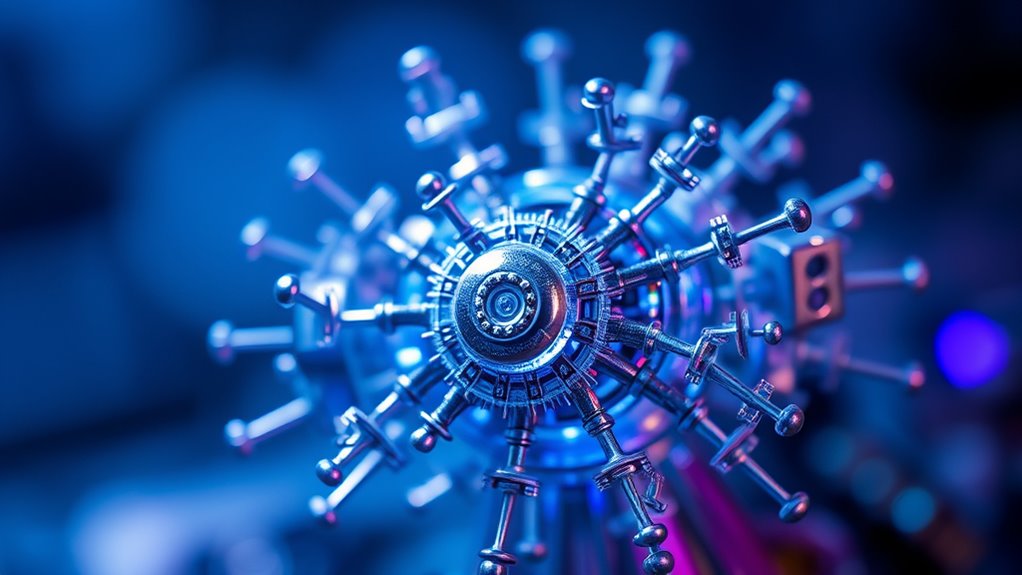
Have you ever wondered how tiny machines at the nanoscale can perform complex tasks? It’s fascinating to realize that these minuscule devices, often just a few nanometers in size, can carry out operations that seem impossible given their scale. One of the key concepts behind their functionality is molecular assembly. This process involves the precise organization of individual molecules into specific structures, much like assembling a complex puzzle at an atomic level. By controlling the way molecules connect and interact, scientists can create nanomachines with tailored functions, whether it’s targeting cancer cells or repairing damaged tissues. Molecular assembly is fundamental because it lays the groundwork for more advanced nanoscale robotics, where machines are designed to move, manipulate, and perform tasks with accuracy and efficiency. An understanding of molecular interactions is essential for designing effective nanomachines and ensuring their stability during operation.
Molecular assembly organizes molecules into precise structures, enabling tiny machines to perform complex tasks at the nanoscale.
Nanoscale robotics takes this concept further by integrating these molecular components into functional devices that mimic the behavior of larger robots, but on an incredibly small scale. These tiny robotic systems can be programmed to perform specific actions, such as transporting molecules, sensing environmental changes, or even executing chemical reactions. Unlike traditional machinery, nanoscale robotics operate autonomously or semi-autonomously within biological environments, steering through complex bodily systems or microenvironments. You might imagine them as microscopic robots that can crawl through blood vessels or enter cells to deliver drugs directly to targeted sites, reducing side effects and increasing treatment effectiveness.
The design of nanoscale robotics relies heavily on understanding the interactions between molecules and how to manipulate them reliably. Researchers often use techniques like DNA origami or protein engineering to create robotic components with precise shapes and functions. These methods allow for the construction of movable parts, sensors, and actuators that can respond to stimuli or commands. As you explore more about nanoscale robotics, you’ll realize that the challenge lies in integrating these tiny parts into cohesive systems that can perform multiple tasks in sequence or simultaneously. The goal is to develop versatile, adaptable machines that can operate in complex environments, much like their macroscopic counterparts but with the added advantages of size and specificity.
In essence, molecular assembly provides the building blocks, while nanoscale robotics gives these blocks mobility and purpose. Together, they form the foundation of nanomachines that could revolutionize medicine, manufacturing, and environmental science. Understanding these processes offers a glimpse into a future where we harness the power of the tiniest machines to solve some of humanity’s biggest challenges.
nanomachines kit
As an affiliate, we earn on qualifying purchases.
As an affiliate, we earn on qualifying purchases.
Frequently Asked Questions
What Are the Main Challenges in Nanomachine Development?
You face several challenges in nanomachine development. Ethical considerations, like safety and potential misuse, weigh heavily on progress. Manufacturing scalability is another hurdle, as producing nanomachines reliably and cost-effectively remains difficult. You must also overcome technical barriers in precision control and material stability. Addressing these issues is essential to advancing nanotechnology safely and efficiently, ensuring future applications are beneficial and ethically sound.
How Are Nanomachines Powered at the Nanoscale?
You power nanomachines using tiny energy sources like chemical reactions, magnetic fields, or light. These energy sources enable efficient power transfer at the nanoscale, allowing the machines to perform their tasks. You can also harness environmental energy, like heat or vibrations, to sustain their operation. By optimizing these methods, you guarantee that nanomachines function effectively, opening doors for medical, environmental, and technological breakthroughs.
What Materials Are Used to Build Nanomachines?
You wonder what materials build nanomachines? They’re crafted from biocompatible materials, ensuring safety inside living systems, and fabricated at the nanoscale with incredible precision. Tiny components like carbon nanotubes, DNA strands, and gold nanoparticles form the core. As you imagine these minuscule marvels working seamlessly within your body, it’s clear that advances in nanoscale fabrication open endless possibilities, blending biology and technology in ways once thought impossible.
How Do Nanomachines Communicate With Each Other?
You can think of nanomachines communicating through molecular signaling and wireless communication. Molecular signaling involves releasing chemical signals that nearby nanomachines detect and respond to, enabling coordinated actions. Wireless communication uses tiny electromagnetic signals or encoded vibrations to transmit information between nanomachines without physical contact. These methods allow them to work together efficiently, perform complex tasks, and adapt to their environment, making nanomachines incredibly versatile and powerful tools at the microscopic level.
What Are the Potential Risks of Nanomachine Deployment?
Like Pandora’s box, deploying nanomachines could release unforeseen risks. You might face ethical concerns about control and safety, while environmental impact remains unpredictable if they malfunction or accumulate. These tiny devices could disrupt ecosystems or be weaponized, raising questions about oversight. As with any powerful innovation, you should carefully weigh the benefits against potential dangers, ensuring responsible use to prevent unintended consequences.

DNA Nanotechnology: Methods and Protocols (Methods in Molecular Biology, 1811)
As an affiliate, we earn on qualifying purchases.
As an affiliate, we earn on qualifying purchases.
Conclusion
Now that you understand nanomachines, you’re on the brink of a technological revolution that could change everything. Imagine tiny machines so powerful, they could repair your body at a cellular level or clean entire oceans in seconds—things once thought impossible. These nanomachines are the future, pushing the boundaries of what you believed was possible. Get ready, because you’re about to witness a world where the impossible becomes everyday reality, all thanks to these microscopic marvels.

Old Nobby Organic Chemistry Set (425 pc) Molecular Model Kit with Atoms, Bonds, Guide, Bond Removal Tool – STEM Science Kits for Kids Toys Chemistry Set for Students Teachers Young Scientists
Comprehensive Molecular Learning Kit: Includes high-quality color-coded atoms and bonds for constructing 3D models of compounds; ideal for…
As an affiliate, we earn on qualifying purchases.
As an affiliate, we earn on qualifying purchases.

Adeept 4WD Mecanum Wheel Smart Car Kit for Raspberry Pi 5/4B/3B/3B+(Board Not Included), Line Tracking, Light Tracing, Obstacle Avoidance, Servo Motor, OLED Display, LED Dot Matrix Display
【Mecanum Wheels Car Kit】 Each wheel can be driven independently, it can move in many incredible ways. This…
As an affiliate, we earn on qualifying purchases.
As an affiliate, we earn on qualifying purchases.