

Nanowire batteries use tiny, filament-like wires made from materials like silicon or metal oxides to markedly boost energy storage. Their high surface area and short ion diffusion paths allow faster charging, longer cycle life, and higher capacity. The flexible, durable design helps withstand expansion during use. Although there are manufacturing challenges, progress is being made in scaling up production and integrating these batteries into real-world devices. If you continue exploring, you’ll discover how this breakthrough could transform energy storage for everyone.
Key Takeaways
- Nanowire batteries use ultra-thin, high-surface-area nanowires for faster charge transfer and higher energy density.
- Their one-dimensional structure accommodates volume changes, enhancing durability and cycle life.
- Scalable manufacturing methods are being developed to produce high-quality nanowires cost-effectively.
- They enable rapid charging and longer-lasting performance, promising advances for electric vehicles and energy storage.
- Ongoing research aims to overcome production challenges and bring nanowire batteries to commercial reality.
high capacity nanowire batteries
As an affiliate, we earn on qualifying purchases.
As an affiliate, we earn on qualifying purchases.
What Are Nanowire Batteries and Why Do They Matter?

Nanowire batteries are advanced energy storage devices that utilize tiny, filament-like structures called nanowires to enhance performance. These nanowires are incredibly thin, often thousands of times thinner than a human hair, and made from materials like silicon, gold, or metal oxides. Their small size creates a high surface-area-to-volume ratio, which boosts contact between the electrode and electrolyte, resulting in faster charge transfer. Because of their flexible, nanoscale structure, nanowires can better withstand the expansion and contraction typical during charging and discharging. This flexibility helps prevent cracking and capacity loss over time. Overall, nanowire batteries promise higher energy densities, faster charging, longer cycle life, and improved power delivery, making them a game-changer for portable electronics, electric vehicles, and renewable energy storage.

FASTPRO 20V Lithium Ion Battery, 1.5-Amp Hour, 1 Pack
20V Lithium Ion Battery, 1.5-Amp Hour, 1 Pack
As an affiliate, we earn on qualifying purchases.
As an affiliate, we earn on qualifying purchases.
How Nanowire Design Boosts Battery Performance

The unique design features of nanowires substantially enhance battery performance by facilitating faster charge and discharge cycles. Their high surface-area-to-volume ratio increases contact between the electrode and electrolyte, boosting charge transfer rates. Short Li diffusion paths in nanowires enable rapid ion movement, reducing charging times. The one-dimensional structure creates interconnected networks that maintain electrical pathways even during volume changes, especially in high-capacity materials like silicon. Mechanical flexibility helps nanowires withstand expansion and contraction without cracking, preserving electrode integrity. Additionally, their ability to be integrated into composite architectures improves electronic conductivity and power density. This combination of enhanced ionic and electronic transport, along with structural resilience, results in batteries that charge faster, last longer, and deliver higher power, making nanowire design a game-changer for energy storage. Innovative European cloud servers can leverage advanced nanomaterials to optimize data center energy efficiency and sustainability.
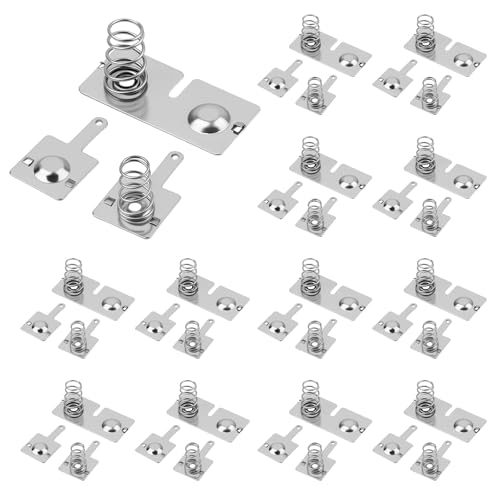
Asofelk 10 Pairs Nickel-Plated AA Battery Springs, Negative to Positive Conversion Contacts, 12x12MM & 12×26.5MM Durable Conductive Springs for Battery Cases, DIY Electronics and Device Maintenance
Durable Stainless Steel Material – Crafted from high-quality stainless steel, these battery spring contacts deliver excellent durability and…
As an affiliate, we earn on qualifying purchases.
As an affiliate, we earn on qualifying purchases.
Overcoming Challenges in Manufacturing and Scaling Up

Scaling up nanowire battery manufacturing presents significant hurdles due to the complexity of producing uniform, high-quality nanostructures at high throughput. You face challenges like maintaining consistent nanowire dimensions, controlling core–shell coatings, and integrating these structures into scalable electrode formats. Additionally, optimizing electrode density without sacrificing surface area is tricky. To overcome these, research focuses on:
- Developing scalable synthesis methods like roll-to-roll chemical vapor deposition
- Improving coating techniques for uniform core–shell structures
- Fusing nanowires with host particles to enhance packing density
- Streamlining integration into existing manufacturing lines with new handling processes
- Ensuring quality control and testing procedures are adaptable for large-scale production. Implementing robust quality assurance protocols is vital for maintaining standards during mass production. Furthermore, establishing effective scaling strategies can facilitate smoother transition from prototypes to commercial products. Implementing advanced manufacturing techniques can significantly reduce production costs and improve consistency. These steps aim to balance performance, cost, and scalability, making nanowire batteries viable for commercial production. Achieving reliable, large-scale manufacturing remains a critical hurdle on the path to market.

Advanced Nanomaterials for Energy Storage Devices
As an affiliate, we earn on qualifying purchases.
As an affiliate, we earn on qualifying purchases.
Real-World Applications and Commercial Progress

Although nanowire battery technology has shown remarkable promise in laboratory settings, translating these advances into commercial products remains a work in progress. Currently, startups like OneD Battery Sciences are developing silicon nanowire-based anodes, aiming to improve energy density and charging speeds for electric vehicles and grid storage. Industry interest is high because of potential benefits like faster charging and longer cycle life, but scaling production is challenging. Manufacturing methods need refinement for uniform, cost-effective nanowire synthesis and integration into existing cell designs. While prototypes demonstrate impressive cycle life and energy density, full-cell validation under real-world conditions is still underway. Commercialization depends on resolving scale-up issues, reducing costs, and ensuring safety and durability for mass-market adoption. Additionally, ongoing research into the Gold IRA markets highlights the importance of transparent and reliable investment options as the industry advances. Addressing manufacturing challenges is crucial for bringing nanowire batteries from lab prototypes to everyday use. Furthermore, developing scalable production techniques is essential to meet the growing demand for high-performance energy storage solutions. Advances in manufacturing processes could significantly accelerate the transition from experimental to commercial-grade nanowire batteries.
The Future of Energy Storage With Nanowire Technology

Nanowire technology is poised to revolutionize energy storage by enabling batteries that are faster, more durable, and have greater capacity. As this innovation matures, expect significant shifts in how we power everything from electric vehicles to grid systems. You’ll see higher energy densities, allowing longer ranges and more efficient storage. Faster charging becomes possible thanks to short lithium diffusion paths and expanded interfaces. Improved cycle life means batteries last thousands of cycles without capacity loss. Plus, enhanced power delivery will support rapid acceleration and high-demand applications. This breakthrough also promises improved safety features, making batteries more reliable and less prone to overheating or failure. Additionally, the use of nanostructured materials enhances overall performance and stability of these advanced batteries. Incorporating advanced manufacturing techniques further optimizes their performance and scalability. These advancements contribute to energy efficiency and sustainability in modern energy solutions. – Increased energy density for longer-lasting batteries – Faster charging times to reduce downtime – Extended cycle life for cost-effective use – Better safety and stability through advanced materials and designs
Frequently Asked Questions
What Are the Main Safety Concerns With Nanowire-Based Batteries?
Your main safety concerns with nanowire-based batteries involve potential electrode cracking, which can lead to capacity loss or short circuits. The high surface area increases the risk of electrolyte instability and dendrite formation, possibly causing internal shorts. Additionally, the large volume changes during cycling might cause electrode pulverization, risking thermal runaway. Proper engineering, such as core–shell designs and gel electrolytes, helps mitigate these risks, but safety validation remains essential before widespread use.
How Cost-Effective Are Nanowire Batteries Compared to Traditional Technologies?
While nanowire batteries show impressive potential, they currently aren’t as cost-effective as traditional technologies. You’ll find that their advanced manufacturing processes, like precise nanowire growth and specialized coatings, drive up production costs. Although these innovations promise higher performance and longer lifespans, scaling up for mass-market use remains expensive. As research progresses, costs may decrease, but for now, they’re best suited for high-value applications rather than everyday use.
Can Nanowire Batteries Operate Reliably Under Extreme Temperature Conditions?
Yes, nanowire batteries can operate reliably under extreme temperatures, but it depends on their design and materials. You need to guarantee proper thermal management and use temperature-resistant electrolytes and coatings. Active materials like silicon nanowires may expand or contract with temperature changes, so incorporating flexible or protective layers helps maintain performance. With optimized engineering, nanowire batteries can withstand harsh environments, making them suitable for applications like aerospace or deep-sea exploration.
What Are the Environmental Impacts of Large-Scale Nanowire Battery Production?
Think of large-scale nanowire battery production as planting a vast, intricate garden. It can cause environmental impacts like resource depletion—especially rare metals—and generate chemical waste from manufacturing processes. You might also face concerns about energy consumption and potential toxicity from chemicals used in nanowire synthesis. To minimize harm, adopting greener methods, recycling materials, and improving process efficiency are essential, helping guarantee this innovative garden grows sustainably without damaging our environment.
How Do Nanowire Batteries Perform in High-Power Versus Long-Duration Applications?
Nanowire batteries excel in high-power applications because their short diffusion paths and interconnected networks enable rapid charge and discharge, delivering high current quickly. For long-duration use, their high energy density allows extended runtime. You’ll find them ideal for fast-charging electric vehicles and power tools, but they also support long-lasting grid storage. Their flexibility and durability make them versatile, balancing power and capacity to meet diverse energy demands effectively.
Conclusion
Imagine holding a tiny, powerful river in your hand—that’s what nanowire batteries promise. As they revolutionize energy storage, you’ll find devices charge faster, last longer, and become more reliable. Just like a river carving new paths, nanowires carve breakthroughs in tech, pushing us toward a future where energy flows seamlessly. With each innovation, you’re one step closer to a world powered by smarter, more efficient batteries—changing everything, one nanowire at a time.