

By 2050, nanotech will revolutionize your battlefield experience through advanced armor, making it lighter yet stronger with nanomaterials. Surveillance becomes more precise with tiny sensors and miniature cameras, enhancing situational awareness. Weapons will be smarter and more compact, offering greater power and stealth. Medical support will be faster and more targeted, boosting soldier resilience. If you want to understand how these breakthroughs shape future conflicts, you’ll find fascinating details ahead.

Get the latest gadgets delivered free with Prime
- Fast, free delivery on millions of items
- Prime Video, Amazon Music and more included
- Member-only deals all year
Key Takeaways
- Nanotech enhances armor and vehicles for lighter, stronger protection, improving soldier safety and mobility.
- Miniaturized sensors and cameras enable advanced surveillance and real-time battlefield intelligence.
- Autonomous nanoweapons and nanomaterial-based munitions increase precision and destructive capabilities.
- Nano-implants and targeted drug delivery improve soldier health, resilience, and battlefield medical response.
- Ethical and ecological risks from self-replicating nanorobots and proliferation of nanoweapons pose future challenges.
As an affiliate, we earn on qualifying purchases.
Advancements in Protective Gear and Armor

Recent advancements in nanotechnology are transforming protective gear and armor, making them lighter, stronger, and more adaptable. You’ll notice body armor reinforced with tungsten and carbon nanotubes, offering superior ballistic protection without added weight. Nano-fibers woven into uniforms can constrict injuries into tourniquets, minimizing blood loss. Surfaces become scratch-resistant and self-healing, reducing maintenance and repainting. Coatings built with nanomaterials resist degradation, extending gear lifespan. Aircraft and vehicles benefit from nanotech-enhanced structural materials, leading to faster, fuel-efficient designs. These innovations improve your safety and mobility on the battlefield, enabling soldiers to operate more efficiently. As nanotech continues advancing, expect even more resilient, versatile protective gear that adapts dynamically to threats while reducing burdens and enhancing overall performance. Understanding nanomaterials will be key to developing even more innovative protective solutions in the future. Additionally, nanostructured composites are being developed to provide customizable protection tailored to specific combat scenarios. The integration of smart nanomaterials could further enable protective gear to respond actively to environmental challenges and combat conditions. Moreover, ongoing research into self-healing nanocoatings promises to extend the durability and lifespan of battlefield equipment under extreme conditions. Furthermore, advances in nanofiber technology are enabling the creation of highly flexible and breathable armor that does not compromise mobility.
nano sensor surveillance devices
As an affiliate, we earn on qualifying purchases.
As an affiliate, we earn on qualifying purchases.
Innovations in Surveillance and Reconnaissance Technologies
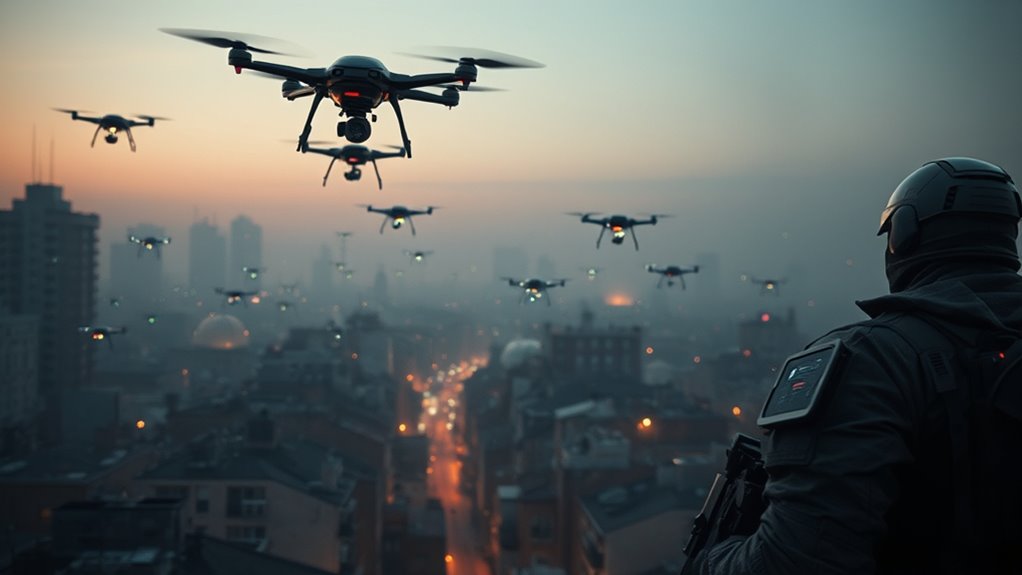
How are nanotechnology innovations revolutionizing surveillance and reconnaissance? You’ll notice smaller, more powerful sensors that can detect chemical, biological, and environmental threats with unprecedented precision. Wearable devices—smartwatches, bandages, rings—monitor essential signs, stress levels, and infection risks in real time, alerting soldiers before symptoms appear. Nanotech enables cameras to shrink in size, increasing their deployment density on drones, vehicles, and uniforms, which enhances coverage without adding weight. These sensors consume less power and cost less to produce, making widespread deployment feasible. The convergence of biotech and nanomaterials improves detection sensitivity while reducing device size and weight. Additionally, advanced color accuracy in sensors ensures more reliable data collection, further enhancing battlefield intelligence. As a result, you gain faster, more accurate intelligence, enabling real-time decision-making and a significant strategic advantage on the battlefield.
As an affiliate, we earn on qualifying purchases.
Shift Toward Autonomous and Nano-Enhanced Weaponry
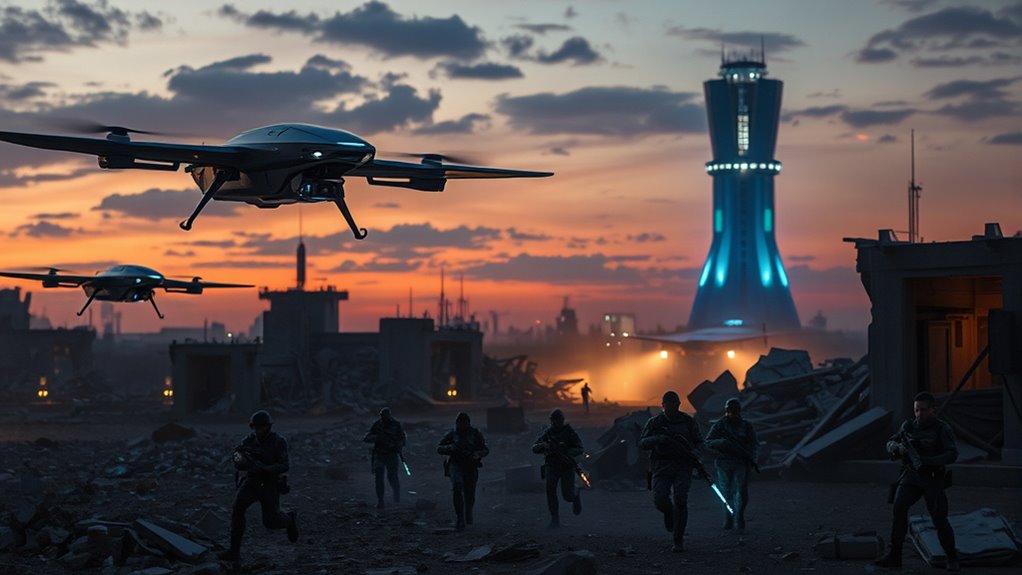
Advancements in nanotechnology are rapidly transforming weapon systems into more autonomous and highly efficient tools of warfare. You’ll see a shift toward smaller, smarter armaments that operate with minimal human oversight. Here’s what’s happening:
- Nano-enhanced lasers and munitions deliver greater destructive power in compact sizes.
- Self-replicating nanorobots autonomously seek and destroy targets.
- Cheaper, miniaturized weapons make widespread deployment feasible.
- Submarines and aircraft evade detection using nanomaterials that reduce radar signatures.
- The integration of nanotechnology into existing systems enables unprecedented levels of precision and adaptability.
These innovations enable faster response times, increased precision, and reduced collateral damage. As weapon systems become more autonomous, you’ll need to contemplate new ethical and strategic challenges. The battlefield of 2050 will be dominated by nanotech-enabled weaponry that’s smarter, smaller, and more lethal than ever before.
As an affiliate, we earn on qualifying purchases.
Transformations in Medical Support and Human Performance
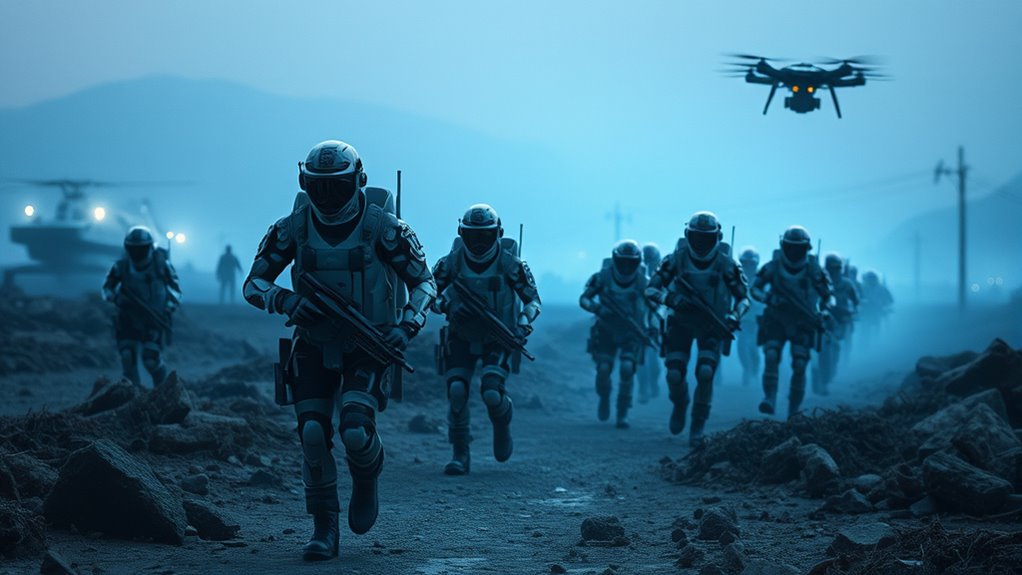
As nanotechnology continues to evolve, it is revolutionizing medical support and human performance on the battlefield by enabling faster, more precise medical interventions and real-time health monitoring. You’ll benefit from nano-implants and wearable sensors that track essential signs, stress levels, and injury risks instantly, alerting you to potential issues before symptoms appear. Nano-medic devices can deliver targeted drug therapies directly to wounded tissue, speeding up recovery and reducing complications. These advancements allow medics to diagnose and treat injuries on-site with unprecedented accuracy. Additionally, nanotech enhances human performance by augmenting strength, endurance, and resilience. This integration of nanotechnology into medical systems ensures you stay healthier, recover faster, and perform at peak levels, fundamentally transforming the way battlefield medicine supports and empowers soldiers. filtration systems play a crucial role in maintaining the effectiveness and longevity of nanotech devices in demanding environments.
Emerging Risks and Ethical Considerations

The rapid development of nanotechnology in military applications introduces significant ethical dilemmas and safety concerns that demand urgent attention. First, you must consider the risk of self-replicating nanorobots spiraling out of control, potentially causing ecological or human harm. Second, the proliferation of nanoweapons raises questions about escalation and global stability, risking misuse or accidental conflict. Third, privacy becomes a major issue as surveillance devices become smaller, more invasive, and harder to regulate. Fourth, the miniaturization of nuclear devices could lead to increased use and reduced fallout, complicating disarmament efforts. These advancements challenge existing ethical frameworks, forcing you to weigh technological benefits against potential risks to humanity and the environment. Addressing these concerns now is *vital* to prevent future catastrophe. Additionally, understanding the body jewelry measurements and materials used in nanotech devices will be crucial for developing safe and effective military technology. Moreover, the potential for self-replicating nanobots to malfunction underscores the importance of establishing rigorous safety protocols and oversight. The importance of regulatory frameworks is underscored by the need to adapt rapidly to technological advancements and ensure responsible use. It is also essential to consider the public awareness to foster responsible development and deployment of nanotech in military contexts.
Frequently Asked Questions
How Will Nanotech Impact Global Military Power Balance by 2050?
Nanotech will markedly shift the global military power balance by 2050, giving you access to advanced materials, miniaturized sensors, and autonomous weapons. Nations investing heavily will develop superior protection, surveillance, and strike capabilities, making conflicts more precise and less predictable. If you’re part of this evolution, you’ll see increased dominance for tech-savvy countries, while those lagging behind risk strategic disadvantage, instability, and potential loss of influence on the world stage.
What Regulations Might Govern Nanotechnology Use in Warfare?
You’ll see regulations governing nanotech in warfare emerge from international bodies and national governments, aiming to prevent misuse and catastrophic risks. These rules might include bans on self-replicating nanorobots, limits on weapon miniaturization, and strict oversight of surveillance technologies. As breakthroughs occur, laws will evolve to balance innovation with safety, ensuring that nanotechnology enhances defense without escalating conflicts or endangering humanity.
Could Nanotech Advancements Lead to New Types of Warfare?
Yes, nanotech advancements could lead to new types of warfare. You might face tiny, powerful weapons like nanorobots that destroy targets autonomously or hypersonic missiles with nanomaterials. Surveillance becomes more invasive with smaller, smarter sensors, and even medical enhancements could be weaponized. As you adapt to these innovations, expect conflicts to evolve into more precise, faster, and potentially more destructive forms, challenging traditional strategies and defenses.
How Will Nanotechnology Affect Civilian Security and Privacy?
A picture is worth a thousand words, but nanotech’s impact on civilian security and privacy is even more complex. You’ll find sensors and surveillance devices becoming smaller, smarter, and more pervasive, making it easier for authorities to monitor your whereabouts and health. While these innovations can enhance safety, they also risk infringing on your privacy, leading to concerns about data misuse, government overreach, and loss of personal freedom.
What Are the Long-Term Environmental Impacts of Nanomaterials?
You should be aware that nanomaterials could pose long-term environmental risks, such as pollution from tiny particles that persist in ecosystems. These particles might accumulate in water, soil, and air, potentially harming plants, animals, and humans. Their small size makes cleanup difficult, and their chemical properties could cause unforeseen toxic effects over time. Consequently, careful regulation and ongoing research are essential to minimize environmental damage from nanotech waste.
Conclusion
By 2050, you’ll see a battlefield shimmering with nano-armor that molds to your body like a second skin, while drones silently hover above like watchful shadows. Medical tech will heal wounds in moments, and weapons will respond with lightning speed. But as you navigate this high-tech chaos, remember the ethical lines blurred and risks lurking beneath the shiny surface. The future of war isn’t just about tech—it’s about how you choose to wield it.
Halloween Picks
halloween
As an affiliate, we earn on qualifying purchases.