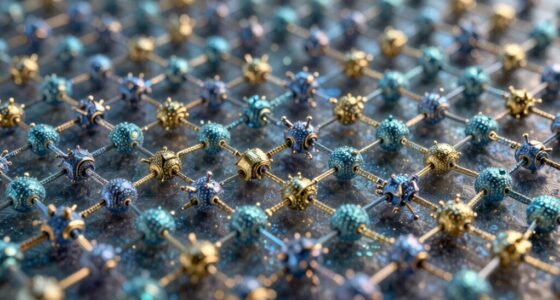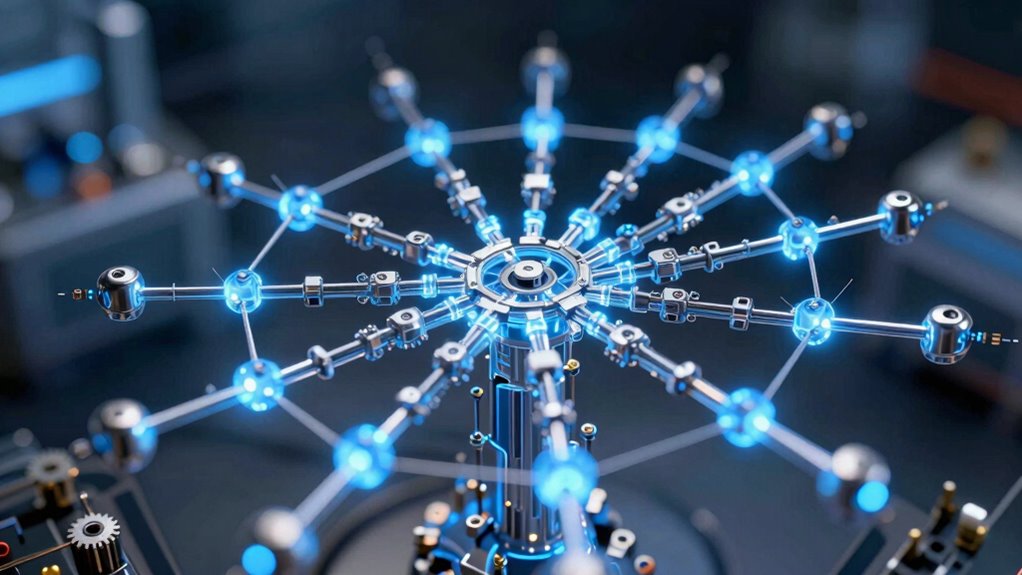

Based on current advances, it’s plausible that a highly precise nanotech assembler could become a reality. Scientists are developing tools for atomic manipulation, molecular machinery, and self-assembling structures, bringing the idea closer to fruition. Challenges remain, like avoiding unwanted reactions and scaling up the technology, but progress is rapid. If these hurdles are overcome, ultra-accurate, self-replicating nanosystems could revolutionize manufacturing. Continue exploring to discover how close we are to making a truly ultimate nanomachine.
Open a free Amazon Business account
Business pricing, bulk buying and tax-exempt orders.
As an affiliate, we earn on qualifying purchases.
Key Takeaways
- Advances in molecular assembly and mechanosynthesis suggest the potential for highly precise nanomachines capable of atom-by-atom construction.
- Current challenges include controlling unwanted reactions, low yields, and self-assembly limitations, hindering the creation of fully functional nanotech assemblers.
- The concept of nanofactories with interconnected nanomachines hints at scalable, automated systems that could function as ultimate nanomachines.
- Future developments in nanomechanical systems and self-replication may enable the creation of versatile, autonomous nanotech assemblers.
- Ethical and technical hurdles must be overcome before true nanotech ‘assemblers’ become feasible, but ongoing progress makes their eventual emergence plausible.
atomic force microscope for nanomanipulation
As an affiliate, we earn on qualifying purchases.
As an affiliate, we earn on qualifying purchases.
The Foundations of Molecular Assembly
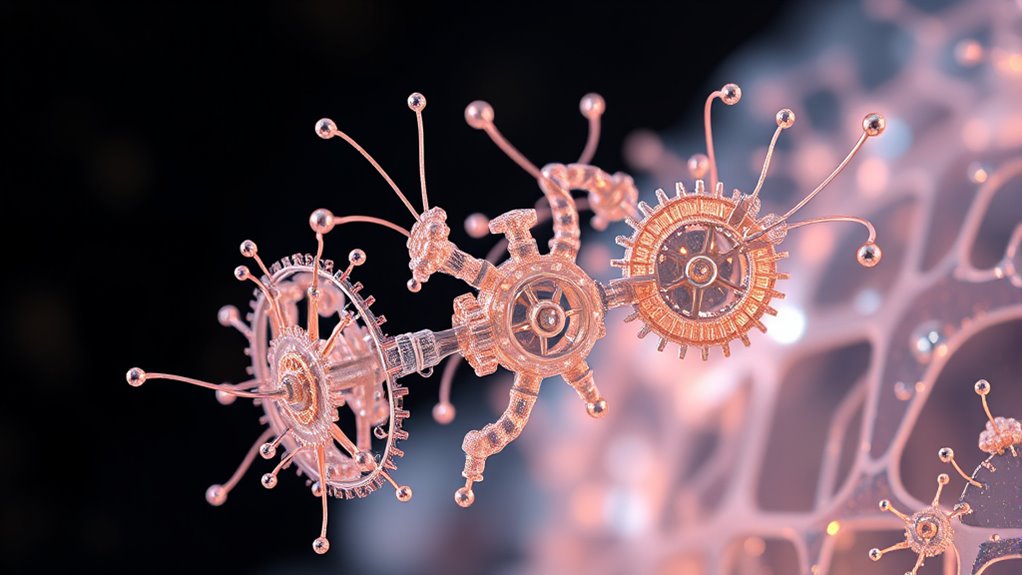
The foundations of molecular assembly rest on understanding how molecules can be precisely manipulated and combined at the atomic level. You need tools that can position reactive molecules with atomic accuracy, guiding chemical reactions step-by-step. Molecular assemblers achieve this by providing three-dimensional control over components, ensuring the correct orientation and placement during construction. Instead of using traditional tweezers, they rely on mechanosynthesis—using physical force to bond atoms or molecules selectively. This approach allows for building complex structures atom by atom or molecule by molecule. The goal is to enable self-replication of these assemblers, creating a scalable manufacturing process. While the concept is ambitious, current progress includes self-assembled structures, molecular machines, and automated synthesis platforms, all laying the groundwork for precise, atomically controlled fabrication. Advances in nanotechnology continue to push the boundaries of what is possible in molecular assembly.
As an affiliate, we earn on qualifying purchases.
Current Advances in Nanotechnology
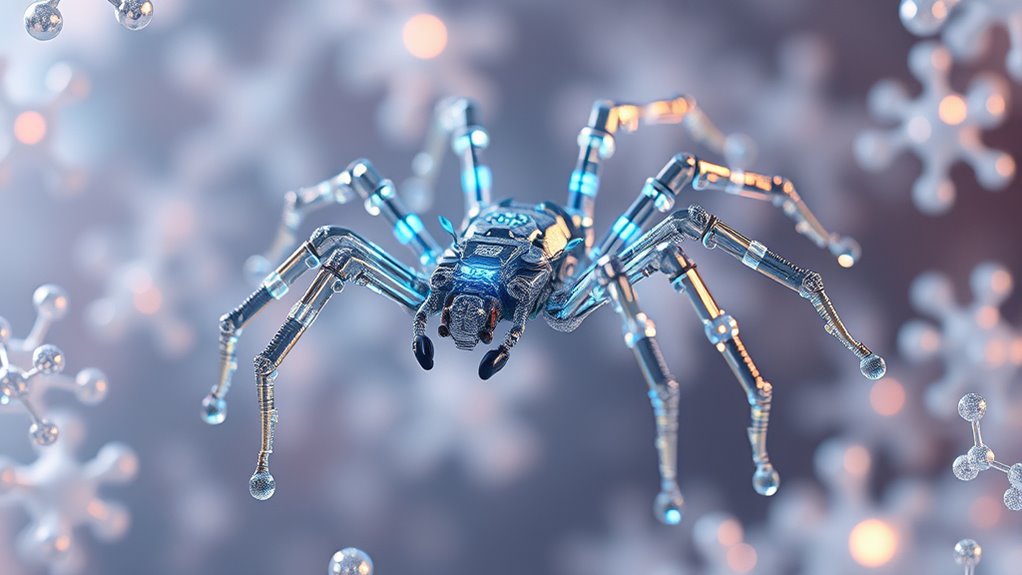
Recent progress in nanotechnology showcases a range of innovative molecular systems and devices that bring us closer to practical atomic-scale fabrication. Researchers have developed supramolecular aggregates of bifunctional surfactants that produce polymers through phase-separated reactants. Rotaxane-based machines can now remove amino acids sequentially to assemble peptides, while molecular robots use nanomechanical arms to move substrates between reactive sites, creating stereoisomers. Platforms automate the synthesis of numerous small molecules with thousands of compatible building blocks. DNA structures by Seeman include wire-frame objects, mechanical actuators, and rotary motors through self-assembly. These advances demonstrate how molecular control and self-assembly are pushing nanotech closer to reliable, scalable manufacturing processes, laying the groundwork for future atomic precision tools and complex nanosystems. Self-assembly techniques continue to evolve, enabling increasingly sophisticated nanoscale architectures.
As an affiliate, we earn on qualifying purchases.
Overcoming Challenges in Nano-Construction

Advances in molecular systems have shown impressive progress, but significant challenges remain in achieving reliable nano-construction. One major hurdle is controlling random molecular bumping in solution, which causes unwanted reactions and complicates building complex structures. Self-assembly processes often yield low proportions of perfect products due to statistical mismatches, limiting precision. Redesigning DNA-based assemblies for new structures demands extensive effort and restricts materials to DNA, reducing flexibility. Additionally, current nanoreplicators lack full atomic fabrication capabilities, restricting their replication scope. Noncovalent assembly operations are limited to specific inputs, making it difficult to incorporate diverse, disordered materials. Overcoming these challenges requires developing precise positioning methods, minimizing unwanted interactions, and creating scalable processes to reliably produce complex nanostructures. Achieving precise molecular control will be essential for advancing the field toward practical nano-assemblers. Moreover, progress in molecular systems has demonstrated promising avenues, but translating these into scalable, versatile nanomachines remains a significant hurdle. Developing advanced control techniques will be crucial for overcoming the unpredictable nature of molecular interactions in complex assemblies.
As an affiliate, we earn on qualifying purchases.
The Concept and Design of Nanofactories
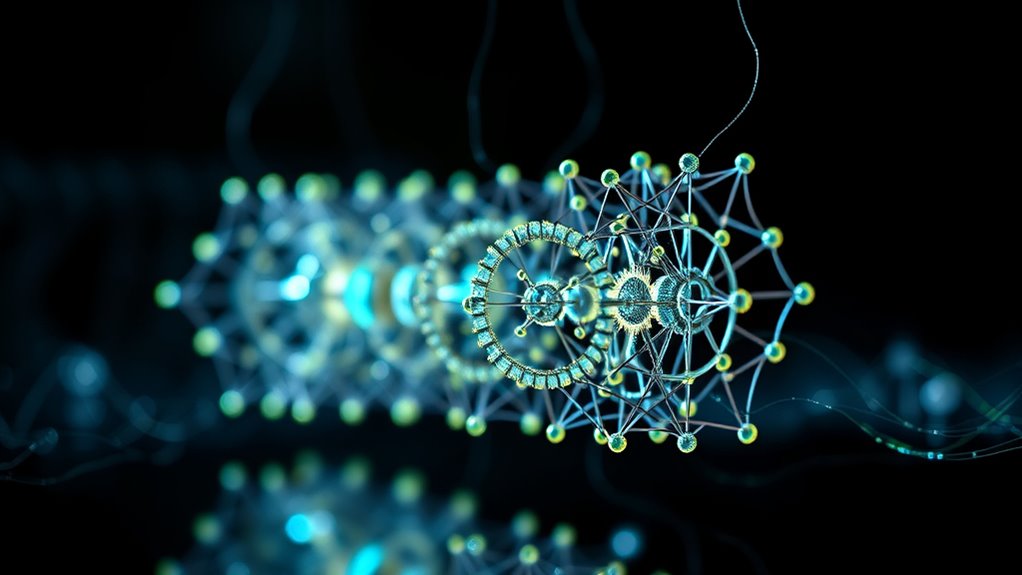
You’ll see that nanofactories rely on an assembly line architecture where thousands of nanomachines work together to produce complex materials with atomic precision. Distributed manufacturing systems enable these factories to operate across multiple locations, increasing efficiency and scalability. Self-replication adds the potential for exponential growth, allowing nanofactories to multiply rapidly and meet large-scale production demands.
Assembly Line Architecture
The architecture of a nanofactory centers on integrating numerous nanomachines into a cohesive production line capable of atomically precise manufacturing. You design these nanomachines to work together seamlessly, with each performing specific tasks such as positioning molecules or supplying energy for bonding. The assembly line employs parallel processing, where identical modules operate simultaneously, vastly increasing throughput. You use sophisticated control systems to coordinate manipulator motions, ensuring correct sequence and alignment of components. Self-replication capabilities allow nanomachines to produce spare parts and expand the factory exponentially. By automating the entire process, you create a continuous, scalable system capable of building complex structures atom-by-atom, transforming manufacturing from a single-step process into a highly efficient, self-sustaining production network.
Distributed Manufacturing Systems
Distributed manufacturing systems distribute the tasks of a nanofactory across multiple interconnected units, enabling scalable and flexible production. You can think of it as a network of nano-assemblers working together to build complex structures efficiently. This setup allows for parallel processing, reducing manufacturing time and increasing adaptability to different products. You’ll find that these systems can expand by adding more units, making large-scale fabrication feasible. Coordination among units is vital to guarantee precision and avoid errors. The design emphasizes modularity, where each nanomachine performs specific functions. Communication protocols synchronize actions, while energy sharing optimizes resource use. Overall, this approach paves the way for versatile, high-throughput manufacturing, moving closer to real-world applications of nanotechnology.
- Parallel task execution
- Modular nanomachine design
- Synchronization and communication
- Scalability and flexibility
- Resource sharing
Self-Replication Capabilities
Self-replication is a cornerstone concept in the design of nanofactories, enabling these systems to produce themselves autonomously and exponentially increase their manufacturing capacity. By integrating mechanisms that allow nanomachines to duplicate their components, you can create a self-sustaining production cycle. Molecular assemblers, guided by precise positional control, can build copies of themselves atom-by-atom or molecule-by-molecule. These replicators leverage mechanosynthesis and phase-separated reactions, mimicking biological models like ribosomes. Challenges include minimizing errors from random molecular interactions and designing systems that efficiently manage complex assemblies. Advancements aim to develop nanoreplicators capable of rapid, reliable self-copying, which would enable the scalable, exponential production of nanofactories. Ultimately, self-replication is essential for achieving autonomous, large-scale manufacturing at the nanoscale.
Potential Applications and Impact of Atomic-Scale Manufacturing
Atomic-scale manufacturing could revolutionize medicine by enabling highly precise drug delivery and new therapies. It promises a manufacturing overhaul, producing complex materials and devices with unmatched accuracy and efficiency. Additionally, by controlling materials at the atomic level, we can reduce environmental impact and create sustainable solutions for the future.
Medical Breakthroughs Unlocked
Have you ever wondered how nanotechnology could revolutionize medicine? Atomic-scale manufacturing promises groundbreaking advances. You could see personalized drug delivery, where nanomachines target specific cells, reducing side effects. Imagine repairing tissues at the molecular level, effectively reversing damage or aging. Precise gene editing could become routine, correcting mutations with minimal risk. Early detection of diseases might involve nanosensors that identify biomarkers before symptoms appear. Additionally, complex biomaterials could be built for implants that seamlessly integrate with your body. Unexplained phenomena continue to challenge our understanding of reality, hinting at potential breakthroughs in controlling biological processes at the atomic level.
Manufacturing Revolution Ahead
The advent of atomic-scale manufacturing is poised to transform how products are designed and produced, enabling unprecedented precision and customization. You’ll see tiny devices assembled atom by atom, releasing possibilities like tailored materials and complex structures impossible with traditional methods. Imagine a factory where nanomachines build everything from advanced electronics to medical implants seamlessly. The table below illustrates potential applications and their impacts:
| Application | Impact |
|---|---|
| Custom electronics | Faster, more efficient devices |
| Advanced materials | Stronger, lighter, smarter products |
| Medical nanodevices | Targeted therapies, precise diagnostics |
| Aerospace components | Ultra-light, durable parts |
This revolution will redefine manufacturing, making it faster, more adaptable, and capable of creating the impossible. Atomic‑scale manufacturing has the potential to revolutionize entire industries by enabling these groundbreaking capabilities.
Environmental Impact Mitigated
By enabling precise control over material assembly at the molecular level, nanotech assemblers can markedly reduce waste and environmental contamination. You could see fewer byproducts and lower energy consumption during manufacturing, decreasing pollution. This precision minimizes excess raw materials, reducing landfill waste and resource depletion. Additionally, atomic-scale manufacturing allows for the creation of biodegradable or recyclable materials, further lessening environmental impact. You might also use nanomachines to clean polluted environments or break down hazardous substances safely.
- Reduces material waste and energy use
- Produces environmentally friendly, recyclable products
- Enables targeted cleanup of pollutants
- Lowers harmful emissions during manufacturing
- Promotes sustainable resource utilization
Technological and Ethical Hurdles Ahead
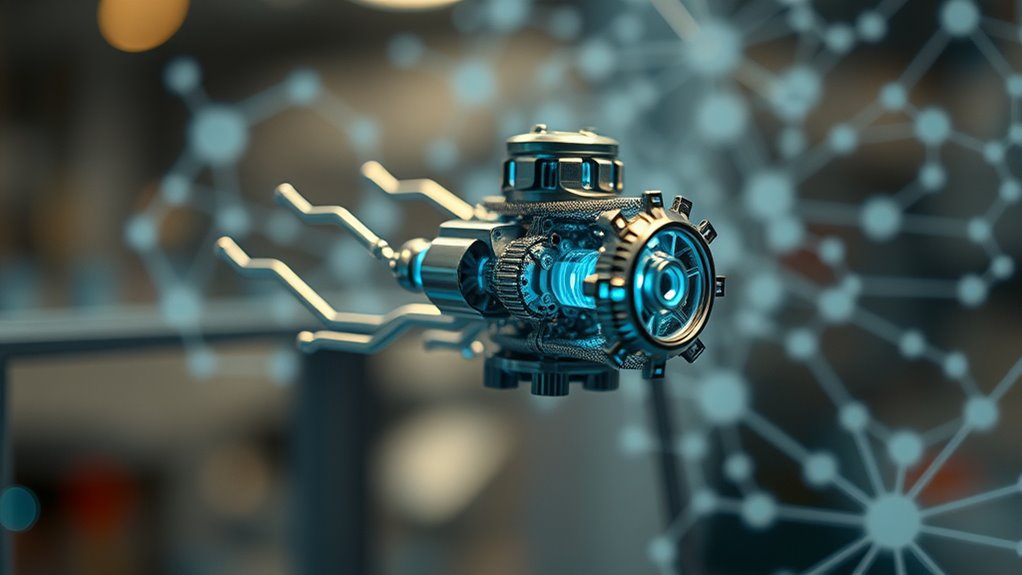
Advancing nanotech assemblers faces significant technological hurdles that could slow or limit their development. Precise control at atomic scales remains a major challenge, especially avoiding errors caused by random molecular bumping or mismatched reactions. Current self-assembly methods often produce imperfect results, complicating reliable manufacturing. Developing versatile tools that can handle diverse materials without redesign is difficult, and scaling up production while maintaining accuracy is complex. Ethically, concerns arise around self-replication and potential uncontrolled proliferation of nanomachines, risking unintended environmental impacts or misuse. Ensuring safety, establishing regulations, and preventing malicious applications require careful oversight. These hurdles demand breakthroughs in nanofabrication, error correction, and governance before truly functional, safe nanotech assemblers can become a reality.
Envisioning the Future of Ultimate Nanomachines
What will it take for nanomachines to become truly ultimate tools capable of building anything you imagine? You’ll need breakthroughs that enable atomic precision, self-replication, and complex assembly. Future nanomachines could:
- Use molecular guides to position molecules with atomic accuracy, ensuring precise construction.
- Self-replicate exponentially, scaling production rapidly without external input.
- Integrate mechanical and chemical processes for complex, multistep synthesis.
- Overcome current limitations like unwanted reactions and low yield, achieving near-perfect outcomes.
- Operate within larger systems, combining to form vast, interconnected manufacturing networks.
These advances will transform nanomachines from specialized tools into versatile, autonomous assemblers, capable of creating everything from microscopic devices to macro-scale structures, revolutionizing manufacturing and medicine.
Frequently Asked Questions
Can Molecular Assemblers Operate in Complex Biological Environments?
Molecular assemblers can operate in complex biological environments, but they face significant challenges. You need to guarantee they can navigate crowded, dynamic spaces without unwanted reactions or interference. Precise control over their positioning and reactions is essential, and overcoming issues like diffusion, Brownian motion, and molecular bumping is critical. Advances in bio-compatible materials and self-assembly techniques help, but achieving reliable operation in living systems remains a complex hurdle.
What Are the Energy Requirements for Large-Scale Mechanosynthesis?
Energy essentials for large-scale mechanosynthesis demand dedicated, deliberate input. You’ll need significant, sustained supplies of physical force and energy to drive precise, repetitive reactions at the atomic level. As structures grow, so do energy requirements, with larger assemblies demanding exponentially more power. You must account for inefficiencies, heat, and potential losses, ensuring enough energy is available to consistently, confidently construct complex nanostructures without compromising precision or progress.
How Will Error Correction Be Managed During Atomic Assembly?
You’ll manage error correction during atomic assembly by implementing real-time feedback systems that detect deviations and correct them instantly. Molecular machines will use high-precision sensors and adaptive algorithms to compare actual positions with target locations, adjusting as needed. Mechanical error correction methods, like reversible bonds or error-proofing design, will help guarantee accuracy. Combining these approaches, you’ll increase reliability, minimize defects, and achieve high-fidelity structures in nanoscale manufacturing.
Are There Safety Concerns With Self-Replicating Nanomachines?
Think of self-replicating nanomachines as a double-edged sword—like a fire that warms but can also burn. You should be cautious because unintended replication could lead to uncontrolled growth, risking environmental or biological harm. Proper safeguards, such as fail-safes and control protocols, are essential. While they promise incredible benefits, you need to address safety concerns now to prevent potential disasters and ensure responsible development of this powerful technology.
How Soon Could Practical Nanofactories Become Commercially Viable?
Practical nanofactories could become commercially viable within the next few decades, possibly 20 to 30 years. Advances in molecular assembly, self-replication, and automation are progressing rapidly, making large-scale, atomically precise manufacturing feasible. You’ll likely see early applications in medicine, materials, and electronics first, as researchers overcome current challenges like error rates and material diversity. Continued investment and breakthroughs are essential to accelerate this timeline.
Conclusion
Imagine a world where you hold the power of gods in your hands, building anything from atoms itself. The ultimate nanomachine could revolutionize existence, curing every disease, ending scarcity, and transforming reality beyond your wildest dreams. While challenges remain, the journey toward this marvel promises a future so astounding, it’ll make today’s technology seem like mere child’s play. Stay hopeful—your future might just be crafted at the atomic level, faster than you can imagine.
Fall Picks
fall essentials
As an affiliate, we earn on qualifying purchases.