

Quantum dots are incredibly useful in imaging and displays because they produce bright, pure, and highly saturated colors that can be precisely tuned by changing their size. Their nanoscale size allows them to emit specific wavelengths, improving color accuracy and brightness. They also enhance energy efficiency, making screens brighter and more durable. As a result, they help create sharper, more vibrant images with better longevity. Keep exploring to discover how these tiny particles are transforming visual technology.

Get the latest gadgets delivered free with Prime
- Fast, free delivery on millions of items
- Prime Video, Amazon Music and more included
- Member-only deals all year
Key Takeaways
- They produce highly pure, saturated colors with narrow emission spectra, enhancing color accuracy and vibrancy.
- Their size-dependent emission allows precise tuning of light wavelengths for customized display performance.
- Quantum dots offer bright, stable, and energy-efficient light emission, improving display brightness and longevity.
- Their nanomaterial properties enable high-definition images with vivid color fidelity and improved visual clarity.
- They enhance overall display efficiency, durability, and color precision, revolutionizing imaging and display technology.
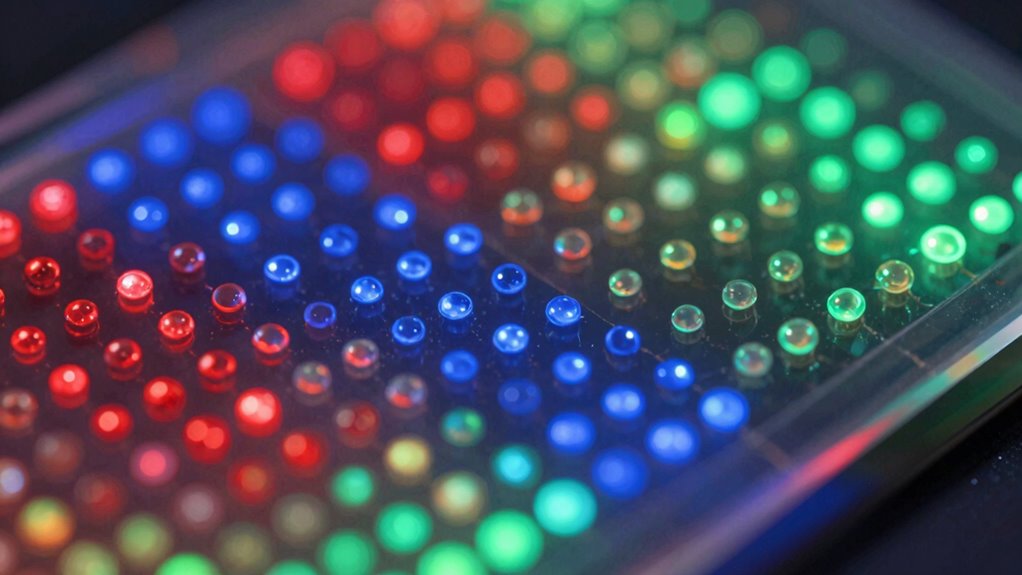
Have you ever wondered how modern screens produce such vibrant and accurate colors? The secret lies in the remarkable properties of quantum dots, tiny nanocrystals that have transformed the way we experience imaging and displays. At the core of their usefulness are their unique nanomaterial properties, which give them exceptional ability to emit bright, pure colors when energized. Unlike traditional display materials, quantum dots can be tuned precisely to produce specific wavelengths of light, resulting in a broader color spectrum and more vivid images. This precision is what makes them so effective for color enhancement, allowing screens to display richer reds, greens, and blues than ever before. Their size-dependent emission is a key factor in their ability to produce such precise colors.
Nanomaterial properties refer to the distinctive behaviors of materials at the nanoscale, and quantum dots are no exception. These nanocrystals are just a few nanometers in size, giving them quantum confinement effects that directly influence how they emit light. When they’re excited by an energy source, they emit light at very specific wavelengths, producing pure, saturated colors. This size-dependent emission means that by simply adjusting the size of the quantum dots, manufacturers can tailor the color output to match the desired spectrum. The result is a highly efficient, bright, and stable light emission that enhances the overall display quality. The energy efficiency of quantum dots is another significant advantage, making them more environmentally friendly and cost-effective over time. Additionally, their tunable optical properties allow for customization to meet specific display requirements.
Color enhancement is one of the most compelling reasons quantum dots are so popular. Traditional display technologies often struggle with color accuracy and brightness, but quantum dots change the game. They produce highly pure colors because their emission spectra are narrow compared to conventional phosphors. This purity translates into more precise and vibrant images, making everything from movies to gaming look more lifelike. Additionally, quantum dots have excellent stability and longevity; they don’t degrade quickly over time, ensuring that your display maintains its brilliance for years. Their ability to produce intense, saturated colors without sacrificing energy efficiency makes them ideal for modern high-definition screens. Advances in nanomaterial properties continue to push the boundaries of what’s possible in display technology, leading to even more impressive visual experiences.
In essence, quantum dots leverage their nanomaterial properties to improve the way displays and imaging systems handle color. They enable manufacturers to create screens that are not only brighter and more colorful but also more efficient and durable. Incorporating quantum dots has revolutionized the display industry, setting new standards for visual clarity and color fidelity. Whether you’re watching a movie or playing a game, the enhanced color fidelity you enjoy is thanks to these tiny nanocrystals and their remarkable capabilities. Quantum dots truly are a technological marvel that’s reshaping how we see and experience visual content.
Popular right now

TCL 85 Designer Series QD-Mini LED TV (Model 85A400U) with Google Smart TV

Sony WH-1000XM6 Wireless Noise-Canceling Over-Ear Headphones, Blue, Bundle

KitchenAid Artisan 5-Quart Tilt-Head Stand Mixer, KSM150PS, Almond Cream
As an affiliate, we earn on qualifying purchases.
Frequently Asked Questions
How Are Quantum Dots Synthesized for Commercial Use?
You synthesize quantum dots through a process called quantum synthesis, which involves carefully controlling chemical reactions to produce nanomaterials with precise size and composition. This method guarantees you get consistent nanomaterial properties, vital for commercial applications. Typically, you use colloidal synthesis techniques, where you mix precursors in a solution, allowing the quantum dots to form uniformly. This controlled process enables reliable, scalable production for imaging and display technologies.
What Are the Environmental Impacts of Quantum Dot Production?
You should be aware that quantum dot production can impact the environment due to toxic materials like cadmium, which pose risks if not properly managed. Environmental regulations aim to control these risks, requiring manufacturers to handle and dispose of toxic waste carefully. While advancements reduce harmful impacts, ongoing oversight is essential to minimize pollution and guarantee sustainable practices in quantum dot manufacturing.
Can Quantum Dots Be Used in Flexible or Wearable Displays?
Yes, quantum dots can be used in flexible and wearable displays. Their flexible integration allows you to bend and stretch the displays without losing image quality. This makes them ideal for wearable technology, like smartwatches or fitness bands, where durability and flexibility are essential. Quantum dots enhance color brightness and energy efficiency, providing vibrant visuals on flexible surfaces, making your wearable displays more immersive and comfortable to use.
How Do Quantum Dots Compare Cost-Wise to Traditional Materials?
You’ll find quantum dots tend to be pricier than traditional materials, with a cost analysis showing they can be two to three times more expensive. However, their enhanced brightness and color accuracy often justify the investment. As market affordability improves with technological advances and scaling, quantum dots are becoming more accessible, offering a compelling balance between cost and performance that could revolutionize imaging and display technologies.
What Are the Latest Advancements in Quantum Dot Technology?
Recent advancements in quantum dot technology focus on boosting quantum efficiency and enhancing color accuracy. Researchers have developed new synthesis methods that produce more stable, brighter quantum dots with precise emission wavelengths, leading to richer, more vibrant displays. Additionally, improved surface passivation techniques reduce energy loss, making quantum dots more efficient. These breakthroughs enable better image quality, higher contrast, and more true-to-life colors, pushing the boundaries of modern imaging and display technologies.
Conclusion
As you explore the fascinating world of quantum dots, you realize their true potential is just beginning to unfold. They promise brighter, more vivid images, but the full extent of their capabilities remains a thrilling mystery. Will they revolutionize your screens or reveal new frontiers in medical imaging? Only time will tell. One thing’s certain — quantum dots are poised to transform how you see the world, leaving you excited to discover what’s next.