
📊 Full opportunity report: The NVIDIA Earnings Preview: What Q1 FY27 Will Reveal About the AI Cycle on ThorstenMeyerAI.com — validation score, market gap, and execution plan.
Open a free Amazon Business account
Business pricing, bulk buying and tax-exempt orders.
Create a free accountAs an affiliate, we earn on qualifying purchases.
TL;DR
NVIDIA is set to release its Q1 FY27 earnings on May 20, 2026, with a forecasted revenue of around $78 billion. The results will shed light on the health of the AI infrastructure cycle, including demand from hyperscalers and geopolitical impacts. The report’s outcome could confirm or challenge the bullish AI growth thesis.
NVIDIA is scheduled to report its first quarter fiscal year 2027 earnings on May 20, 2026, with a projected revenue of approximately $78 billion, exceeding analyst consensus and guided by company CEO Jensen Huang. This earnings release is the most significant in 2026 for the tech sector, as it will provide critical insights into the demand for AI infrastructure amid ongoing geopolitical and supply chain challenges.
The $78 billion revenue forecast for Q1 FY27 is a notable increase from $68.13 billion in Q4 FY26, representing a 73% year-over-year growth. This guidance surpasses the consensus estimate of $78.8 billion, indicating robust demand in the data center segment, which is expected to generate between $66 billion and $70 billion, primarily driven by hyperscaler buildouts.
Key indicators to watch include the company’s gross margin, which is targeted at 75%, and its EPS forecast of $1.78, both reflecting pricing power amid the Rubin platform’s rollout. The report will also clarify whether the $1 trillion order backlog, announced by Huang, is translating into recognized revenue on schedule, a critical factor in validating the broader AI demand story. The results will also inform on the pace of the Blackwell-to-Rubin architecture transition, the strength of sovereign AI revenue, and the geopolitical impacts on China-related revenue, which is excluded from the current forecast.
$78 billion.
One print. The whole thesis.
May 20 settles questions that no amount of analysis can settle in advance.
Q1 FY27 guide $78B / consensus $78.8B. Excludes all China data center compute revenue ($50B addressable, zeroed). $1T Blackwell + Vera Rubin order backlog visibility through 2027 per Huang at GTC. The print resolves multiple structural theses simultaneously — bubble question, capex thesis, in-house silicon migration, sovereign AI diversification. Composition matters more than headline.
2026 tech earnings print
Twelve variables. One print.
The composition matters more than the headline. $78B with 87% Blackwell mix and $14B networking is a meaningfully different signal than $78B with 72% mix and $11B networking.
Three scenarios. One print.
35/50/15 probability. $5.2T market cap means perfection is partly priced in. Asymmetric risk profile favors reading the print over predicting it.
- Revenue $82-86BBeating $78B guide by 5-10%.
- 87% Blackwell mixNetworking $13-15B.
- 75% margin holdsPricing power intact.
- Sovereign AI $5-8BGeographic diversification confirmed.
- Outcome: Stock +10-15%. FY27 trajectory $340-360B.
- Revenue $77-80BIn-line with $78B guide.
- 82-85% BlackwellNetworking $12-13B.
- 74-75% marginStable pricing.
- Sovereign rolled inNot separately disclosed.
- Outcome: Stock -2 to +3%. Continuation trajectory.
- Revenue $72-76B3-7% below guide.
- 75-80% BlackwellSupply-constrained.
- 73-74% marginPricing pressure visible.
- FY27 30-50% YoY decelQ2 guide soft.
- Outcome: Stock -10 to -18%. Bear case gains evidence.
NVIDIA Q1 FY27 is not a standalone earnings event. It is a structural test of multiple theses that the dispatch series has identified — bubble question, capex absorption, in-house silicon migration, sovereign diversification. The single print resolves several uncertainties at once.
Four assignments. By role.
Avoid concentrated pre-earnings positioning.
$5.2T market cap means perfection partly priced in. Even meeting expectations may produce limited upside; missing expectations produces material downside. Dollar-cost averaging or option strategies (puts as hedge, calls for upside capture) more appropriate than concentrated bets either direction. The print itself is the data point to act on, not anticipate.
Use May 20 to recalibrate broader exposure.
NVIDIA’s print is the strongest single read on the hyperscaler capex thesis. Meaningful beat reduces impairment-cycle probability for hyperscalers. Miss elevates it. Position broader AI infrastructure exposure (CoreWeave, Oracle, second-tier) based on May 20 result. Bubble question dispatch provides framework for differentiating durable-value from frothy-category names.
Read NVIDIA customer commentary as indirect signal.
NVIDIA’s customer commentary indirectly reveals hyperscaler deployment health. Strong commentary supports $725B capex thesis. Mixed or weakening commentary signals buildout pace may be moderating. Differentiate Microsoft (UAE+nuclear), Alphabet (TPU+SMR), Amazon (Trainium), Meta (most exposed) by power/silicon strategy quality.
Plan API pricing around Rubin trajectory.
NVIDIA Q1 FY27 reveals cost structure for AI inference at production scale. Rubin’s 10× reduction in inference token cost — if confirmed — directly improves AI lab unit economics through 2027. Schedule API price changes accordingly. Anthropic IPO disclosure flagged margin compression risk; Rubin economics partially offset that risk.
Implications of Q1 Earnings for AI Industry Outlook
The earnings report is a key indicator of the health of the AI infrastructure cycle, which has broad implications for the tech sector, hyperscaler investments, and global supply chains. A strong Q1 result would validate the bullish thesis that AI demand is accelerating, supporting NVIDIA’s $5.2 trillion market cap and the $1 trillion order backlog. Conversely, a miss could signal supply constraints or demand softening, raising questions about the durability of the current growth trajectory and geopolitical risks affecting revenue streams.
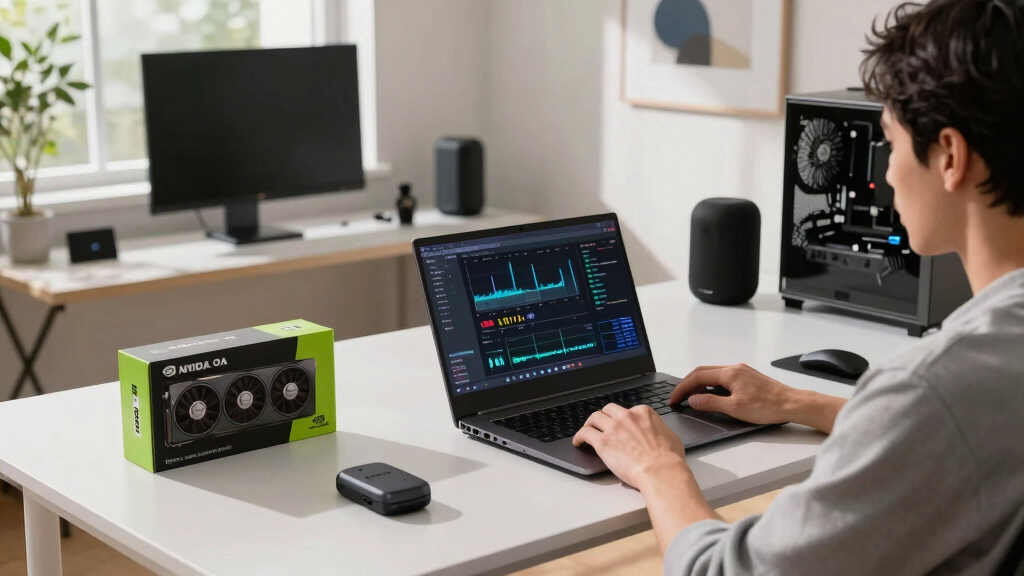
NVIDIA GeForce RTX 4090 graphics card
As an affiliate, we earn on qualifying purchases.
As an affiliate, we earn on qualifying purchases.
Background on NVIDIA’s AI Market Position and Expectations
Leading up to the earnings, NVIDIA’s guidance and commentary from CEO Jensen Huang have fueled optimism about a sustained AI cycle, with Huang projecting at least $1 trillion in orders through 2027, doubling previous estimates. The company’s market share in data center GPUs exceeds 90%, and its architecture transition from Blackwell to Rubin is a key factor influencing future demand. The broader context includes a $725 billion hyperscaler capex plan, geopolitical tensions affecting China revenue, and supply chain constraints, particularly in advanced packaging capacity at TSMC.
Previous quarters have shown rapid growth in data center revenue, driven by AI model training and inference, but concerns remain about supply bottlenecks and geopolitical fragmentation. The upcoming earnings will be pivotal in confirming whether these trends are translating into actual revenue and profit growth, or if market expectations need to be adjusted.
“Right here where I stand, I see through 2027, at least $1 trillion in orders.”
— Jensen Huang
high-performance AI data center server
As an affiliate, we earn on qualifying purchases.
As an affiliate, we earn on qualifying purchases.
Key Uncertainties Surrounding Q1 Earnings Impact
It remains unclear whether the $1 trillion order backlog is fully converting into revenue on schedule, as the timing of recognition depends on supply chain and architecture transition progress. The pace of the Blackwell-to-Rubin transition and its effect on gross margins is also uncertain. Additionally, the potential impact of geopolitical tensions on China-related revenue and sovereign AI investments remains to be clarified. Market reaction will depend on whether actual results meet, beat, or fall short of these expectations.
As an affiliate, we earn on qualifying purchases.
Next Steps Following NVIDIA’s Q1 Earnings Report
After the earnings release, investors and analysts will scrutinize the detailed revenue breakdown, margins, and forward guidance, especially for Q2 FY27. The company’s commentary on architecture transition, geopolitical risks, and demand signals will influence stock performance and sector outlook. Further updates on supply chain capacity and government-related AI investments are expected in subsequent quarters, shaping the longer-term outlook for NVIDIA and the AI infrastructure cycle.
professional GPU for AI development
As an affiliate, we earn on qualifying purchases.
As an affiliate, we earn on qualifying purchases.
Key Questions
What is the main revenue forecast for NVIDIA’s Q1 FY27?
Analysts and NVIDIA guidance project approximately $78 billion in revenue for Q1 FY27, representing significant growth year-over-year.
Why is the Q1 earnings report so important for the AI industry?
The report will reveal whether demand for AI infrastructure is accelerating as expected, validating or challenging the broader growth thesis and investment plans.
What could cause NVIDIA’s actual results to differ from expectations?
Supply chain constraints, delays in architecture transitions, geopolitical tensions affecting China revenue, or demand softness could lead to results below forecasts.
How might the earnings impact NVIDIA’s stock price?
A strong beat could lead to an 8-15% increase, while a miss might cause an 8-15% decline, depending on the guidance and market sentiment.
Source: ThorstenMeyerAI.com
Flea & tick season Picks
flea and tick prevention
As an affiliate, we earn on qualifying purchases.