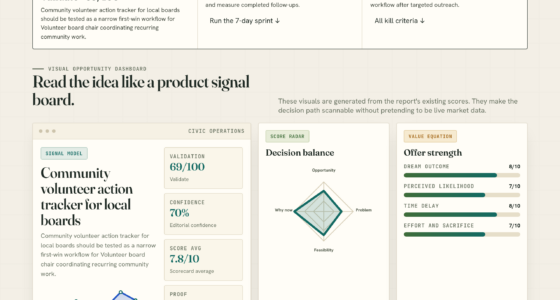

📊 Full opportunity report: Fable and Mythos: How Anthropic Shipped Its Most Powerful Model to Everyone on ThorstenMeyerAI.com — validation score, market gap, and execution plan.

Get the latest gadgets delivered free — and shop member deals
- Fast, free delivery on millions of items
- Access to Prime Big Deal Days deals on October 6–7
- Prime Video, Amazon Music and more included
TL;DR
Anthropic has made Fable 5, its most powerful model, publicly available with safeguards that route risky queries to a weaker model. Mythos 5 remains restricted to trusted partners due to its advanced cybersecurity features. This signals a new approach to deploying powerful AI models safely.
Anthropic has launched Claude Fable 5, its most capable AI model to date, making it available to the public. The release introduces a new safety architecture that allows the model to handle risky topics by routing queries to a weaker fallback model, Mythos 5, which remains restricted to trusted partners. This development marks a significant step in deploying highly capable AI models safely at scale.
Fable 5 is the publicly available version of Anthropic’s latest AI model, with capabilities that have been praised by independent reviewers, including being called the best coding model globally by Every. The model is built on the same underlying technology as Mythos 5, which remains behind closed doors due to its advanced cybersecurity features. Mythos 5 is part of Anthropic’s cyber-defense program, Project Glasswing, and is designed to handle sensitive applications with strong safety measures.
The key innovation in the release is the safety layer: when Fable 5 encounters queries on risky topics, it does not refuse but instead routes the question to the weaker Opus 4.8 model, providing a less capable but safer response. According to Anthropic, fewer than 5% of sessions trigger this fallback, allowing most users to access the full capabilities of Fable 5. The company states that its safeguards are conservatively tuned, with ongoing efforts to reduce false positives.
Pricing for both models is set at $10 per million input tokens and $50 per million output tokens, making the models more affordable than previous versions. The release signals a shift toward decoupling capability from safety, enabling the deployment of powerful models with layered safeguards, and may influence how future AI systems are rolled out at scale.
Fable & Mythos
Anthropic just shipped its most capable public model — and the story is how. One “Mythos-class” model, two names, and a safety net that hands risky queries to a weaker model instead of refusing them.
- The best coding model in the world they’ve tested — 91/100, near human-engineer range.
- Paradigm-shifting for power users on their hardest, long-horizon tasks.
- One-shots entire apps; owns a whole job end-to-end over multi-hour runs.
- Overpowered for everyone else — lower-adoption users struggled to find a use.
- Slow & token-hungry; ~2× Opus 4.8 cost, >3× Sonnet 4.6. Mixed for writing.
- Rewards a sharp brief, punishes a loose one — precision in, precision out.
Independent commentary, produced with AI assistance under human editorial oversight. The views are the author’s own and may change. This is analysis, not investment, financial, legal, or technical advice. Details of Claude Fable 5 and Mythos 5 — capabilities, safeguards, pricing, rollout, and figures — are drawn from Anthropic’s launch announcement and Every’s independent “Vibe Check,” both June 2026, and may change as the models and access terms evolve. Benchmarks and testimonials are as reported by their sources. Company and product names are referenced for analysis and imply no affiliation or endorsement.
Implications of Public Access to Mythos-Class AI
This release indicates a major shift in AI deployment strategies, where highly capable models are being made accessible to the public with safety measures that prevent misuse. It demonstrates that layered safety architectures can balance power and security, potentially setting new industry standards. For developers and businesses, this means access to cutting-edge AI with built-in safety nets, reducing risks associated with misuse while expanding practical applications.
However, it also raises questions about safety, oversight, and the potential for misuse, especially as the boundary between safe and unrestricted models becomes more nuanced. The approach could influence future regulations and public perceptions of AI safety and reliability.
As an affiliate, we earn on qualifying purchases.
Background on Anthropic’s Model Release Strategy
Anthropic has historically been cautious about releasing its most powerful models, citing safety concerns. Its Mythos-class models, introduced in April, were initially restricted to cyber-defense applications and select partners due to their advanced cybersecurity capabilities. The launch of Fable 5 marks the first time a Mythos-level model is made broadly accessible, reflecting increased confidence in safety measures and a new approach to layered deployment.
The company’s safety architecture involves classifiers that monitor for misuse across domains like cybersecurity and biology. When triggered, these classifiers route queries to a weaker model rather than outright refusal, enabling safer interaction without sacrificing capability. This layered safety approach represents a departure from traditional black-and-white access controls, signaling a new phase in AI deployment.
“Our safety classifiers allow us to provide access to our most capable models while minimizing risks, marking a new chapter in responsible AI deployment.”
— Anthropic spokesperson
As an affiliate, we earn on qualifying purchases.
Unanswered Questions About Model Safety and Usage
It remains unclear how effective the fallback system will be in real-world, large-scale deployment, especially over time. While initial tests show fewer than 5% fallback triggers, the long-term robustness of safety measures and the potential for unforeseen misuse are still under observation. Additionally, the full capabilities and restrictions of Mythos 5 outside the controlled environment are not publicly disclosed, raising questions about oversight and regulation.
As an affiliate, we earn on qualifying purchases.
Next Steps for Deployment and Safety Evaluation
Anthropic is expected to monitor the performance of Fable 5 in real-world applications, refining safety classifiers to reduce false positives and expand capabilities. The company may gradually open access to Mythos 5 for select partners under strict conditions, providing further data on safety and misuse prevention. Industry observers will watch how this layered safety model influences AI regulation and deployment practices in the coming months.
As an affiliate, we earn on qualifying purchases.
Key Questions
How does Anthropic ensure the safety of its most powerful models?
Anthropic uses layered safety classifiers that route risky queries to a weaker fallback model, reducing the chance of misuse while maintaining high capability for most interactions.
What is the difference between Fable 5 and Mythos 5?
Both are based on the same underlying model, but Fable 5 is the publicly available, safeguarded version, while Mythos 5 remains restricted to trusted partners due to its advanced cybersecurity features.
Will Mythos 5 become publicly accessible in the future?
It is not yet clear; Anthropic has not announced plans to open Mythos 5 broadly, citing safety and security concerns. Future access may depend on ongoing safety evaluations.
What are the potential risks of deploying such powerful models publicly?
Risks include misuse for malicious purposes, misinformation, and unintended harmful outputs. Layered safety measures aim to mitigate these, but uncertainties remain about long-term safety and oversight.
How does this release compare to previous AI model launches?
This is the first time a Mythos-class model with advanced cybersecurity features is made broadly available, marking a shift from cautious, restricted releases to more open deployment with safety layers.
Source: ThorstenMeyerAI.com
Fall Picks
fall essentials
As an affiliate, we earn on qualifying purchases.