
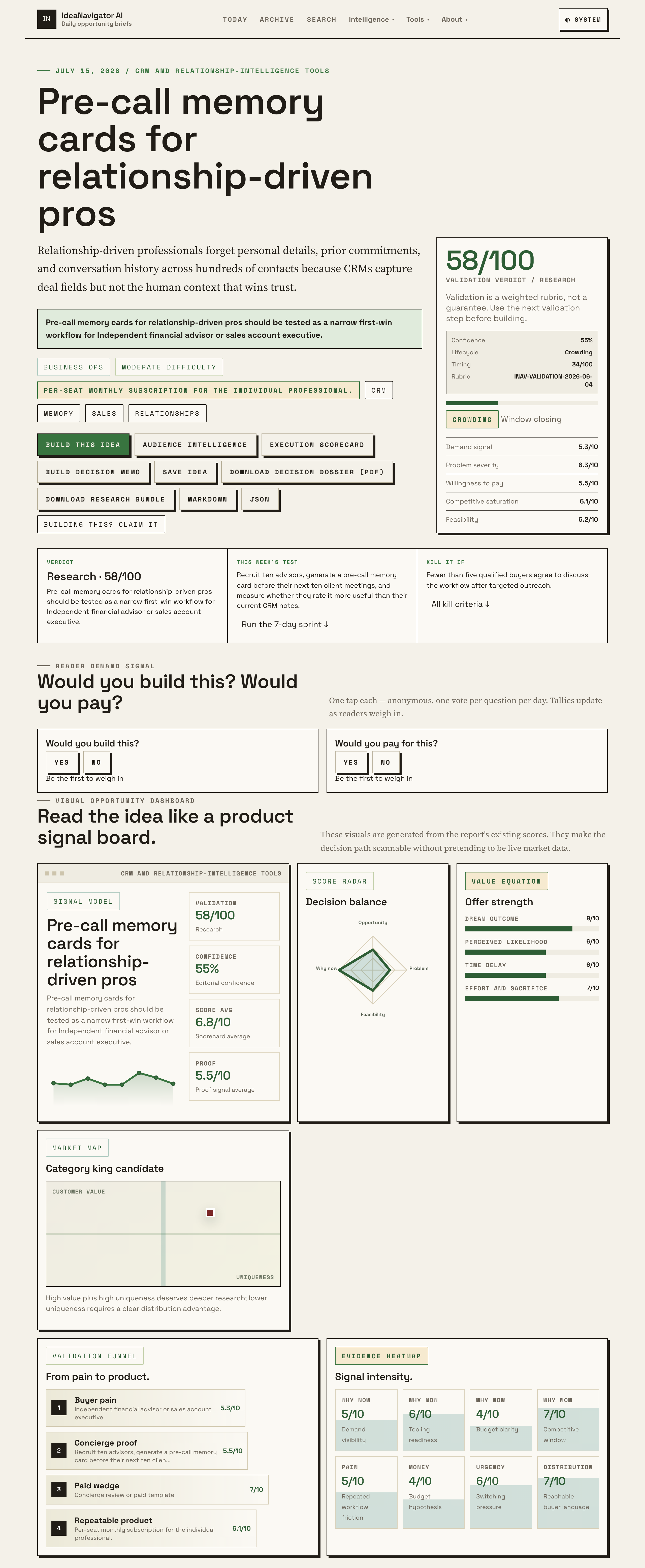
📊 Full opportunity report: Memory Cards In Sales: Strengthening Relationships Before Each Call on IdeaNavigator AI — validation score, market gap, and execution plan.
TL;DR
A new workflow involving pre-call memory cards is being tested for independent financial advisors and sales professionals. These cards aim to improve client relationships by providing quick, detailed summaries of past interactions, leveraging recent advances in language models.
Pre-call memory cards for relationship-driven professionals are being tested as a targeted workflow to enhance client interactions for independent financial advisors and sales account executives. This development aims to address the challenge of maintaining personal context across hundreds of contacts, which current CRMs often fail to capture, potentially impacting trust and relationship-building.
The opportunity arises from recent advances in large-language-model summarization technology, which now makes it feasible to distill long conversation histories into concise, searchable memory cards. These cards are designed to include key details such as who the client is, what was last promised, and open discussion threads, providing a quick, comprehensive overview before each call.
The proposed solution involves creating a pre-call brief generator that connects a contact’s past emails and notes to produce a one-page memory card. This approach is being tested with a small group of independent financial advisors and sales professionals, with the goal of measuring whether these cards are rated as more useful than existing CRM notes. The model relies on a per-seat monthly subscription fee for individual users.
Market analysts see this as a potential enhancement to CRM and relationship intelligence tools, aiming to improve trust and engagement by making personal details more accessible during client interactions. The initial validation involves recruiting ten advisors, generating memory cards for their next ten client meetings, and collecting feedback on usefulness and impact.
Why Pre-Call Memory Cards Could Transform Client Relationships
This development could significantly improve how professionals manage client relationships by providing immediate access to relevant personal and conversation history. It addresses a key pain point: the tendency to forget or overlook important details that foster trust and rapport. If successful, this workflow could lead to higher client satisfaction, increased retention, and more effective sales conversations, especially in relationship-driven sectors like finance and sales.
Furthermore, leveraging recent AI advancements makes this approach more practical and scalable than previous attempts. It demonstrates how emerging technology can directly impact relationship management practices, potentially setting new standards for client engagement tools.

dot. Card – Digital Business Card – Tap Compatible with iPhone & Android (Black)
No app or device requirement: Share your dot.Profile with anyone, as others don't need an app or a…
As an affiliate, we earn on qualifying purchases.
As an affiliate, we earn on qualifying purchases.
Background on CRM Limitations and AI Advancements
Current CRMs primarily focus on deal fields and transaction data, often neglecting the nuanced human context that influences trust and loyalty. As a result, professionals frequently forget personal details or prior commitments during client calls, which can hinder relationship development.
Recent breakthroughs in large-language-model summarization—enabled by cost-effective AI—allow for the quick distillation of lengthy email threads and notes into digestible summaries. This technological shift makes the concept of pre-call memory cards feasible and potentially transformative for relationship-driven professions.
The idea of supplementing CRMs with AI-generated memory aids has been discussed in industry circles, but practical testing is only now beginning, with a focus on real-world validation through pilot programs.
“The ability to generate concise, relevant summaries before client calls could be a game-changer in relationship management.”
— an anonymous researcher
AI-powered client interaction summaries
As an affiliate, we earn on qualifying purchases.
As an affiliate, we earn on qualifying purchases.
Uncertainties Around Effectiveness and Adoption
It is still unclear how well these pre-call memory cards will perform in practice, including whether professionals will find them sufficiently useful or easy to integrate into their routines. The pilot program is in early stages, and feedback from participants is not yet available. Additionally, questions remain about the accuracy of summaries generated by AI and how they will be maintained over time.
pre-call client relationship tools
As an affiliate, we earn on qualifying purchases.
As an affiliate, we earn on qualifying purchases.
Next Steps in Testing and Validation
The initial testing phase involves recruiting ten advisors, generating memory cards for their next ten client meetings, and collecting detailed feedback. Based on this data, developers will refine the tool and consider broader deployment. Further research may explore integration with existing CRM systems and additional features such as open-thread tracking or real-time updates.

Customer Relationship Management Software: Maximize Value And Increase Profits From Your CRM
As an affiliate, we earn on qualifying purchases.
As an affiliate, we earn on qualifying purchases.
Key Questions
How do pre-call memory cards differ from current CRM notes?
Memory cards aim to distill long conversation histories into concise, relevant summaries that are easy to review before calls, whereas CRM notes often focus on deal-specific data and lack personal context.
What technology enables the creation of these memory cards?
Recent advancements in large-language-model summarization, which can process and condense lengthy email threads and notes, make the creation of effective memory cards feasible.
Who is testing this new workflow?
Independent financial advisors and sales account executives are the primary users in the current pilot program, aiming to evaluate its usefulness in real client interactions.
Will this replace existing CRM systems?
It is unlikely to replace CRMs entirely; instead, it aims to augment them by providing quick, personalized summaries that enhance relationship-building during calls.
When might this workflow become widely available?
Widespread adoption depends on the success of initial pilots and further development; it could take several months to a year before broader rollout.
Source: IdeaNavigator AI