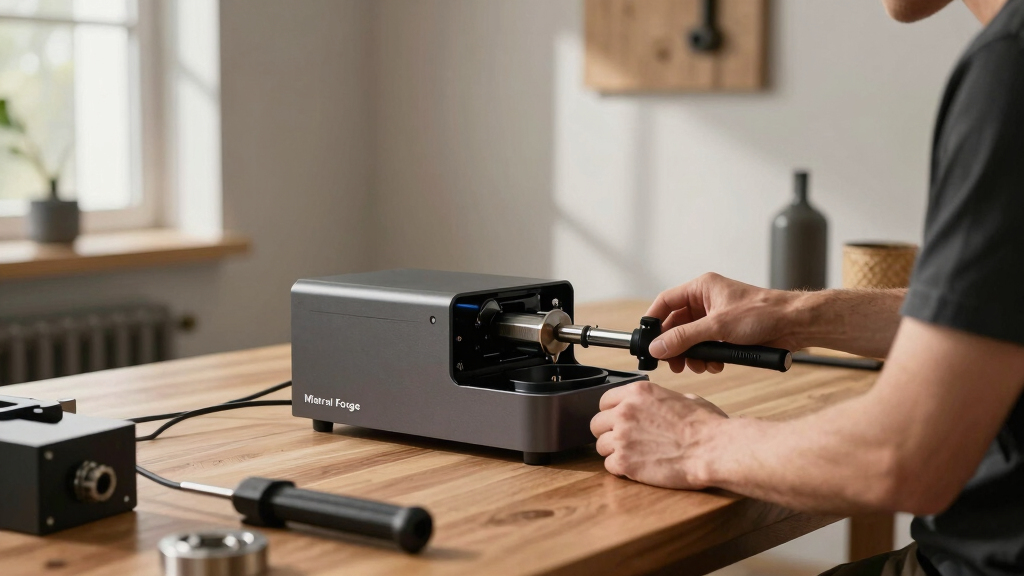

📊 Full opportunity report: Should You Use Mistral Forge? A Buyer’s Decision Guide on ThorstenMeyerAI.com — validation score, market gap, and execution plan.

Get the latest gadgets delivered free with Prime
- Fast, free delivery on millions of items
- Prime Video, Amazon Music and more included
- Member-only deals all year
TL;DR
Mistral Forge is a powerful, full-lifecycle AI model platform suited only for specific high-stakes, sovereign use cases. Most organizations should consider cheaper, simpler tools unless they meet strict conditions.
Mistral Forge is a sophisticated AI model development platform that is only suitable for organizations with strict sovereignty and data control needs. This guide clarifies when Forge is a good fit and when other tools are preferable, helping buyers make informed decisions.
The platform is designed for high-consequence use cases such as government, regulated finance, and industrial sectors, where data sensitivity, sovereignty, and proprietary knowledge are critical. It is not recommended for most organizations that lack the technical maturity or specific constraints.
Forge’s strengths lie in its ability to support on-premises, air-gapped, or non-US operated environments, and to incorporate proprietary knowledge into models that reason within specific legal, linguistic, or technical frameworks. However, it is a complex, costly solution that requires significant data management maturity and operational capacity.
Most organizations do not meet these conditions and should consider alternative solutions like prompt engineering, retrieval-augmented generation (RAG), or open-weight models with self-hosted infrastructure. Red flags include needs for frequent knowledge updates, document search, or low data maturity.
Should you use Mistral Forge? A buyer’s decision guide
Forge isn’t overrated — it’s over-reached-for. A scalpel for a specific, high-value incision, wrong for most jobs. Here’s the honest filter: who it fits, what to use instead, and the red flags that mean “not this, not now.”
- Gov / defense — language, law, process; air-gapped
- Regulated finance — compliance internalized
- Industrial / mfg — specialist constraints & data
- Telecom · deep-code tech — proprietary specs / codebase
- …but only the data-mature, high-consequence, sovereign ones
- You want an assistant / doc-search / support bot → RAG
- Knowledge changes often or must be cited/deleted → RAG
- Low data maturity — fix the data first
- You need cheap, fast, easily updatable
- Small org · no ML capacity · no sovereignty need
- Can’t answer IP / portability / lock-in questions
- No PoC beating a RAG + fine-tune baseline
Forge is a precise instrument for deep domain reasoning + sovereignty + lifecycle control, for orgs mature enough to wield it. For the vast majority the honest answer is not Forge, not yet, maybe never — and that’s fit, not failure. Even the sovereignty-driven buyer has a lighter, reversible choice in self-hosted open weights. The discipline isn’t picking the most powerful tool — it’s matching the tool to the job, the data, and the maturity you actually have, and demanding proof before you commit. Sequence for almost everyone: 1 prompt + RAG → 2 targeted fine-tune → 3 Forge only if a measured gap remains. Climb, don’t leap.
Why Mistral Forge Is a Niche Solution for Specific Organizations
This matters because adopting Forge involves substantial investment and operational complexity. It is only justified for organizations with critical sovereignty constraints, proprietary knowledge that must be integrated into models, and the technical capacity to manage such systems. For most, cheaper and simpler tools will suffice, avoiding unnecessary costs and complexity.
on-premises AI model deployment hardware
As an affiliate, we earn on qualifying purchases.
As an affiliate, we earn on qualifying purchases.
High-Consequence Use Cases Define Forge’s Target Profile
Mistral Forge’s core audience includes governments, regulated financial institutions, and industrial firms with specialized vocabulary and strict data sovereignty requirements. These organizations often operate air-gapped or on-premises, and need models that reason within their legal and technical frameworks. The platform is not designed for general-purpose AI needs or organizations with immature data practices.
Historically, enterprise AI adoption has been hindered by data management challenges, and Forge’s complexity amplifies this barrier. Its design is tailored for high-stakes environments where control and compliance outweigh ease of use or cost.
“Forge is a scalpel, not a sledgehammer — ideal for precise, high-stakes environments but overkill for most enterprise applications.”
— Industry expert
air-gapped AI development platform
As an affiliate, we earn on qualifying purchases.
As an affiliate, we earn on qualifying purchases.
Unclear Which Organizations Will Fully Benefit From Forge
It remains unclear how many enterprises will meet all four conditions necessary for Forge’s optimal use, especially regarding data maturity and operational capacity. The long-term adoption rate and real-world success stories are still emerging.
data sovereignty compliance software
As an affiliate, we earn on qualifying purchases.
As an affiliate, we earn on qualifying purchases.
Next Steps for Potential Buyers and Industry Watch
Organizations considering Forge should evaluate their data readiness, sovereignty constraints, and technical capacity. Industry analysts expect more case studies and user feedback over the coming months, clarifying Forge’s practical value. Vendors may also introduce more flexible or scaled solutions tailored for broader markets.
As an affiliate, we earn on qualifying purchases.
Key Questions
Who should consider using Mistral Forge?
Organizations with strict data sovereignty needs, proprietary knowledge that must be embedded into models, and the technical capacity to manage complex AI systems—such as governments, regulated finance, and industrial firms—are the primary candidates.
What are the main red flags indicating Forge is not suitable?
If your organization needs frequent knowledge updates, document search, or lacks mature data practices, Forge is likely not the right choice. Cheaper tools like prompt engineering or RAG are more appropriate in these cases.
Are there cheaper alternatives to Forge?
Yes. For many use cases, prompt engineering, retrieval-augmented generation, or self-hosted open-weight models with RAG and light fine-tuning provide effective, lower-cost options that do not require the extensive operational capacity of Forge.
Can organizations switch from Forge to other solutions later?
Yes. Because Forge is complex and costly, organizations can consider transitioning to open-weight models with self-hosted infrastructure if their data maturity and sovereignty needs evolve or if operational capacity improves.
Source: ThorstenMeyerAI.com
Halloween Picks
halloween
As an affiliate, we earn on qualifying purchases.