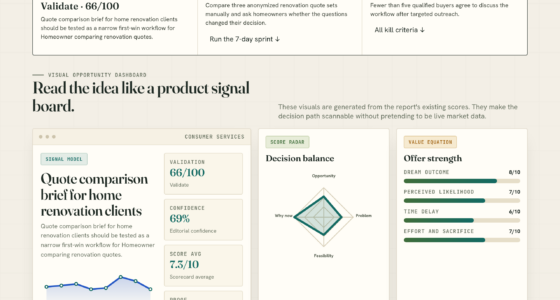

📊 Full opportunity report: The Internal Customer Conundrum In AI Implementation on ThorstenMeyerAI.com — validation score, market gap, and execution plan.
TL;DR
Many enterprises have adopted AI widely, but most see little to no measurable ROI. The core issue is organizational resistance and internal customer acceptance, not the technology itself. Success depends on addressing internal barriers.
Despite nearly 90% of Fortune 500 companies running AI in production, most are unable to demonstrate measurable ROI, with only 29% reporting significant financial benefits, according to recent surveys. The core challenge is not the technology but internal resistance from employees, processes, and organizational structures.
Data from multiple studies, including MIT, McKinsey, and Morgan Stanley, reveal that while AI adoption is widespread, 95% of pilots in sales and marketing sectors fail to generate immediate P&L impact within six months. The primary reason is organizational dysfunction, such as unclear ownership, lack of success metrics, and unaltered workflows, rather than model capability.
Research indicates that 80% of the effort to transition AI pilots into production involves data engineering, governance, and workflow integration—tasks that are organizational rather than technical. Less than 1% of enterprise data is currently integrated into AI models, not due to technological limits but because of resistance rooted in data silos, governance issues, and legacy systems.
Furthermore, a significant portion of the workforce harbors fears about AI, with 29% of employees and 44% of Gen Z admitting to sabotaging AI initiatives. Concerns about job security and data leaks are prevalent, making internal acceptance a major hurdle to successful AI deployment.
Near-universal adoption, near-total value failure. The gap between spend and proof is the defining tension of enterprise AI in 2026.
Why Internal Resistance Undermines AI ROI
This situation matters because it highlights that technological readiness alone does not guarantee success. Organizational culture, employee trust, and internal processes are critical factors. Without addressing these, enterprises risk wasting billions on AI investments that fail to deliver value, potentially damaging trust and competitive positioning.
AI change management tools for enterprises
As an affiliate, we earn on qualifying purchases.
As an affiliate, we earn on qualifying purchases.
Organizational Challenges in Enterprise AI Adoption
Since 2020, AI adoption in enterprises has surged from 20% to over 80% among Fortune 500 companies, with total investments exceeding $2.5 trillion. However, success stories are rare; only a minority of pilots scale beyond initial testing phases. Previous efforts often faltered because organizations underestimated the complexity of integrating AI into existing workflows and the cultural shifts required.
Studies from 2026 confirm that most failures are rooted in organizational issues—unclear ownership, resistance, and lack of success criteria—rather than technical shortcomings. This aligns with earlier research emphasizing that the last mile of AI deployment is organizational, not technological.
"The real bottleneck is not the model, but organizational dysfunction—unclear ownership, no success criteria, and unredesigned workflows."
— Thorsten Meyer
organizational resistance management software
As an affiliate, we earn on qualifying purchases.
As an affiliate, we earn on qualifying purchases.
Unresolved Aspects of Internal Resistance in AI
While data shows organizational dysfunction is a key factor, it is still unclear how best to measure and systematically improve internal acceptance. The specific strategies that reliably overcome fears and resistance, and how organizations can effectively redesign workflows at scale, remain under investigation. Additionally, the long-term impact of internal sabotage and fear on AI ROI needs further study.
As an affiliate, we earn on qualifying purchases.
Future Strategies for Internal Customer Engagement
Organizations are expected to focus on change management, internal stakeholder engagement, and redesigning workflows to better integrate AI. Success stories suggest that partnerships with external experts—often called 'AI Sherpas'—and targeted internal change initiatives can improve adoption rates. Monitoring how these approaches influence ROI and organizational culture will be key in the coming years.
employee AI adoption training programs
As an affiliate, we earn on qualifying purchases.
As an affiliate, we earn on qualifying purchases.
Key Questions
Why do most AI pilots fail to deliver ROI?
Most pilots fail because of organizational issues such as unclear ownership, resistance from employees, and workflows that are not redesigned to incorporate AI effectively.
Is the technology at fault for the low success rate?
No, studies indicate that the technology works; the main hurdles are organizational and cultural, not technical limitations.
How can companies improve internal acceptance of AI?
Effective strategies include engaging internal stakeholders early, redesigning workflows, establishing clear ownership, and addressing fears about job security through transparent communication.
What role do external partners play in successful AI deployment?
External partners or AI 'Sherpas' help bridge the gap between technology and organizational change, guiding enterprises through cultural and process adjustments that internal teams often struggle with.
What is the long-term outlook for AI ROI in enterprises?
Success depends on overcoming organizational barriers; as companies improve internal change management, ROI from AI is expected to increase significantly in the coming years.
Source: ThorstenMeyerAI.com