📊 Full opportunity report: Why Small Towns Are Exploring Storefront-Matching Platforms on IdeaNavigator AI — validation score, market gap, and execution plan.

Get the latest gadgets delivered free with Prime
- Fast, free delivery on millions of items
- Prime Video, Amazon Music and more included
- Member-only deals all year
TL;DR
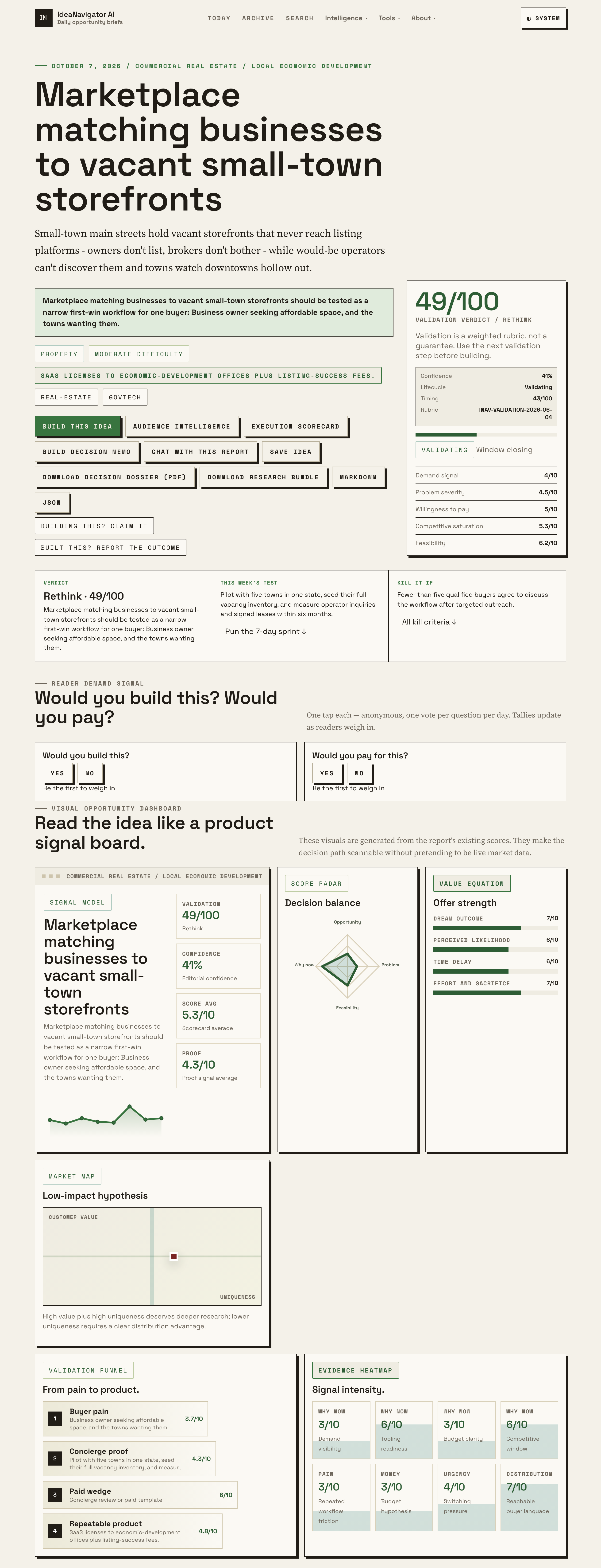
IdeaNavigator AI proposes a marketplace connecting vacant small-town storefronts with business operators and local economic-development offices. The proposal recommends testing the idea in five towns and tracking inquiries and signed leases over six months; it does not confirm a pilot or results.
IdeaNavigator AI has proposed a marketplace to match vacant small-town storefronts with business operators, with local economic-development offices helping connect listings to available grants. In its proposal, IdeaNavigator AI recommends testing the platform in five towns in one state and measuring inquiries and signed leases over six months. The proposal does not report that a pilot has begun or that the platform has secured users.
IdeaNavigator AI’s proposal identifies a potential discovery gap: some storefront owners do not advertise available space on listing sites, while brokers may not pursue properties in smaller markets. The proposal suggests that operators seeking affordable premises may therefore miss spaces towns hope to fill. It presents this as a potential marketplace opportunity, not as a measured account of vacancy rates or a verified estimate of how many businesses are unable to locate space.
For an initial product, IdeaNavigator AI suggests that owners and towns post basic listing details, including photos, size, rent and incentive programs. The proposal says prospective operators could browse by town profile and foot-traffic data. In the proposed workflow, an interested operator’s inquiry would go to a local development office, which could provide information about relevant grants.
The proposal suggests a business model combining software licenses for economic-development offices with fees tied to successful listings. These are proposed revenue streams, not reported contracts or established pricing. IdeaNavigator AI recommends collecting a town’s full storefront-vacancy inventory across five towns in one state, then tracking operator inquiries and signed leases during a six-month pilot.
Connecting Listings to Local Support
If the proposed workflow works, it could give operators a more direct way to discover spaces and give local development offices a role in turning interest into a lease. The proposal argues that bringing property details and grant information together could reduce the effort involved in contacting separate owners and municipal offices. It does not quantify expected savings or improvements in occupancy.
For towns, the potential value is not just a larger set of online listings. A platform would need owners to share accurate availability and operators to follow through; otherwise, it could reproduce gaps found in existing channels. As IdeaNavigator AI proposes, measuring inquiries and completed leases could help distinguish genuine business interest from browsing activity. Whether fees for successful listings or town subscriptions could support the service remains an open commercial question.
Popular right now

DREAME D20 Air Plus Robot Vacuum and Mop with Auto-Empty Dock

KitchenAid Artisan 5-Quart Tilt-Head Stand Mixer, KSM150PS, Almond Cream

Vitamix VX1 Professional-Grade Blender, 64 oz, Black
As an affiliate, we earn on qualifying purchases.
A Proposed Main Street Marketplace
IdeaNavigator AI frames the idea around two groups with related needs: business owners seeking affordable space and towns seeking occupants for vacant storefronts. The proposal cites renewed small-town interest associated with remote-work migration and grant funding for economic development as reasons the matching problem may be timely. It provides no data demonstrating the scale of that migration, the amount of grant funding available, or how many towns have budgeted for this kind of service.
The plan is deliberately narrow: focus on storefront discovery and route interested operators to local development offices, rather than building a broad commercial real-estate platform. That focus could make a pilot easier to evaluate, but its value would depend on whether towns can assemble complete listings and maintain them as rents, availability and incentives change.
Pilot Results Remain Unknown
IdeaNavigator AI’s proposal confirms no launch, participating towns or results. It does not identify a platform operator, development-office partners, funding commitments or a schedule for starting the suggested pilot. It also provides no figures for existing vacancies, user demand, lease conversion rates or the cost of building and maintaining the service.
The proposal leaves operational questions open: how owners would verify listings, who would update availability and incentive details, how foot-traffic data would be sourced, and what counts as a successful match. It is also unclear how listing-success fees would be defined or whether towns would pay for licenses before evidence of leases. The six-month period is a recommended test window, not a confirmed trial timetable.
Five-Town Test Would Measure Leases
IdeaNavigator AI proposes recruiting five towns in one state, gathering their full vacancy inventories and populating listings with photos, dimensions, rent and incentive details. Under the proposed workflow, the platform would route operator inquiries to local development offices and connect relevant grant information to those conversations.
Over the suggested six months, organizers would track both inquiries and signed leases. Those measures could show whether operators are finding spaces and whether interest results in occupancy, though the proposal sets no target numbers and does not specify how results would be independently checked. Until towns and a platform operator commit to the test, the marketplace remains a proposal rather than an operating service.
Source: IdeaNavigator AI proposal
Key Questions
What is a storefront-matching platform?
IdeaNavigator AI proposes an online marketplace where towns and property owners list vacant storefronts and business operators search for space. The suggested service would also connect inquiries to local development offices.
What details would storefront listings include?
According to the proposal, listings would include photos, size, rent and incentive programs. Operators could browse by town profile and foot-traffic data, though the proposal does not specify how that data would be collected.
Has the five-town pilot started?
No pilot is confirmed. IdeaNavigator AI presents testing the platform in five towns in one state as a recommended validation plan, not a reported launch.
How would the platform be evaluated?
The proposal recommends tracking operator inquiries and signed leases over six months. It provides no targets or current performance figures, and no timetable is confirmed.
How might the service make money?
IdeaNavigator AI suggests software licenses for economic-development offices and fees tied to successful listings. The proposal reports no prices, customers or signed agreements.
Source: IdeaNavigator AI