
TL;DR

Get the latest gadgets delivered free with Prime
- Fast, free delivery on millions of items
- Prime Video, Amazon Music and more included
- Member-only deals all year
The Quantum Insider reports that theoretical physicist Juan Maldacena discussed how many qubits a quantum computer might need to simulate a holographic universe in a new episode of The Quantum Kid. The source does not give the numerical estimate, and says the required qubits would need to be stable and near-perfect—closer to error-corrected logical qubits than today’s noisy physical qubits.
The latest episode of The Quantum Kid features theoretical physicist Juan Maldacena discussing how many qubits a quantum computer might need to simulate a holographic universe, a possible route to studying quantum gravity. The Quantum Insider’s November 2 report says the qubits would need to be stable and near-perfect, but its supplied summary does not state Maldacena’s numerical estimate.
Maldacena, a professor at the Institute for Advanced Study in Princeton, explains the holographic principle: the physics inside a region of space, including gravity, can be described by information on its boundary. His 1997 work formulated a prominent version of this idea, linking gravitational physics with a quantum theory.
The report presents quantum simulation as a potential way to investigate that connection in a controlled setting. It stresses, however, that the relevant hardware would require qubits with exceptionally low error rates. That points toward error-corrected logical qubits, rather than the noisier physical qubits used in current quantum devices.
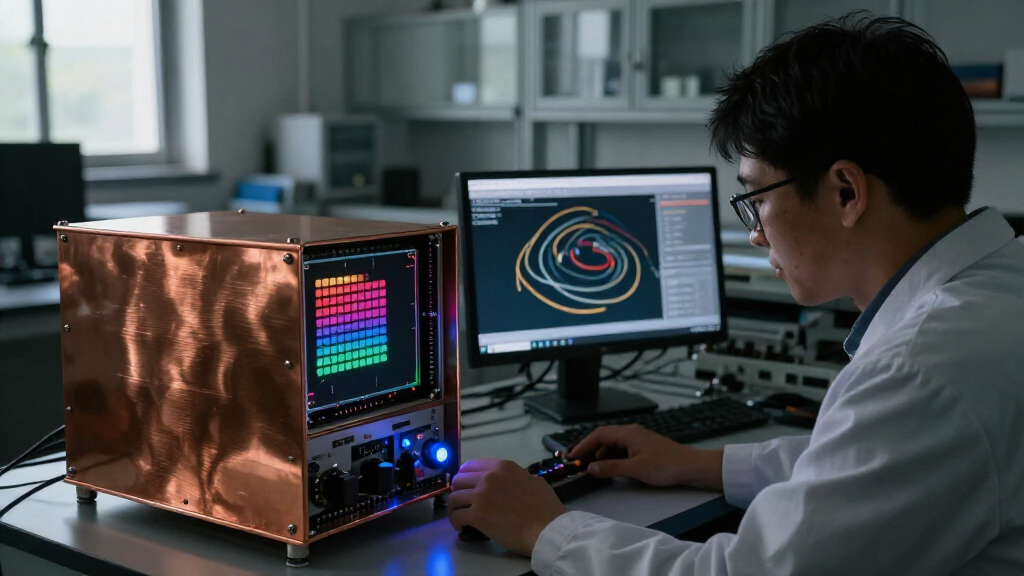
The episode also visits Microsoft’s quantum lab in Copenhagen. There, Dr. Lauri Sainiemi discusses Majoranas and Microsoft’s topological-qubit approach, which is intended to make qubits more robust to noise. The episode brings the theoretical question together with one company’s engineering effort, but it does not establish that this hardware can yet perform the proposed simulation.
Quantum Gravity Meets Hardware Limits
The discussion connects an abstract question in fundamental physics to a practical constraint in quantum computing: qubit quality. A large qubit count alone would not establish that a machine could model a holographic universe. The qubits would also need to remain reliable through the operations required for a demanding simulation, making error correction and hardware stability central issues.
For readers following quantum technology, the episode offers a different prospective application from common industry examples such as materials research or optimisation. Simulating a system that incorporates gravity could help researchers explore questions that are difficult to test directly, but the report describes this as a possibility, not a demonstrated capability. No timeline or experimental result for such a simulation is provided.
Popular right now

KitchenAid Artisan 5-Qt Tilt-Head Stand Mixer – Dried Rose (KSM150PS)

LG 85-Inch QNED73B Mini LED 4K Smart TV (2026)

Dyson Ball Animal 3 Upright Vacuum
As an affiliate, we earn on qualifying purchases.
From Maldacena’s Duality to Qubits
Maldacena’s 1997 paper proposed a mathematical relationship between a theory including gravity in a space and a quantum theory defined on its boundary. The Quantum Insider describes the paper as the most cited in high-energy physics. The holographic principle is relevant here because it gives researchers a way to connect gravitational systems with quantum information.
The engineering portion of the episode focuses on Microsoft’s effort to develop topological qubits using Majoranas. The company’s approach is designed to improve robustness, according to the report, while Sainiemi explains the challenges of building more stable qubits. The source does not provide device performance data or independently verify the approach’s progress toward the qubit quality Maldacena’s scenario would require.
The Estimate and Its Limits
The supplied report summary says Maldacena gives a specific qubit estimate, but does not include the number. It also does not specify the assumed universe, simulation fidelity, duration, error-correction overhead or computational method. Without those details, the estimate cannot be evaluated or compared with hardware roadmaps from the material provided.
It remains unclear whether the episode’s estimate refers to logical qubits, physical qubits, or a particular model with defined assumptions. The report’s comparison to near-perfect, error-corrected logical qubits is a useful qualification, but it does not provide a complete technical specification. Nor does the episode description establish that Microsoft’s topological approach has reached the required stability or that a full holographic-universe simulation is currently feasible.
Episode Details and Research Ahead
The episode is available on The Quantum Kid’s YouTube channel, according to the report. Viewers seeking the numerical estimate and its assumptions would need to consult the episode itself; the supplied article summary does not reproduce them. Further evaluation would require a clearly defined model, a stated qubit count and error assumptions, and hardware results that can be compared with those requirements.
For now, the report presents the qubit estimate as a theoretical target and Microsoft’s lab work as an engineering effort aimed at more stable hardware. Whether topological qubits can deliver the reliability needed for this kind of simulation remains an open question.
Key Questions
How many qubits would it take to simulate a holographic universe?
The Quantum Insider says Juan Maldacena gives a specific estimate in the episode, but the supplied report summary does not state the number. It also does not provide enough assumptions to assess the estimate.
What does the holographic principle mean?
It is the idea that information describing the physics inside a region of space, including gravity, can be represented by information on that region’s boundary. Maldacena discusses this connection between gravity and quantum theory in the episode.
Could today’s quantum computers run the simulation?
The report does not say that current machines can do so. It says the required qubits would need to be stable and near-perfect, more like error-corrected logical qubits than today’s noisy physical qubits.
What is Microsoft’s role in the episode?
The episode visits Microsoft’s quantum lab in Copenhagen, where Dr. Lauri Sainiemi discusses Majoranas and the company’s topological-qubit approach. The report describes its goal of improving robustness, not a completed holographic simulation.
Source: thequantuminsider.com