
TL;DR
OpenAI said on November 18 that its models rewrote parts of AMD chip designs, with the best reported result reaching up to 14% improvement in power, performance and area against heavily optimized baselines. The models changed SystemVerilog code, which Synopsys tools checked for functional equivalence and design metrics, according to OpenAI and media reports. Block-level figures, averages and an independent review have not been published.
OpenAI said November 18 that its models helped rewrite parts of designs for AMD processors, reporting up to 14% gains in power, performance and area on an AMD flagship GPU design. The result is a company-reported best case, and OpenAI has not published the chip blocks tested, an average improvement, or an independent audit.

Get the latest gadgets delivered free with Prime
- Fast, free delivery on millions of items
- Prime Video, Amazon Music and more included
- Member-only deals all year
The work focused on register-transfer-level (RTL) code, written in SystemVerilog to describe how chip circuits behave. OpenAI says its models proposed alternative code for existing functions, then Synopsys design tools checked that the rewrites preserved behavior and evaluated their power, performance and area, or PPA. The reported workflow covers a specific design stage; it does not mean the models independently designed or manufactured a whole processor.
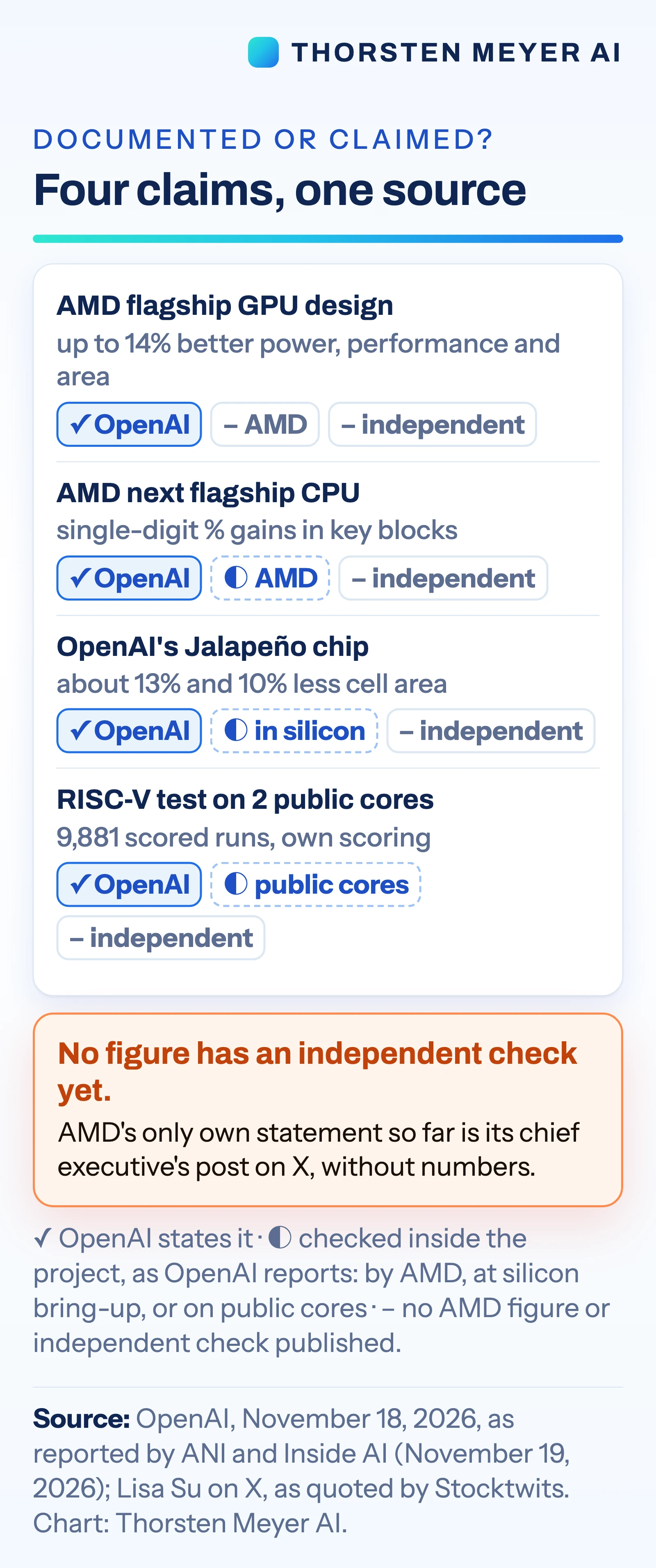
OpenAI said its models found up to 14% better PPA against “heavily optimised baselines” for AMD’s flagship GPU design. It said some model-generated changes were included in a design AMD had sent for manufacturing, while other changes entered production design files for future versions. The company did not identify the affected GPU blocks or say whether the maximum gain applied to one metric, a combined measure, or a particular block.
OpenAI also reported that AMD verified single-digit percentage PPA gains in key blocks of its next flagship CPU. Separately, OpenAI described results on its own Jalapeño inference chip: model-proposed changes reduced standard-cell area by about 13% in one unit and 10% in another, with validation after the first chips returned, according to the company. Reports differ on the name of the first unit. OpenAI also said it ran 9,881 scored tests across five models on the open-source PicoRV32 and Ibex processor cores; that benchmark is distinct from the AMD design results.
AI Models Enter Chip Design Work
The announcement points to a possible way for AI tools to assist with a technically demanding part of chip development: exploring alternative implementations while engineers retain established tools to check whether they work. If such changes can be applied reliably, they could help chip teams test more design options within a given schedule. OpenAI described the AMD GPU result as roughly a year of progress achieved in less than five months, but that timeline comparison is the company’s characterization; the published information does not give a method for independently evaluating it.
The claim may matter to AMD because some changes reportedly reached a design sent for manufacturing, which suggests the work moved beyond a software-only demonstration. The size and practical effect of the improvements remain difficult to judge without details about the blocks, baselines, trade-offs and product schedule. A change that improves area, for example, may affect other design constraints; the public summary does not provide enough data to assess those trade-offs.
OpenAI and AMD also have a financial relationship. Since October 2025, OpenAI has held a warrant for up to 160 million AMD shares, which vests as AMD chips are deployed. That connection does not establish that the reported results are inaccurate, but it is relevant context when evaluating performance claims presented by OpenAI. AMD’s own published account and fuller technical data would help outside readers assess them.
Popular right now

Bose QuietComfort Wireless Noise Cancelling Headphones – Twilight Blue Limited Edition

Ninja Foodi 6-in-1 DualZone FlexBasket Air Fryer, 7-Qt MegaZone, Black, DZ071

Dyson Cyclone V10 Origin Cordless Vacuum
As an affiliate, we earn on qualifying purchases.
From RTL Rewrites to Fabrication
RTL is an early description of a chip’s logic. Engineers write code specifying how a circuit block processes information over clock cycles. Synthesis tools translate that description into logic gates, followed by later stages that arrange and connect components for a physical chip. OpenAI’s account concerns proposed rewrites at the RTL stage, with design tools used to check behavior and measure implementation trade-offs.
OpenAI’s November 18 post, titled “Advancing chip design with OpenAI models,” is the primary source for the claims summarized here. The company’s post was not available to the source publisher through an automated request, so details were drawn from reports by ANI, The Decoder and Inside AI. OpenAI president Greg Brockman separately described the AMD result on X as roughly an additional year of progress achieved in less than five months. Those descriptions remain attributed claims, rather than independently reproduced measurements.
The Jalapeño and open-source-core results provide separate examples of the approach, but they should not be treated as confirmation of the AMD GPU figure. OpenAI says it began using GPT-4o on Jalapeño in early 2025. The reported 9,881 runs concern tests on PicoRV32 and Ibex, not AMD silicon. Each result has a different design target and evidence base.
Missing Data Limits the Comparison
OpenAI has not publicly identified the AMD GPU blocks behind the 14% result, provided per-block measurements, reported an average across changes, or specified how the three PPA measures were combined. The phrase “up to” signals a maximum, not a typical result across the design. The company also has not released enough information for outsiders to reproduce the comparison against the heavily optimized baselines.
AMD’s own public figures are absent from the materials cited by the reports. OpenAI says AMD verified single-digit gains on CPU blocks and that some GPU changes entered a design sent for manufacturing, but the reporting does not establish which changes made it through later fabrication and validation steps or how they affect a shipping product. No independent audit of the reported chip-design results has been published.
The public account also leaves open what resources the model-assisted work required, how much human engineering review each proposed rewrite received, and whether the gains persist across other blocks or chip generations. Those details would help distinguish a repeatable design method from a set of promising, selected examples.
AMD Data Would Clarify Results
The next useful evidence would be technical results from AMD describing the affected blocks, baselines and measured trade-offs, along with an account of which changes survived later design and manufacturing checks. OpenAI could also clarify whether the 14% figure refers to one metric or a particular combination, and publish representative results rather than only the maximum.
For now, the announcement establishes that OpenAI says its models contributed RTL changes to AMD designs and that some changes were included in a design sent for manufacturing. It does not establish the average improvement across those designs or the effect on products customers can buy. Further details from either company, or independently reviewed measurements, could sharpen that picture.
Key Questions
What did OpenAI say its models changed?
OpenAI said its models rewrote parts of SystemVerilog RTL, code that describes chip circuitry. Synopsys design tools checked the rewrites for equivalent behavior and measured design metrics, according to OpenAI and media reports.
What does “up to 14%” refer to?
It is OpenAI’s reported best-case improvement in power, performance and area against heavily optimized baselines on an AMD flagship GPU design. The company has not published the block-level data or an average result.
Did AMD confirm the results?
OpenAI said AMD verified single-digit gains in key blocks of a next flagship CPU. AMD has not published its own figures in the source material cited for this article.
Were any changes used in a design headed to manufacturing?
OpenAI said some model-generated changes were included in an AMD design sent for manufacturing. The public reports do not specify which changes or confirm their effect in a finished product.
Has an independent party checked the claims?
No independent audit of the chip-design results has been published. The headline measurements and descriptions are claims reported by OpenAI; more detailed data would be needed for outside assessment.
Source: Thorsten Meyer AI