
Molecular motors are tiny biological machines inside your cells that convert chemical energy, mainly from ATP, into movement. They perform essential tasks like transporting materials, helping muscles contract, and dividing cells by changing shape and structure. These motors “walk” along tracks like microtubules or actin filaments through coordinated shifts in their components. Understanding how their dynamic structures work offers fascinating insights into how life’s tiny machines keep your cells functioning smoothly.
Key Takeaways
- Molecular motors are tiny biological machines that convert chemical energy, mainly from ATP, into mechanical movement inside cells.
- They facilitate essential functions like muscle contraction, intracellular transport, and cell division through structural shape changes.
- Movement is driven by conformational shifts triggered by ATP binding and hydrolysis, enabling the motor to “walk” along cellular tracks.
- Examples include kinesin and myosin, which move along microtubules and actin filaments, respectively, powering cellular activities.
- Their efficiency and design are results of evolutionary optimization, highlighting their crucial role in maintaining cellular health.

Have you ever wondered how tiny machines inside our cells move and perform essential functions? These microscopic entities, known as molecular motors, are fundamental for processes like muscle contraction, intracellular transport, and cell division. At their core, they are remarkable examples of biological engineering, converting energy into motion with incredible efficiency. When you consider their role, it’s fascinating to realize how they harness energy conversion to generate mechanical work. They take chemical energy, often from molecules like ATP, and transform it into movement, powering vital cellular activities.
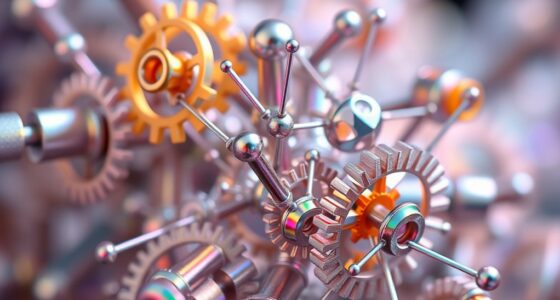
Understanding how these motors achieve this feat requires delving into their structural dynamics. Each molecular motor is a complex, highly specialized structure that can change shape and conformation in response to energy input. These structural shifts are not random; they follow precise, coordinated patterns that allow the motor to “walk” along cellular tracks such as microtubules or actin filaments. This movement depends on the dynamic interactions between their different domains, which act like tiny gears and levers. As ATP binds and is hydrolyzed, the motor undergoes conformational changes, which translate chemical energy into mechanical force. This process exemplifies how structural dynamics are fundamental to their function, enabling movement at a scale invisible to the naked eye.
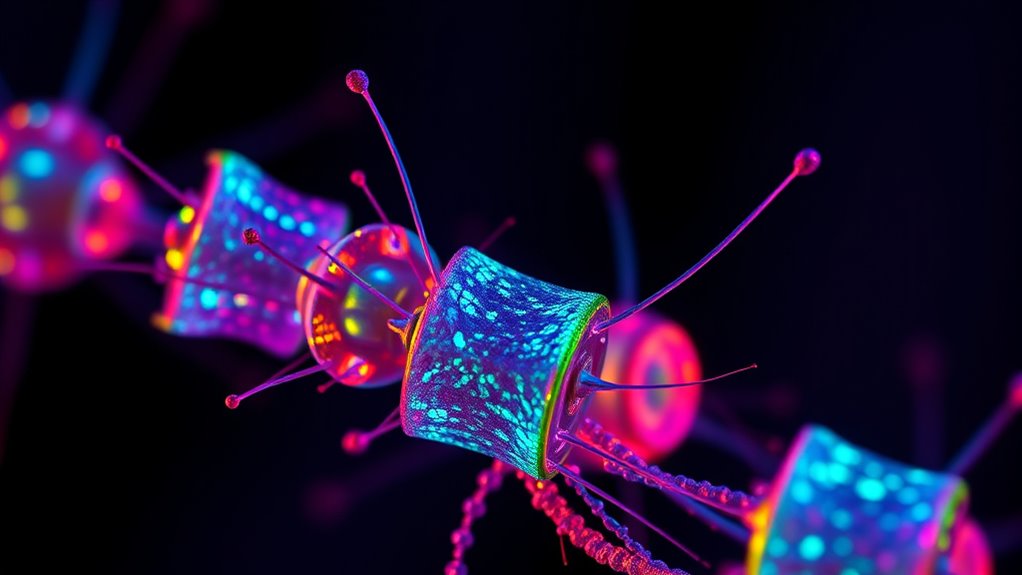
The structural design of these motors is highly efficient. For instance, the motor protein kinesin has a head that binds to microtubules and a tail that attaches to cargo. When ATP is hydrolyzed, the head shifts position through structural rearrangements, propelling kinesin forward along the microtubule. This cycle repeats rapidly, allowing continuous transport of cellular materials. Similarly, myosin, another molecular motor, interacts with actin filaments to generate muscle contractions. Its ability to change shape and position relies on a precise sequence of structural states driven by energy conversion. These conformational changes are what make molecular motors so effective, turning chemical reactions into directed, purposeful movement.
In essence, molecular motors demonstrate how biological systems leverage structural dynamics and energy conversion to perform complex tasks at a microscopic scale. They are nature’s nanomachines, meticulously designed through evolution to guarantee cellular life functions smoothly. By continuously adapting their structure in response to energy input, they maintain the delicate balance necessary for cellular health and activity. Their ability to transform chemical energy into mechanical work, facilitated by intricate structural shifts, underscores the elegance of biological machinery. This intricate interplay of energy and structure is what makes molecular motors one of the most fascinating subjects in molecular biology. Understanding these processes also highlights the importance of structural dynamics in biological function and innovation.
As an affiliate, we earn on qualifying purchases.
Frequently Asked Questions
How Do Molecular Motors Differ From Macroscopic Motors?
You notice that molecular motors differ from macroscopic motors because they operate at a tiny scale, using specific protein structures. Their motor mechanisms rely on chemical energy, like ATP, to produce movement, unlike macroscopic motors that use electricity or fuel. This allows molecular motors to perform precise tasks inside cells, such as transporting cargo, by harnessing their unique protein structures and energy-efficient motor mechanisms.
What Energy Sources Power Molecular Motors?
You might think tiny molecular motors run on just a simple energy source, but they actually harness the incredible power of ATP hydrolysis. This process fuels dramatic protein conformational changes, transforming chemical energy into mechanical work. The energy release is so mighty that it drives these motors to crawl, walk, and carry cargo with astonishing precision. It’s like a microscopic explosion, propelling life’s tiniest engines forward in a dance of molecules.
Can Molecular Motors Malfunction or Fail?
Yes, molecular motors can malfunction or fail. You might notice motor malfunction when they lose efficiency or stop working altogether, which can disrupt cellular processes. Factors like damage to the motor proteins, mutations, or changes in energy supply can cause motor failure. When these issues happen, they can lead to cellular problems or diseases. Understanding these failures helps researchers develop ways to prevent or fix motor malfunction in biological systems.
How Are Molecular Motors Studied Experimentally?
Imagine peering into a bustling microscopic city, where you can watch molecular motors in action. You study them experimentally using single molecule imaging to visualize individual motors in real-time, and force spectroscopy to measure the tiny forces they generate. These techniques allow you to understand how they move, interact, and respond to different conditions, revealing the intricate dance of these tiny yet essential biological engines.
What Potential Applications Do Molecular Motors Have in Medicine?
You can harness molecular motors in medicine for drug delivery and cancer therapy. They actively transport drugs directly to target cells, increasing effectiveness and reducing side effects. By designing these motors to recognize specific cancer markers, you improve precision in treatment. Their ability to navigate cellular environments makes them promising tools for personalized medicine, potentially revolutionizing how we treat diseases with targeted, efficient, and minimally invasive approaches.
microtubule and actin filament educational kit
As an affiliate, we earn on qualifying purchases.
As an affiliate, we earn on qualifying purchases.
Conclusion
You now see how molecular motors serve as tiny, tireless workers within your cells, ferrying essential cargo along shimmering protein tracks. Their energy-driven strides resemble a delicate ballet, orchestrating life’s most intricate processes beneath the surface. These microscopic engines, though invisible to the naked eye, power the vibrant dance of life, ensuring everything runs smoothly. Understanding their elegant mechanics offers a glimpse into the mesmerizing world where biology and physics collide in perfect harmony.
cell biology molecular motors poster
As an affiliate, we earn on qualifying purchases.
As an affiliate, we earn on qualifying purchases.
As an affiliate, we earn on qualifying purchases.