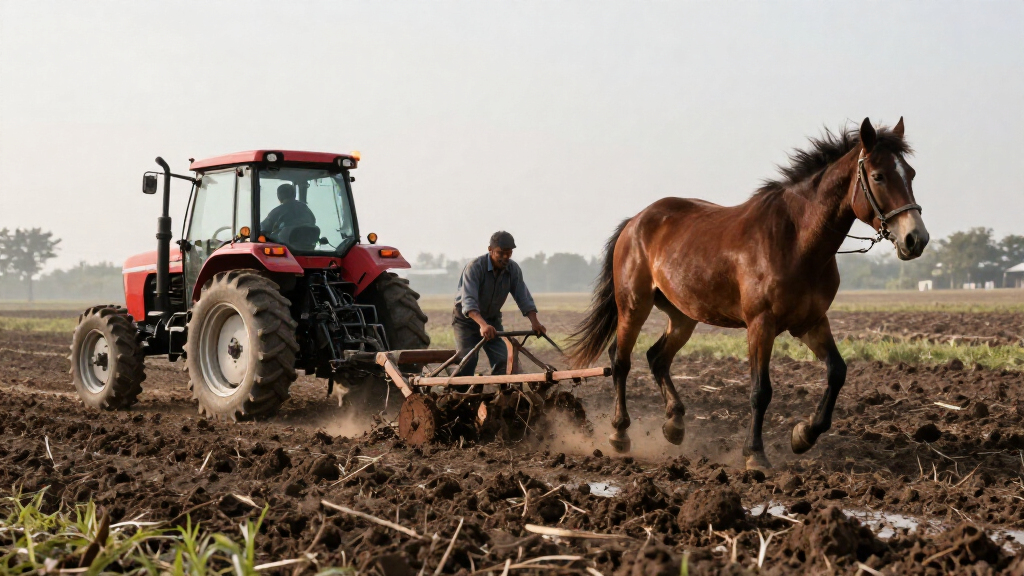
🔍 Read the full analysis: A Question Of Horsepower: Tractors And Working Animals on ThorstenMeyerAI.com

Get the latest gadgets delivered free with Prime
- Fast, free delivery on millions of items
- Prime Video, Amazon Music and more included
- Member-only deals all year
TL;DR
U.S. farm horses and mules peaked at 26.7 million in 1918, then fell to 3.1 million by 1960 as tractors spread. The shift freed cropland used to feed working animals and coincided with a major decline in farm employment, but the horse-to-worker comparison has limits and current autonomous farm equipment remains specialized.
A November 4 report from ThorstenMeyerAI.com traces how tractors replaced working animals on U.S. farms: horses and mules peaked at 26.7 million in 1918, then declined to 3.1 million by 1960 as tractor numbers climbed. The history matters to current debates over automation because it shows that a major shift in farm technology also changed land use and employment, though it does not by itself predict what machines will do to workers today.
Historical estimates cited in the report put the number of farm horses and mules at 26.7 million on January 1, 1918. Horses alone had peaked at 21.4 million in 1915; mules continued to increase afterward. In that same year, about 93 million acres of harvested U.S. cropland—more than a quarter of the total—grew feed for the animals. The figure was still about 90 million acres in 1920.
Tractors spread quickly over the following decades. The report gives estimates of about 1,000 tractors in 1910, 246,000 in 1920 and 4.69 million in 1960. The count of farm horses and mules fell from 25.7 million in 1920 to 3.1 million in 1960. Around 1955, tractors outnumbered the animals: 4.35 million to 4.31 million, according to the figures cited. The report notes that tractor and animal counts were collected at somewhat different dates and that the counting methods changed.
The transition extended beyond tractors. Combine harvesters rose from about 4,000 on U.S. farms in 1920 to 1.042 million in 1960, while other machinery and changes in inputs also contributed to higher output. The U.S. Department of Agriculture estimated that farm workers supplied 7.1 people per worker in 1910 and 47.1 in 1970. Farm employment, meanwhile, fell from 13.6 million in 1916 to 4.5 million in 1970, even as the overall U.S. labor force doubled.
Mechanization Changed Farms and Work
The horse-to-tractor shift involved more than replacing one source of pulling power with another. As fewer animals were kept, less land was needed to grow feed. The report says the acreage used for horse and mule feed fell from about 93 million acres in 1915 to about 5 million in 1960. That land could instead produce crops for people or for sale, while machinery allowed fewer farm workers to produce more.
The employment figures show the disruption as well as the productivity gains. U.S. farm employment dropped sharply over the period, and the report says new jobs were concentrated in cities, requiring many people to move. It does not offer a detailed account of individual workers’ outcomes or establish that mechanization alone caused every employment change. The historical record does, however, show that technology can reshape where work is done and what skills or livelihoods remain in demand.
That is why the analogy is invoked in discussions of artificial intelligence and robotics. In 1983, economist Wassily Leontief compared workers with horses displaced by tractors. The comparison highlights the possibility that technology can make some forms of labor less necessary, but the horse’s fate is not a forecast for people: workers can change occupations, organize politically and influence policy in ways animals cannot.
Popular right now

Hisense 65-inch U6 Pro Mini-LED 4K UHD Smart Fire TV

Bose QuietComfort True Wireless Earbuds with Active Noise Cancellation, Black

Philips 2200 Series Fully Automatic Espresso Machine with Classic Milk Frother, 2 Coffee Varieties, Intuitive Touch Display, Ceramic Grinder
As an affiliate, we earn on qualifying purchases.
From Fordson to Farm Robots
Tractors existed before World War I, but the report describes early models as heavy, expensive and better suited to large farms. In 1917, Ford introduced the Fordson. The Henry Ford museum calls it “the first mass-produced and inexpensive lightweight tractor” and says it was designed for smaller farmers. On February 21, 1920, the 100,000th Fordson left the assembly line, a marker of how production helped bring mechanized power within reach of more farms.
The reported adoption figures are drawn from the U.S. Census Bureau’s Historical Statistics of the United States, Colonial Times to 1970, which reprinted Department of Agriculture estimates. The source cautions that tractor counts for several census years were taken on slightly different dates, and that from 1951 the department counted horses and mules together. These details matter when comparing the series, even though the broad decline in working animals is clear.
Modern agricultural automation is not yet a direct equivalent of a farm staffed entirely by tractors. The report says John Deere’s 16-camera autonomy kit, described in February 2025, performs tillage on select large tractors. It also reports that China said about 74% of ploughing, sowing and harvesting was mechanized in 2023. That figure is a reported national measure, not evidence that all farm tasks or jobs have been automated.
Where the Horse Analogy Falls Short
The historical counts establish a large decline in farm horses and mules alongside the growth of tractors, but they do not show exactly how every displaced farm worker found work or how much of the employment change was caused by machinery rather than other economic changes. The report says farmers stopped breeding replacements and working animals gradually aged out; it does not describe a single event that ended the horse economy.
The modern comparison is less settled. The report identifies particular autonomous equipment and a Chinese mechanization estimate, but does not provide independent performance data, adoption rates for driverless tractors across countries, or a forecast of how many agricultural jobs automation may affect. The 74% figure refers to mechanization of ploughing, sowing and harvesting, not to every farm operation. It remains unclear how broadly the cited autonomy system is being used and what effects it has had on labor.
Tracking Automation Beyond Tillage
The next useful test is whether autonomous equipment expands from limited tasks and selected large tractors into a wider range of farm operations. Evidence to watch includes how many farms adopt the systems, which tasks they can perform reliably, their costs, and whether they reduce labor needs or change the kinds of work farms require.
For the historical comparison, further evidence on workers’ movement into urban jobs and on the causes of changing farm employment would help distinguish the effects of mechanization from broader economic shifts. The source report offers a cautionary analogy, not a prediction: the horse economy shows how quickly a technology can displace an established system, while the human consequences of automation remain dependent on the technology, labor markets and public choices involved.
Key Questions
When did farm horses and mules peak in the United States?
The report cites a combined peak of 26.7 million on January 1, 1918, including 21.2 million horses and 5.5 million mules. Horses alone peaked earlier, at 21.4 million in 1915.
How many farm horses and mules remained by 1960?
The historical figures cited in the report put the 1960 count at 3.1 million, down from 26.7 million in 1918. The source says farmers stopped breeding replacements and the working population aged out.
Did tractors cause the decline in farm employment?
The report documents that farm employment fell from 13.6 million in 1916 to 4.5 million in 1970 as mechanization advanced. Those figures alone do not establish that tractors were the only cause; the report also describes broader changes in farming and the economy.
Are driverless tractors already common across farming?
The source describes a John Deere autonomy kit for tillage on select large tractors, cited as of February 2025. It does not provide adoption figures showing how common autonomous tractors are across farms or countries.
Does the horse analogy predict what AI will do to workers?
No. It offers a historical comparison, not a forecast. The report notes that workers differ from horses because they can change occupations and influence political decisions, while the scale and effects of current automation remain uncertain.
Source: ThorstenMeyerAI.com