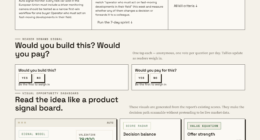

📊 Full opportunity report: How AI-Driven Automation With ChatGPT Changed Zapier’s Marketing Strategy on ThorstenMeyerAI.com — validation score, market gap, and execution plan.

Get the latest gadgets delivered free — and shop member deals
- Fast, free delivery on millions of items
- Access to Prime Big Deal Days deals on October 6–7
- Prime Video, Amazon Music and more included
TL;DR
OpenAI published a case study revealing Zapier adopted ChatGPT Work to change its marketing workflows. While specific impacts remain unconfirmed, this signals a broader move toward AI integration in routine business functions.
OpenAI has published a customer story confirming that Zapier integrated ChatGPT Work into its core marketing operations, marking a significant step in AI-driven automation for business teams. This development highlights how generative AI tools are moving beyond experimental use to influence routine organizational processes, making it relevant for marketing and automation leaders alike.
The announcement states that Zapier adopted ChatGPT Work to support its marketing functions, but it does not specify which workflows were affected or the deployment timeline. No performance metrics, such as productivity gains or cost savings, have been disclosed, and the description remains at a high level, emphasizing the use of AI in core activities without detailed evidence.
OpenAI’s account is based on a customer case study published on its platform, positioning Zapier as an example of AI moving into central business operations. However, the report does not include independent validation, nor does it clarify the scope of automation or the specific results achieved. Details about employee involvement, data handling, or process changes are not provided, leaving the full impact uncertain.
Implications of AI Integration in Core Marketing Tasks
This development matters because it signals a shift in how AI tools like ChatGPT are being embedded into routine business processes, not just as content generators but as components of ongoing operational workflows. For marketing teams, this could mean increased efficiency, consistency, and new ways to manage campaigns, though concrete benefits are yet to be quantified.
For organizations considering similar integrations, Zapier’s example suggests AI can be incorporated into established workflows, but the lack of detailed results means companies should evaluate potential impacts carefully and await further evidence of effectiveness.
As an affiliate, we earn on qualifying purchases.
OpenAI’s Customer Stories and Enterprise AI Adoption
OpenAI has a history of publishing customer accounts to showcase its AI products’ applications in business. The Zapier case is part of this trend, illustrating how generative AI is increasingly positioned as a core operational tool. Prior to this, AI adoption in marketing often remained experimental or limited to content creation, but recent stories point toward broader integration.
The announcement does not specify when Zapier began using ChatGPT Work or how extensively it was deployed, nor does it detail whether the AI replaced existing tools or supplemented them. These gaps leave questions about scalability and reproducibility for other organizations.
ChatGPT business automation software
As an affiliate, we earn on qualifying purchases.
As an affiliate, we earn on qualifying purchases.
Unverified Aspects of Zapier’s AI Deployment
It remains unclear which specific marketing processes were transformed, what measurable results were achieved, or how extensive the AI integration was within Zapier’s operations. Details about deployment timelines, employee involvement, and data management are also absent, making it difficult to assess the full scope and effectiveness of the initiative.
As an affiliate, we earn on qualifying purchases.
Expected Follow-Up and Additional Evidence
Further disclosures from OpenAI or Zapier are needed to clarify the scope, processes affected, and measurable outcomes. Future updates may include detailed case metrics, deployment timelines, and insights into how AI is integrated with existing workflows. Companies interested in adopting similar solutions should watch for more comprehensive reports and independent evaluations.
AI-powered marketing automation tools
As an affiliate, we earn on qualifying purchases.
As an affiliate, we earn on qualifying purchases.
Key Questions
What specific marketing tasks did Zapier automate with ChatGPT?
The available information does not specify which tasks or workflows were involved, only that core marketing processes were impacted.
Has Zapier reported measurable results from using ChatGPT Work?
No performance metrics, such as productivity improvements or cost savings, have been disclosed in the published account.
When did Zapier start using ChatGPT Work in its marketing operations?
The timeline for deployment or expansion has not been provided in the announcement.
Will other companies be able to replicate Zapier’s AI-driven marketing changes?
Without detailed process descriptions and results, it is unclear how easily other organizations can reproduce this deployment.
What are the risks or concerns associated with AI in marketing workflows?
Potential issues include data privacy, content accuracy, brand consistency, and oversight, but specific concerns related to Zapier’s deployment are not detailed in the announcement.
Source: ThorstenMeyerAI.com
Fall Picks
fall essentials
As an affiliate, we earn on qualifying purchases.