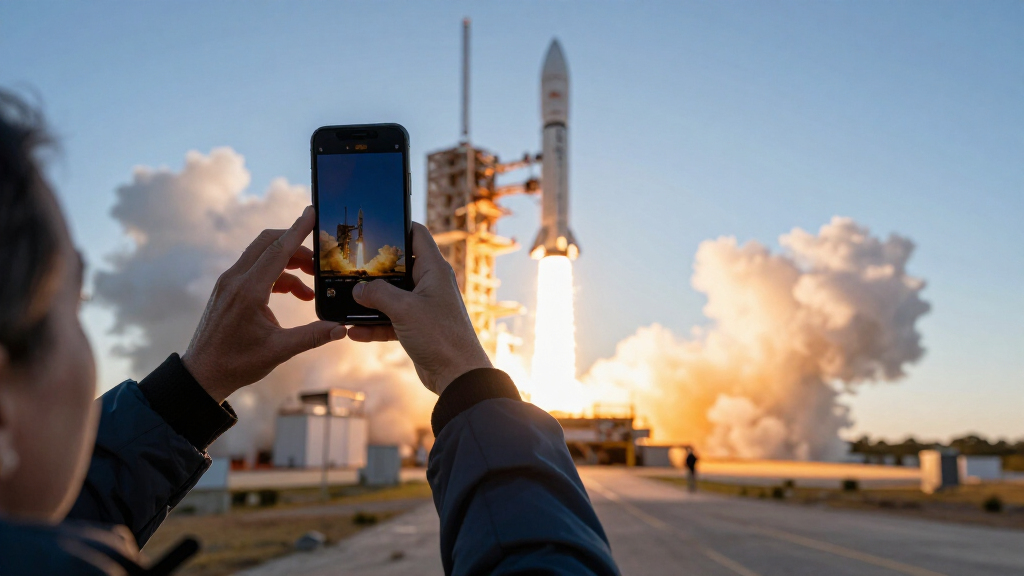

🔍 Read the full analysis: Musk’s Trillion-Dollar Promise Comes Into View After SpaceX’s First Profitable Quarter on ThorstenMeyerAI.com

Get the latest gadgets delivered free with Prime
- Fast, free delivery on millions of items
- Prime Video, Amazon Music and more included
- Member-only deals all year
TL;DR
SpaceX reported $14.6 billion in third-quarter revenue and $4.4 billion in net income, its first profitable quarter as a public company, according to the supplied report. Elon Musk said the company could reach $500 billion to $1 trillion in annual recurring revenue by the end of 2027, a target far above its current run rate and not formal company guidance.
SpaceX reported $14.6 billion in third-quarter revenue and $4.4 billion in net income on October 20, its first profitable quarter as a public company, while Elon Musk said annual recurring revenue could reach $500 billion to $1 trillion by the end of 2027. The earnings figures are reported results; Musk’s projection is a target, not formal company guidance, and the call did not provide a detailed path to reach it.
Revenue rose 161% from the same quarter a year earlier, while net income swung from a $1.1 billion loss to a profit. Adjusted EBITDA was $8.8 billion. Revenue also exceeded analyst estimates of about $12.7 billion, according to the supplied report, and SpaceX shares rose roughly 8% in after-hours trading.
The result was not solely a measure of operating performance. Income from operations was $2.8 billion, below net income, which included $873 million in interest income, $1 billion in other income and a $390 million tax benefit. The report says $561 million of the other income came from a related party.
SpaceX’s Super Intelligence segment, which the report says includes compute rentals, Grok and Cursor, brought in $7.6 billion in revenue, more than half the company’s total. It reported $431 million in operating income, including $1.2 billion in stock compensation associated with the Cursor deal; excluding that compensation, the report estimates operating income at about $1.6 billion. Connectivity, including Starlink, generated $5.2 billion, while the Space segment recorded $1.8 billion.
Infographic 01 · The quarter in numbers
AI compute is now SpaceX's biggest business.
Revenue rose 161% to $14.6 billion. Super Intelligence (formerly AI) is more than half of it, and takes 84% of all capital spending.
Revenue by segment, Q3 2026
Bar length on a $0–8B scale.
SI revenue +830% y/y: cloud services agreements, Cursor ($608M since 14 Aug) and Grok; $538M of it is advertising.
Capital spending, Q3 2026
Where the $19.6B went. Bar length on a $0–17B scale.
Nine months: $48.1B capex vs $13.1B operating cash flow, funded by $85.7B of IPO proceeds.
Profit by segment
Q3 2026. SI operating income includes $1.2B Cursor-related stock compensation.
| Segment | Revenue | Op. income | Adj. EBITDA |
|---|---|---|---|
| Space | $1.8B | −$7M | $357M |
| Connectivity | $5.2B | $2.4B | $3.5B |
| Super Intelligence | $7.6B | $431M | $5.0B |
| Total | $14.6B | $2.8B | $8.8B |
Source: SpaceX Q3 2026 results (20 Oct 2026); Q4 capex guidance from the earnings call.
Powered by Thorsten Meyer AI
A Profitable Quarter, With Heavy Spending
The results show a company whose reported revenue mix is increasingly shaped by AI and compute services, rather than launch activity alone. That shift matters because Musk’s ambitious revenue target depends on expanding compute and connectivity businesses at extraordinary speed, alongside progress in rockets and satellite capacity.
Growth is also requiring substantial investment. SpaceX reported $19.6 billion in third-quarter capital expenditure and $48 billion in capital projects over the first nine months, against $13.1 billion in operating cash flow during that period. The company guided to $35 billion to $40 billion of capital expenditure in the fourth quarter. Its cash and marketable securities at the end of September were $51.3 billion and $38.6 billion, respectively, according to the supplied report.
That spending makes the distinction between profit and cash generation important. SpaceX was profitable on the quarter’s reported measures, but the scale of its investment means the company must keep financing and executing a rapid build-out. The report says it used $85.7 billion in net IPO proceeds to support its funding position.
As an affiliate, we earn on qualifying purchases.
The Gap Between Results and Target
Musk’s projection came during a call covering Starship, Starlink and compute infrastructure. SpaceX’s chief financial officer, Bret Johnsen, was reported as saying the company remained on track for $100 billion in annual recurring revenue by the end of 2026, using December revenue as the measure. The supplied report says Q3 revenue annualizes to roughly $58 billion and the company’s Q1 2027 revenue guidance of $33 billion to $37 billion would annualize to about $140 billion.
Annual recurring revenue is commonly estimated by multiplying a recent month’s revenue by 12. On that basis, Musk’s range would imply roughly $42 billion to $83 billion in revenue in one month at the end of 2027. The report says no formal definition or detailed calculation bridging current results to Musk’s target was supplied on the call. The company reported a $63 billion backlog, but the source does not establish how much of that backlog supports the recurring-revenue projection.
On Starship, the report says Flight 14 reached orbit and deployed 26 Starlink V3 satellites. Musk said Flight 15, expected the following month, would attempt to catch both the booster and upper stage at the launch tower. SpaceX also set targets for a faster launch cadence and announced a planned Louisiana spaceport, with a first launch targeted for 2029. These are future plans, not completed milestones.
“Somewhere between 500 billion and a trillion”
— Elon Musk, as quoted in the supplied report
As an affiliate, we earn on qualifying purchases.
How SpaceX Could Reach the Range
The largest unknown is the path from reported revenue and near-term guidance to Musk’s $500 billion to $1 trillion ARR range. The call, as summarized in the source, did not define the target in detail or explain the contribution expected from compute, Starlink, Grok, Cursor or other businesses. ARR is a run-rate measure, not a guarantee of future revenue or cash flow.
The scale of the investment plan adds execution and financing questions. The report gives a fourth-quarter capital-spending forecast but does not explain how spending will change after that period or how the company expects to match it with operating cash. It also does not provide independent verification of the call’s forward-looking projections.
Several space-related milestones remain prospective. The booster and upper-stage catch, orbital refuelling, more frequent flights and the Louisiana launch site have not yet been completed. The supplied material also ends before giving the full detail of Musk’s Starlink bandwidth plans, so the specific timetable and technical assumptions behind the cited 100-times-bandwidth ambition are unclear.
As an affiliate, we earn on qualifying purchases.
Results and Milestones to Watch
SpaceX’s next financial marker in the supplied report is its forecast of $33 billion to $37 billion in Q1 2027 revenue, more than twice Q3 revenue. Investors will also be watching whether the company can turn its spending on compute into sustained operating earnings and cash generation, rather than just higher reported sales.
On the launch side, the next stated test is Flight 15’s planned attempt to catch both stages, which Musk said was expected the following month. SpaceX president Gwynne Shotwell was also reported as pointing to a second-stage reflight and an orbital-refuelling attempt early in 2027. The source describes those as planned milestones, not firm outcomes.
For now, the earnings report confirms a profitable quarter and a sharp increase in revenue. Whether SpaceX can approach Musk’s much larger 2027 target depends on results that have yet to be demonstrated, including continued growth in compute and connectivity, large-scale investment and successful execution of the company’s rocket and satellite plans.
As an affiliate, we earn on qualifying purchases.
Key Questions
What did SpaceX report for Q3 2026?
SpaceX reported $14.6 billion in revenue, $4.4 billion in net income and $8.8 billion in adjusted EBITDA for the third quarter, according to the supplied report.
Is the $1 trillion revenue figure company guidance?
No. Musk described a possible annual recurring revenue range of $500 billion to $1 trillion by the end of 2027. The source says the call did not provide a formal definition or detailed bridge, and the figure is not formal company guidance.
Which SpaceX business generated the most Q3 revenue?
The Super Intelligence segment reported $7.6 billion in revenue, ahead of Connectivity at $5.2 billion and the Space segment at $1.8 billion. The supplied report says Super Intelligence includes compute rentals, Grok and Cursor.
Why was net income higher than operating income?
Operating income was $2.8 billion, compared with $4.4 billion in net income. The report attributes the difference to interest income, other income and a tax benefit, including $873 million in interest income and a $390 million tax benefit.
What is the next major Starship milestone?
The next stated milestone is Flight 15’s planned attempt to catch both the Super Heavy booster and the Starship upper stage at the launch tower. The attempt was described as planned, and Musk said success was not guaranteed.
Source: ThorstenMeyerAI.com
Halloween Picks
halloween
As an affiliate, we earn on qualifying purchases.