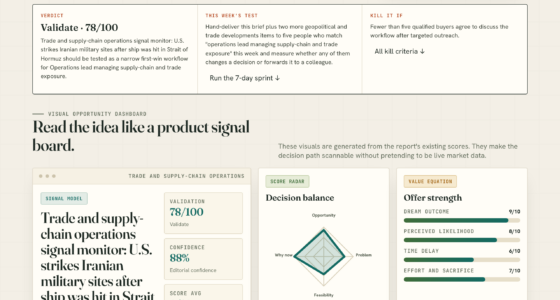

📊 Full opportunity report: The Timeline Of China’s Four Frontier AI Models Launch In Record Time on ThorstenMeyerAI.com — validation score, market gap, and execution plan.

Get the latest gadgets delivered free with Prime
- Fast, free delivery on millions of items
- Prime Video, Amazon Music and more included
- Member-only deals all year
TL;DR
In just eight weeks, Chinese AI labs launched four frontier-class open-weight models, demonstrating an accelerated development pace. This timeline influences global AI development strategies and competitiveness.
Chinese labs have released four frontier-class open-weight AI models in roughly eight weeks, from late April to mid-June 2026, demonstrating an accelerated development timeline. This sequence of launches highlights China’s ongoing efforts in AI research and development, with potential implications for global competitiveness and open-source AI initiatives.
Starting with DeepSeek V4 on April 24, followed by MiniMax M3 on June 1, and then Kimi K2.7-Code and GLM-5.2 within days of each other in mid-June, Chinese laboratories have exhibited a rapid development cycle. All four models are available for download, with most under permissive licenses similar to MIT, and offered at prices lower than Western API services when hosted independently.
DeepSeek V4 Pro, the leading Chinese open-weight model as of July 2026, achieved a score of 87 on BenchLM’s rankings, placing it close to the top proprietary models at 93. This positions it as one of the most capable open-weight models, approaching the performance of closed models. Chinese organizations such as Z.ai, Moonshot, and Alibaba have each introduced models targeting different aspects of AI performance, including cost efficiency, long-term stability, and accessibility.
Meanwhile, the Western open-weight AI landscape has experienced slower progress, with projects like Meta’s models and Ai2’s Olmo 3 trailing behind Chinese counterparts in raw capability. The recent release pattern from China indicates a strategic focus on rapid iterative improvements, influenced by hardware constraints and export policies, aiming to establish a leading position in the AI infrastructure.
Four Frontier-Class Open Models in Eight Weeks
China’s Release Cadence Is the Story
Same-day-verified market pulse · July 13, 2026
The production line — spring 2026
The board this week — BenchLM overall score, July 2026
Gift & complication — the European read
The gift
Frontier-adjacent capability, permissive licenses, weeks-long refresh cycle. This cadence is what makes serious on-premises AI economically thinkable in 2026.
The complication
Still a dependency — geopolitical, not technical. Hosted Chinese APIs fall under Chinese data law; many Western agencies won’t touch the weights at all. Licensing generosity is a policy, not a law of nature.
The signal: if your infrastructure strategy assumes open models improve slowly, it’s already wrong. If it assumes the current licensing generosity is permanent, it’s unhedged.
Implications for Global AI Development and Strategy
The accelerated release cycle of Chinese frontier AI models suggests a notable shift in the AI development environment. It makes advanced open-weight AI models more accessible and potentially more cost-effective for self-hosted deployments, especially in regions seeking autonomous AI solutions.
However, this rapid pace also raises considerations related to geopolitical factors and dependency. Western organizations and governments often exercise caution with Chinese-origin models due to data sovereignty laws and export restrictions, which can limit their deployment in sensitive or regulated contexts. The development reflects a broader strategic competition for leadership in AI technology, with China making significant progress in closing the gap with proprietary models.
open-weight AI models for download
As an affiliate, we earn on qualifying purchases.
As an affiliate, we earn on qualifying purchases.
Rapid Chinese AI Model Releases Reshape Global Benchmarks
Over the past two years, China’s open-weight AI efforts have been concentrated among a few key labs, including DeepSeek, Z.ai, Moonshot, and Alibaba. Their focus has been on developing capable, affordable, and licensable models suitable for self-hosting. The recent series of releases marks a notable increase in development speed, driven by hardware shortages, export restrictions, and strategic objectives to establish dominance in AI infrastructure.
Before 2026, Western efforts such as Meta’s open models and Ai2’s Olmo 3 advanced more slowly and with less aggressive licensing strategies. Chinese models like DeepSeek V4, which contains 1.6 trillion parameters but activates only a subset at a time, exemplify a focus on cost-effective deployment through incremental improvements.
This surge in Chinese AI development occurs amid geopolitical tensions and export controls, prompting strategic efforts to position China as a leader in open-weight AI models.
“The cadence of Chinese AI model releases is notable, reflecting a consistent development pipeline rather than isolated launches.”
— an anonymous researcher
As an affiliate, we earn on qualifying purchases.
Uncertainties About Long-term Impact and Export Policies
The sustainability of this rapid release schedule remains uncertain, as export controls, licensing frameworks, and geopolitical factors could influence future development. Restrictions may limit the ability of Chinese models to maintain their current pace or reach certain markets.
Additionally, deploying these models in sensitive or regulated environments is often constrained by data sovereignty laws and international restrictions, particularly in Western countries. The long-term effects on global AI leadership and sovereignty will depend on evolving policies and technological developments.
As an affiliate, we earn on qualifying purchases.
Next Steps in Monitoring Chinese AI Development and Global Response
Upcoming releases and benchmarking efforts from Chinese laboratories are anticipated to further define their position in open-weight AI. Western and other regional initiatives may respond with increased development activity, licensing strategies, or deployment approaches.
Changes in export regulations and data sovereignty policies will also influence how these models are adopted internationally. Observers will monitor whether the current development pace continues or if external factors slow progress.
AI model licensing and licensing tools
As an affiliate, we earn on qualifying purchases.
As an affiliate, we earn on qualifying purchases.
Key Questions
Why are Chinese AI models releasing so quickly in 2026?
The rapid release schedule is influenced by hardware limitations, strategic objectives to establish AI leadership, and responses to export restrictions, enabling China to accelerate its development efforts.
Can Western companies or governments use these Chinese models?
While the models are often available for download and legally accessible, many Western entities are cautious about deploying Chinese-origin models due to data privacy laws, export restrictions, and geopolitical considerations, which can limit their use in certain contexts.
What does this mean for AI sovereignty in Europe?
The swift development of Chinese open-weight models supports the feasibility of self-hosted AI solutions, which may benefit regional efforts toward AI sovereignty. However, dependencies and legal restrictions remain significant factors.
Will this rapid release cycle continue beyond 2026?
The continuation of this pace is uncertain, as it depends on factors such as policy changes, hardware availability, and geopolitical dynamics. Current trends suggest ongoing development, but external influences could alter the trajectory.
How does this affect the global AI race?
China’s recent model releases are contributing to a narrowing of the gap with Western proprietary models, influencing the competitive landscape and the distribution of AI development leadership worldwide.
Source: ThorstenMeyerAI.com
Halloween Picks
halloween
As an affiliate, we earn on qualifying purchases.