📊 Full opportunity report: Liquid vs Air Cooling for 24/7 Inference Rigs on ThorstenMeyerAI.com — validation score, market gap, and execution plan.
TL;DR
For 24/7 AI inference rigs, air cooling generally offers greater reliability, lower cost, and quieter operation than liquid cooling. Liquid cooling is advantageous only for extreme thermal headroom or space constraints.
For continuous AI inference rigs operating 24/7, air cooling is generally favored over liquid cooling due to its superior reliability, lower total cost of ownership, and quieter operation, according to industry testing and expert analysis.
Most high-performance, unattended AI inference systems benefit from air cooling, which has fewer failure points and requires minimal maintenance. Quality dual-tower air coolers can dissipate 200–250W, sufficient for many CPUs under sustained load, and are warrantied for years, with no fluid or pump to fail.
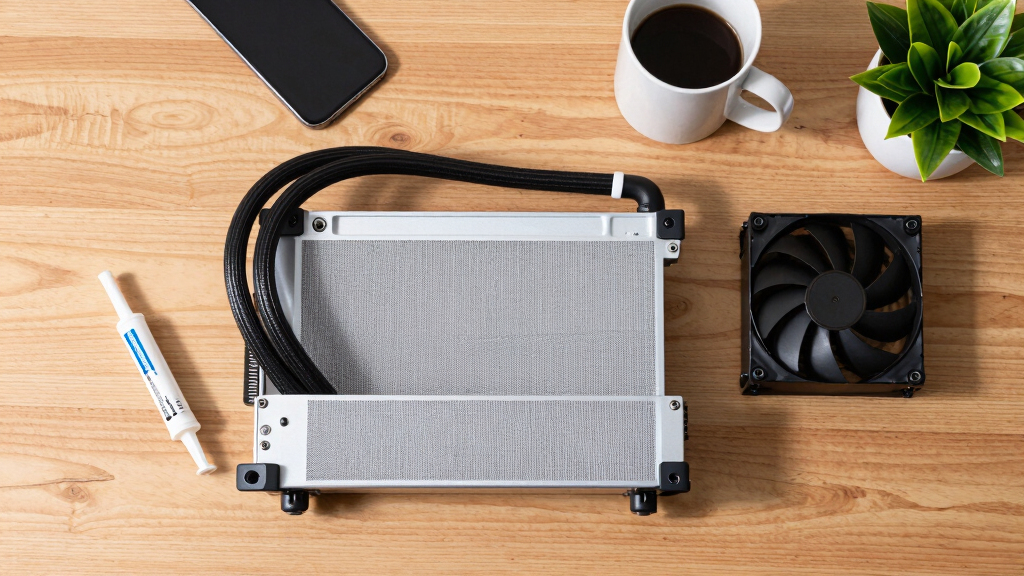
Liquid cooling, specifically all-in-one (AIO) units, offers higher thermal headroom—handling up to approximately 360W with larger radiators—and is advantageous in compact cases or environments where heat export outside the case is desirable. However, AIOs contain a pump, which is a single point of failure, and their coolant can degrade over time, typically lasting 5–7 years, with leaks being rare but possible.
Cost analysis shows air cooling is significantly cheaper over the lifespan of the system, often costing 2–3 times less than liquid solutions when factoring in replacement and maintenance. Noise levels also favor air coolers, which tend to operate more quietly under sustained load, as they lack the constant pump hum characteristic of AIOs.
Liquid vs air
for a 24/7 inference rig.
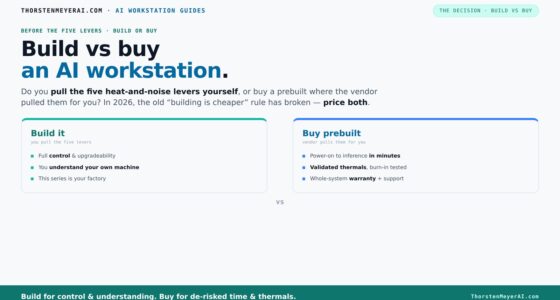
For an always-on machine the question isn’t “which cools better” — it’s which one still works in three years without you thinking about it. That reframing makes air the default for most rigs. Answer three questions in Part 2 to find yours.
- Nothing to fail — fan swaps in minutes
- Lasts a decade+; lower total cost
- Quieter floor — no pump hum (~40–45 dBA)
- Trivial maintenance — wipe & repaste
- Tall — can block RAM, dumps heat in case
- Best headroom — ~360W TDP sustained
- Compact block — fits tight cases, clears RAM
- Exports heat out the radiator & room
- Pump fails at 5–7 yrs; replace whole unit
- Costs 2–3× more over its life; pump hum
- You run it 24/7 and want set-and-forget.
- Your CPU is mainstream-to-high-end (or power-capped).
- A big tower fits your case.
- You value lower cost and a quieter floor.
- Your CPU is too hot for air under sustained all-core load.
- A big tower won’t fit (compact / multi-GPU case).
- You need to export heat out of a warm room.
- RAM clearance is tight.
Why Reliability and Cost Are Critical for 24/7 AI Rigs
For AI inference systems that run continuously, reliability and low maintenance are paramount. Air cooling's simplicity means fewer failures and lower long-term costs, making it the preferred choice for unattended operation. While liquid cooling can handle higher thermal loads, its potential for pump failure and coolant degradation pose risks that are unacceptable in long-term, unmanaged deployments.

Cooler Master Hyper 212 Black CPU Air Cooler, 4 Heat Pipes, PWM Fan
- Compatible with R7 and i7: Four heat pipes for optimal cooling
- Quiet PWM Fan: SickleFlow 120 Edge with dynamic control
- Easy Installation: Redesigned brackets for AM5 and LGA 1700
As an affiliate, we earn on qualifying purchases.
As an affiliate, we earn on qualifying purchases.
Evolution of Cooling Solutions for Continuous AI Operations
Historically, liquid cooling was seen as the superior option for high-performance systems, especially in constrained spaces or for overclocked CPUs. Recent testing and industry consensus, however, show that for systems intended to run 24/7 without intervention, air cooling offers comparable performance with fewer risks. The focus has shifted from peak thermal performance to reliability and total cost of ownership, especially as AI workloads become more prevalent and systems are deployed in diverse environments.
"For unattended, always-on inference rigs, air cooling's reliability and simplicity outweigh the thermal advantages of liquid cooling."
— Thorsten Meyer, AI hardware expert

CORSAIR Nautilus 360 RS Liquid CPU Cooler – 360mm AIO – Low-Noise – Direct Motherboard Connection – Daisy-Chain – Intel LGA 1851/1700, AMD AM5/AM4 – 3X RS120 Fans Included – Black
- High-Performance All-in-One Cooling: Strong, low-noise CPU cooling
- Quiet Pump Operation: Whisper-quiet 20 dBA coolant circulation
- Optimized Cold Plate: Convex design with pre-applied thermal paste
As an affiliate, we earn on qualifying purchases.
As an affiliate, we earn on qualifying purchases.
Remaining Questions About Long-Term Liquid Cooling Durability
While modern AIO liquid coolers are considered reliable, there is limited data on their performance over a decade of continuous operation, especially regarding coolant degradation and seal integrity. The actual lifespan can vary based on usage conditions and quality of the unit.
Leaks are rare but possible, and the impact of coolant permeation over many years remains an open question. Additionally, the availability of replacement parts and repair options for liquid coolers is limited, which could influence long-term maintenance strategies.
quiet 24/7 AI inference cooling system
As an affiliate, we earn on qualifying purchases.
As an affiliate, we earn on qualifying purchases.
Future Developments in Cooling for AI Inference Systems
Industry testing and real-world deployments will continue to clarify the long-term reliability of liquid cooling in unattended systems. Manufacturers may introduce more durable, repairable AIOs or hybrid solutions combining the benefits of both approaches. Meanwhile, system builders are advised to prioritize air cooling for most 24/7 inference rigs, reserving liquid solutions for specific cases where thermal headroom or space constraints outweigh reliability concerns.

Wathai 4 x 120mm GPU Mining Rigs Server Racks Fan with 110V - 240V AC Plug
- Quiet ventilation fan: Suitable for electronics and appliances
- Variable speed control: Adjust fan speed from 4V to 12V
- Universal voltage: Operates from 110V to 240V AC
As an affiliate, we earn on qualifying purchases.
As an affiliate, we earn on qualifying purchases.
Key Questions
Is liquid cooling worth the extra cost for 24/7 AI inference rigs?
Generally, no. For most unattended systems, air cooling offers comparable performance with greater reliability and lower total cost of ownership.
How often do liquid coolers need maintenance or replacement?
Most AIO liquid coolers are designed to last 5–7 years under continuous operation, but coolant degradation and seal wear can reduce effectiveness over time, and leaks, while rare, are possible.
Can air cooling handle the thermal demands of high-end CPUs in inference rigs?
Yes. High-quality dual-tower air coolers can dissipate enough heat for most CPUs under sustained load, making them suitable for most 24/7 workloads.
What are the main risks associated with liquid cooling in unattended systems?
The primary risks are pump failure, coolant leaks, and gradual degradation of the loop, which can lead to system downtime or damage if not monitored or replaced proactively.
Source: ThorstenMeyerAI.com