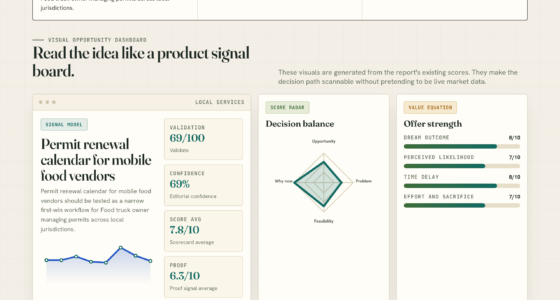

📊 Full opportunity report: When One Agent Isn’t Enough: Claude Now Builds Its Own Team of Agents on the Fly on ThorstenMeyerAI.com — validation score, market gap, and execution plan.

Get the latest gadgets delivered free with Prime
- Fast, free delivery on millions of items
- Prime Video, Amazon Music and more included
- Member-only deals all year
TL;DR
Claude has introduced a new feature called dynamic workflows, enabling it to create and coordinate multiple subagents automatically for complex tasks. This development addresses limitations of single-agent execution and aims to improve handling of high-value, long-term projects. The capability is currently targeted at complex workflows and is not advised for simple tasks.
Claude has introduced a new feature called dynamic workflows, which allows the AI to build and orchestrate its own team of subagents on the fly. This development aims to address the limitations of single-agent operation in complex, high-value tasks, marking a significant step in AI orchestration capabilities.
The feature, named dynamic workflows, enables Claude to generate custom orchestration scripts—small JavaScript programs—that spawn, coordinate, and manage multiple subagents. These subagents can operate with different models, run in isolated workspaces, and work in parallel to improve task performance.
According to Anthropic, this approach is particularly useful for complex workflows such as large-scale research, fact-checking, or code refactoring, where a single agent might underperform due to limitations like goal drift, bias, or incomplete context. The system can decide which model to assign to each subtask, and it can resume interrupted workflows, making it adaptable for ongoing projects.
When one agent isn’t enough: Claude now builds its own team on the fly
Skills package what you know; loops decide how far you delegate over time. Dynamic workflows are the third axis — within a single task, Claude writes its own harness and assembles a temporary team of subagents. Think of it as Claude drawing an org chart for one job.
The shift is from prompting a worker to commissioning a team — more output, more cost, and a manager’s judgment required. Reach for a workflow when a task is big, parallel, adversarial, or judgment-heavy — and when you can feel a single agent getting lazy, grading its own homework, or losing the plot. Bound it (token budgets, pilot first) — workflows can spawn hundreds of agents and burn far more tokens. For everything else, don’t hire five people to change a lightbulb.
Implications for Complex AI-Driven Workflows
This development enhances AI’s capacity to handle complex, multi-step projects that require coordination among specialized subagents. It reduces the risk of errors caused by agent laziness, bias, or goal drift, which are common in single-agent setups. For organizations relying on AI for high-stakes tasks, this could lead to more reliable and efficient outcomes, especially in research, software development, and quality assurance processes.
As an affiliate, we earn on qualifying purchases.
Evolution of Multi-Agent AI Strategies
Previously, AI models like Claude operated as single agents, executing tasks within a fixed context window. Limitations such as partial completion, self-bias, and goal drift hindered performance on long or complex projects. Anthropic’s recent innovations, including skills packages and looped workflows, have progressively advanced AI orchestration. The latest step, dynamic workflows, completes this trajectory by enabling Claude to autonomously assemble and manage its own team of subagents tailored to specific tasks.
This feature builds on prior work to modularize and delegate work, similar to how a human team lead might assign specialists to different parts of a project, but now fully automated within the AI system itself.
“Dynamic workflows allow Claude to write its own harness—custom-built orchestration scripts—that can spawn and coordinate subagents tailored to complex tasks.”
— Thorsten Meyer, AI researcher at Anthropic
multi-agent AI orchestration software
As an affiliate, we earn on qualifying purchases.
As an affiliate, we earn on qualifying purchases.
Limitations and Current Constraints of the Feature
It is not yet clear how widely this feature will be adopted outside of testing environments, or how it performs in real-world, high-stakes scenarios. Anthropic has cautioned that the system uses significantly more tokens and is suited for complex tasks, not simple fixes like typo corrections. Details about performance metrics, safety controls, and scalability are still emerging.
JavaScript automation scripts for AI
As an affiliate, we earn on qualifying purchases.
As an affiliate, we earn on qualifying purchases.
Next Steps for Deployment and Evaluation
Anthropic plans to continue testing and refining the dynamic workflows feature, with potential rollout to select enterprise clients. Further research will evaluate its effectiveness in various domains, and safety mechanisms will be assessed to prevent unintended behaviors. The company may also explore integrating user controls to customize team composition and task orchestration.
As an affiliate, we earn on qualifying purchases.
Key Questions
How does Claude build its own team of agents?
Claude writes a small JavaScript program, called a workflow, which specifies how to spawn, coordinate, and manage multiple subagents tailored to the task at hand. This allows it to dynamically assemble a team with specialized roles.
What types of tasks benefit most from dynamic workflows?
Complex, multi-step projects such as research synthesis, fact-checking, code refactoring, and large-scale verification processes are prime candidates, where single-agent approaches often underperform.
Is this feature ready for general use?
Not yet. It is currently in testing and intended for high-value, complex workflows. Anthropic has cautioned that it uses more tokens and is not suited for simple tasks like fixing typos.
Does this improve AI safety or reliability?
By dividing tasks among specialized subagents and including independent verification, it has the potential to reduce errors like goal drift and bias, thereby improving reliability in complex projects.
Source: ThorstenMeyerAI.com
Columbus Day / Indigenous Peoples' Day Picks
long weekend sales
As an affiliate, we earn on qualifying purchases.