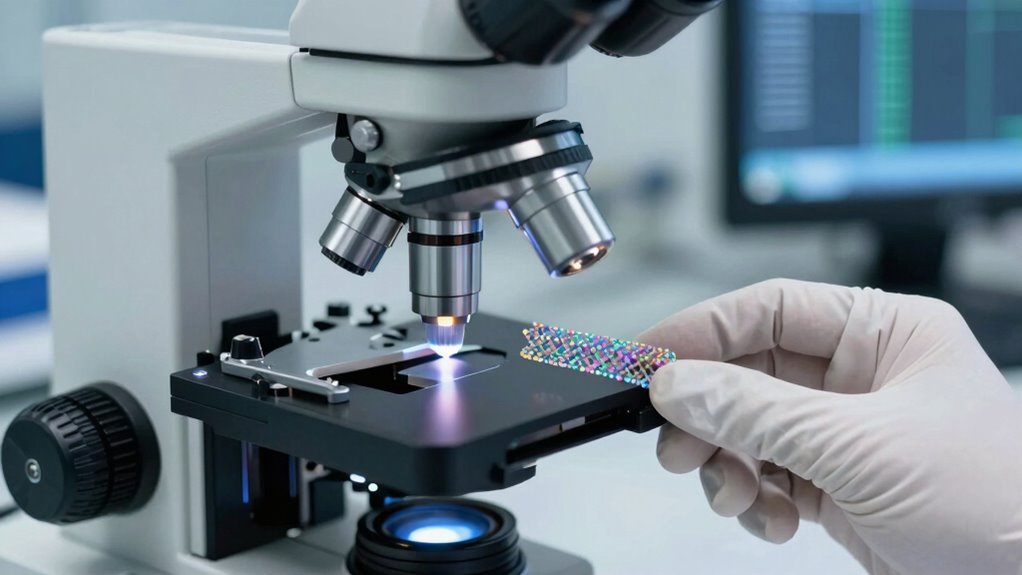

Scaling nanotech from lab to market is challenging because you must navigate regulatory hurdles, which often move slowly and require extensive safety data. Manufacturing consistency becomes tougher at larger scales, as controlling material properties consistently is difficult. You also need to develop scalable processes and quality controls to guarantee reliability. Balancing innovation with patience and compliance is essential for success. Keep exploring to understand the strategies that can help you overcome these obstacles effectively.

Get the latest gadgets delivered free with Prime
- Fast, free delivery on millions of items
- Prime Video, Amazon Music and more included
- Member-only deals all year
Key Takeaways
- Scaling introduces technical and logistical challenges that can compromise nanomaterial consistency and product performance.
- Regulatory approval processes are slow and complex, requiring extensive safety and efficacy data for larger-scale production.
- Maintaining manufacturing precision at scale is difficult due to variations in raw materials and environmental conditions.
- Collaboration with regulators and development of scalable processes are essential to bridge lab success and market readiness.
- Innovation must be paired with patience, rigorous quality control, and process refinement to ensure reliable, market-ready nanotech products.

Have you ever wondered why groundbreaking nanotechnologies often struggle to reach the market? The journey from a lab breakthrough to a commercial product isn’t straightforward. It’s riddled with challenges, especially around regulatory hurdles and manufacturing consistency. While scientists might perfect a new nanomaterial or device in controlled environments, scaling that success for mass production introduces a new set of obstacles.
Regulatory hurdles are among the most significant barriers. Governments and international bodies are cautious about nanotech’s unpredictable risks, which means traversing complex approval processes. These regulations often lag behind technological advancements, leaving innovators in a gray zone where approval can take years, if it comes at all. You’ll find that demonstrating safety and efficacy at a small scale doesn’t automatically translate to approval for larger-scale manufacturing. You need thorough data, rigorous testing, and often, a lot of patience. This lengthy process can dampen enthusiasm and slow down innovation, especially when the regulatory landscape isn’t clear or consistent across regions.
Regulatory hurdles delay nanotech approvals, requiring extensive data and patience amid unclear global standards.
Manufacturing consistency presents another formidable challenge. In the lab, you can produce nanomaterials with remarkable precision, controlling size, shape, and surface properties. But when you move to production lines, maintaining that level of control becomes exponentially harder. Variations in raw materials, equipment calibration, and environmental factors can lead to inconsistencies. These fluctuations can impact the performance and safety of nanotech products, making quality assurance a persistent headache. You need robust, scalable processes that guarantee each batch meets strict standards. Without this consistency, even the most promising nanotech innovations struggle to gain trust from manufacturers, investors, and end-users.
Bridging the gap between lab success and market readiness involves addressing both these issues simultaneously. You have to work closely with regulators, providing the necessary safety and efficacy data while advocating for clearer guidelines. Simultaneously, you need to develop manufacturing techniques that are both scalable and capable of producing uniform products. This often means investing in new equipment, refining processes, and establishing rigorous quality control protocols.
Ultimately, translating nanotechnology from the lab to the marketplace isn’t just about scientific breakthroughs; it’s about traversing complex regulatory landscapes and establishing reliable manufacturing processes. You, as an innovator, must stay adaptable, patient, and diligent. Only then can you turn revolutionary nanotech ideas into tangible products that reach consumers and truly make an impact.
nanotech safety testing equipment
As an affiliate, we earn on qualifying purchases.
As an affiliate, we earn on qualifying purchases.
Frequently Asked Questions
What Are the Primary Safety Concerns in Scaling Nanotech?
You should be aware that primary safety concerns when scaling nanotech include environmental risks and toxicity concerns. As you expand production, nanomaterials may pose hazards to ecosystems if released, and their small size can lead to unexpected health impacts in humans. Ensuring proper containment and thorough testing helps mitigate these risks. Being proactive about safety measures is essential to prevent environmental damage and protect worker health during scale-up.
How Do Regulatory Frameworks Impact Nanotech Commercialization?
Imagine trying to navigate a maze filled with towering walls—regulatory hurdles block your path at every turn. These frameworks shape how quickly you can bring nanotech to market, demanding strict safety and environmental compliance. Your compliance strategies must adapt to evolving rules, ensuring safety without stalling innovation. Ultimately, robust regulatory frameworks can both challenge and propel your efforts, guiding responsible growth and fostering public trust in your groundbreaking nanotech solutions.
What Are the Most Promising Industries for Nanotech Application?
You’ll find nanotech most promising in industries like healthcare, electronics, and energy, where nanomaterials innovation drives breakthroughs. Nano-enabled sensors revolutionize diagnostics and environmental monitoring, offering real-time data and higher precision. In electronics, nanotech enhances device performance and miniaturization. Energy sectors benefit from nanomaterials for better storage and efficiency. These applications demonstrate nanotech’s vast potential to transform industries, making them more efficient, sustainable, and innovative.
How Can Funding Be Secured for Large-Scale Nanotech Production?
Think of securing funding like planting a mighty oak—start with strong roots. You should explore diverse investment strategies, including government grants, venture capital, and corporate funding. Partnership opportunities act as sunlight, helping your project grow. Building alliances with industry leaders and research institutions boosts credibility and attracts investors. By nurturing these relationships, you create a solid foundation for large-scale nanotech production, ensuring your innovation reaches the market successfully.
What Skills Are Needed for a Successful Nanotech Startup?
You need strong Nanotech innovation skills and effective startup leadership to succeed. Focus on mastering technical expertise in nanomaterials and fabrication techniques, while also developing business acumen, such as fundraising, marketing, and scaling operations. Leadership qualities like adaptability, vision, and team management are essential. By balancing technical prowess with strategic oversight, you’ll navigate challenges and turn your nanotech ideas into market-ready solutions.
nanomaterial quality control tools
As an affiliate, we earn on qualifying purchases.
As an affiliate, we earn on qualifying purchases.
Conclusion
As you stand at the edge of this nanotech frontier, the path from lab discoveries to market dominance remains shrouded in uncertainty. The hurdles are formidable, but imagine the breakthroughs hiding just beyond the horizon—products that revolutionize industries, change lives, and redefine what’s possible. Will you be the one to reveal these secrets? The journey is complex, but the potential is extraordinary. The question isn’t if you’ll succeed, but when—and what you’ll expose next.
scalable nanomaterial manufacturing equipment
As an affiliate, we earn on qualifying purchases.
As an affiliate, we earn on qualifying purchases.
nanotech regulatory compliance software
As an affiliate, we earn on qualifying purchases.
As an affiliate, we earn on qualifying purchases.
Fall Picks
fall essentials
As an affiliate, we earn on qualifying purchases.