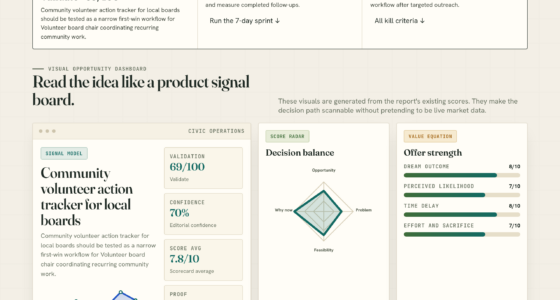

📊 Full opportunity report: Évian and the Fallout: What Europe Actually Wants From Amodei, Hassabis, and Altman on ThorstenMeyerAI.com — validation score, market gap, and execution plan.

Get the latest gadgets delivered free with Prime
- Fast, free delivery on millions of items
- Prime Video, Amazon Music and more included
- Member-only deals all year
TL;DR
At the June 17 G7 summit in Évian, European leaders outlined six key demands from US AI firms, seeking reliable access, sovereignty, and safety assurances amid US export restrictions. The summit marked a significant step toward coordinated AI policy.
European leaders and top US AI company executives met on June 17 at the G7 summit in Évian, France, in a rare gathering that underscored the growing importance of AI governance. The summit occurred five days after the US Commerce Department issued an export-control directive, forcing companies like Anthropic to shut down access to their most advanced models for foreign nationals. This event highlights Europe’s concerns over reliance on foreign AI models and the potential for US government actions to disrupt European access to critical technology.
The summit brought together representatives from major US AI labs—Anthropic, Google DeepMind, and OpenAI—and European and Asian AI firms, alongside political leaders from the US, France, Germany, and the UK. The core issue was the US export controls, which led to a global shutdown of certain AI models, raising fears over digital dependency and sovereignty in Europe. European officials expressed a desire for more control over AI infrastructure and access, emphasizing the importance of trust, sovereignty, and safety in AI deployment.
During the discussions, European leaders outlined six key demands: first, reliable and durable access to AI models; second, guarantees against future US-style kill switches; third, a trusted partners scheme for non-US entities; fourth, technological sovereignty through dedicated European AI infrastructure; fifth, a say in the physical location of data centers and infrastructure; and sixth, strict protections for children and youth from AI-related risks. These demands reflect Europe’s broader push for AI independence and regulation, contrasting with US approaches that prioritize innovation over regulation.
Évian and the fallout: what Europe actually wants
For the first time, Amodei, Hassabis, and Altman sat with heads of state — five days after Washington switched Anthropic’s models off worldwide. Europe’s question: can you rely on models a foreign cabinet can shut down by decree?
The dilemma: what Europe wants from the three CEOs, the three can’t deliver — because they don’t hold the switch, Washington does. Macron’s platform is the right answer, but no fix for a decade-old infrastructure gap. The only answer that doesn’t depend on someone else’s goodwill: your own models, your own compute, open weights you can self-host.
Europe’s Push for AI Sovereignty and Security
This summit signals a shift in global AI governance, with Europe seeking to reduce dependence on US-based models and establish its own standards for safety, trust, and infrastructure. If Europe’s demands are met, it could lead to a more fragmented global AI landscape, with regional controls replacing unified standards. The US, meanwhile, faces pressure to clarify its stance on export controls and international cooperation, affecting the future of AI development and deployment across borders.
European AI infrastructure servers
As an affiliate, we earn on qualifying purchases.
As an affiliate, we earn on qualifying purchases.
US Export Controls and Europe’s AI Dependence
In June 2024, the US Commerce Department issued directives that effectively forced Anthropic to cease providing its advanced models to foreign users, highlighting vulnerabilities in Europe’s AI ecosystem. This move came amid broader concerns over US dominance in AI technology and fears that reliance on foreign models could threaten national security and economic sovereignty. Europe’s response has been to push for a comprehensive strategy to build independent AI infrastructure and establish international cooperation frameworks, as part of its broader Technological Sovereignty Package announced earlier this year.
“It is in our mutual interest that European citizens and companies can safely use the best models, and that we have a say in where our data and infrastructure reside.”
— Ursula von der Leyen
As an affiliate, we earn on qualifying purchases.
Unclear Outcomes of Europe’s Demands and US Response
It remains uncertain whether the US and other AI powers will agree to Europe’s six key demands, especially regarding infrastructure control and export guarantees. The specifics of any formal agreements or commitments are still under negotiation, and the US has not yet clarified its stance on future export controls or cooperation frameworks. Additionally, the impact of these demands on ongoing AI innovation and global cooperation is still developing.
As an affiliate, we earn on qualifying purchases.
Next Steps in European-US AI Cooperation Negotiations
European leaders plan to establish a dedicated cooperation platform within a month, with a follow-up leaders’ summit scheduled for September to formalize agreements. Meanwhile, US authorities are expected to clarify their position on export controls and to engage in further discussions on AI infrastructure and trust frameworks. The broader goal is to reach a consensus that balances innovation, security, and sovereignty, shaping future international AI governance.
As an affiliate, we earn on qualifying purchases.
Key Questions
What are Europe’s main demands from US AI companies?
Europe seeks reliable access to AI models, guarantees against US-style kill switches, trusted partnership schemes, technological sovereignty through European infrastructure, a say in infrastructure placement, and protections for children and youth.
How did US export controls affect European AI access?
The US Commerce Department’s directive led to a shutdown of advanced AI models for foreign users, including European institutions, raising concerns over dependency and sovereignty.
What is the significance of the Évian summit for global AI governance?
It marks a move toward regionalized AI standards and cooperation, with Europe actively asserting its interests and seeking independence from US-dominated AI infrastructure.
Will the US agree to Europe’s demands?
It is currently unclear. Negotiations are ongoing, and US positions on export controls and infrastructure sovereignty remain to be clarified.
What are the implications for AI innovation if Europe gains more control?
Greater European sovereignty could lead to regional AI ecosystems, potentially fragmenting the global market but also fostering independent innovation and safety standards.
Source: ThorstenMeyerAI.com
Fall Picks
fall essentials
As an affiliate, we earn on qualifying purchases.