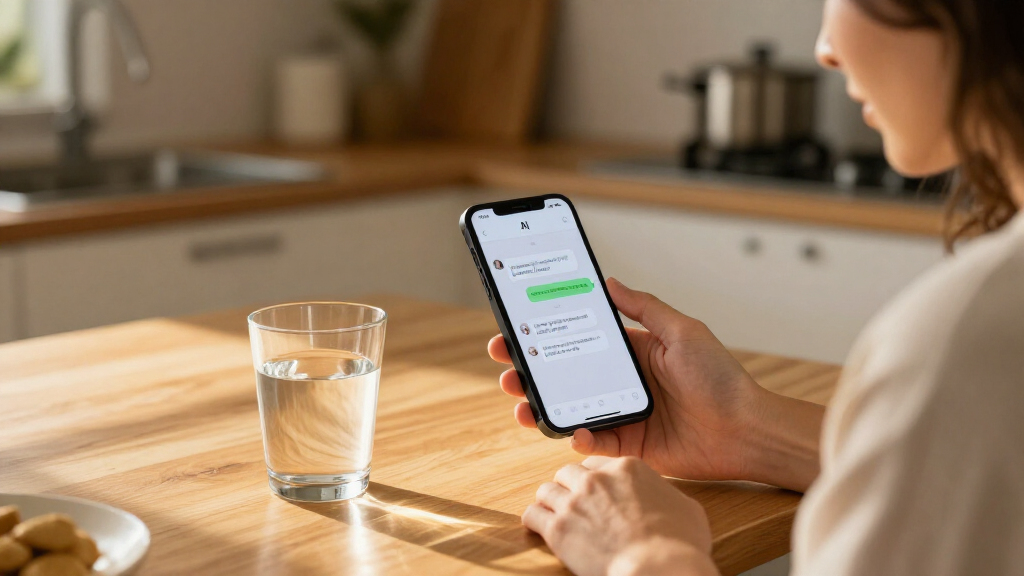

🔍 Read the full analysis: Apple’s New Study Tests The Idea Of Starting Health Questions With AI on ThorstenMeyerAI.com

Get the latest gadgets delivered free with Prime
- Fast, free delivery on millions of items
- Prime Video, Amazon Music and more included
- Member-only deals all year
TL;DR
Apple announced a U.S. research study on Nov. 15, 2026, to examine how people use and understand conversational AI for health questions. The study uses an iPhone app with answers from OpenEvidence and may enroll up to 200,000 adults; Apple says participation is voluntary and study data will not train AI models.
Apple announced the Apple Health AI Usage Study on Nov. 15, a U.S. research project using an iPhone app to examine how people interact with conversational artificial intelligence for health questions. The study, which may enroll up to 200,000 adults, will examine trust, response quality, comprehension and everyday health actions as consumer use of chatbots for health information grows.
The study is being conducted in collaboration with OpenEvidence, a clinical AI platform that Apple says is widely used by health professionals. Participants can ask everyday health questions, explore medical information in accessible language and see linked, peer-reviewed clinical citations with responses. Apple names sources such as The New England Journal of Medicine, the Journal of the American Medical Association and Nature as examples of established medical information used by the platform.
Apple says the research will look at what drives user trust, the quality of AI answers, whether users understand them and whether they affect everyday health actions. It will also examine whether participants can use AI to put personal health information in context or prepare for appointments with their own doctors. Sharing data from Apple’s Health app, including information such as resting heart rate, sleep or lab results, is optional.
Eligibility is limited to people aged 21 or older in the United States who have an Apple Intelligence-enabled iPhone—an iPhone 15 Pro or later—running iOS 26 or later. Apple says the study data will not be used to train AI models. CNET and MacRumors report that OpenEvidence deletes question-and-response data within 24 hours; that deletion detail is reported by those outlets, rather than stated in the supplied summary of Apple’s announcement.
Apple’s announcement describes the project as research, not a new Siri health feature. Its app listing names possible uses including understanding symptoms or conditions, interpreting personal health data, preparing for medical visits and creating personalized exercise or meal plans. Apple warns that the app is not intended to diagnose or treat a condition or replace advice from medical professionals.
Apple Health AI Usage Study · Nov 15, 2026
How a health question travels through Apple’s study app
From your iPhone to a cited answer and back, as Apple and reporting on its press briefing describe it.
The path of one question (schematic)
Six steps in the study app
- You askType an everyday health question; sharing Health data is optionalApple
- On the iPhoneTools remove details that could identify youas reported by CNET
- Study cloudA contractor’s environment delinks the question from your participant ID and screens it againas reported by CNET
- OpenEvidenceWrites the answer from clinical sources, with linked peer-reviewed citationsApple
- GuardrailCertain concerning questions: a suggestion to follow up with a provider or other resourcesApple; no live monitoring, CNET reports
- You rateRate each answer, plus a baseline survey and monthly surveysas reported by CNET
Source: Apple Newsroom, “Apple launches research study to explore the use of AI for health”, Nov 15, 2026; CNET and MacRumors reporting on Apple’s press briefing, Nov 15–16, 2026. Schematic, not the real app screen.
Graphic: Powered by Thorsten Meyer AI
What Apple Is Measuring
The project addresses a practical gap in current knowledge: people are already turning to chatbots for health information, but it is not clear how they interpret the responses or what they do afterward. A KFF poll published in March 2026 found that 32% of adults nationally said they had used AI chatbots for health information in the past year. That finding establishes a measure of reported use, but it does not show whether chatbot answers were accurate, helpful or acted upon.
Apple’s study could gather evidence about trust and comprehension in everyday use, rather than evaluating only a system’s technical performance. The questions matter because an answer can sound clear while still being incomplete, misunderstood or mistaken for a diagnosis. Apple itself says consumer health technologies powered by large language models may sometimes offer responses that are incomplete or unclear.
The study also touches on how people prepare for clinical care. If participants use AI to organize questions or make sense of information before an appointment, that could affect conversations with clinicians. But the project’s stated aims do not establish that AI improves care, replaces professional judgment or changes health outcomes. Those are questions the study may help investigate, not results already demonstrated.
Popular right now

De'Longhi Classic Signature Espresso Machine with Adjustable Milk Frother

Ninja Foodi DZ401 DualZone XL Air Fryer, 10 Qt, 6-in-1, Grey

De'Longhi La Specialista Arte Evo Semi-Automatic Espresso Machine with Grinder and Cold Brew
As an affiliate, we earn on qualifying purchases.
A Research Study, Not a Siri Feature
Apple describes the project as a virtual research study with an associated app, intended to inform responsible design of health AI experiences for Apple and the wider industry. The distinction matters: the announcement is about observing how participants interact with a research tool, not a release of a general-purpose health chatbot built into Apple’s assistant.
Apple Health AI Usage Study responses will be supplied by OpenEvidence. Apple says the platform generates answers from medical information from established sources, while OpenEvidence says on its own website that it has content agreements with organizations including NEJM, JAMA, Nature, NCCN and Cochrane. Citations provide a route to the referenced material, but their presence alone does not establish that every answer is correct or suitable for an individual patient.
Some details about how participation works come from media reports of an Apple briefing rather than the announcement described in the source material. CNET reports that participants rate each answer and provide feedback, complete a baseline survey and receive monthly surveys, with additional surveys related to preparing for doctor visits. CNET also says each person may be asked to participate for up to 12 months. TechCrunch reports that Apple aims to run the study for more than 12 months, which may refer to the overall study rather than each participant.
““Conducting a dedicated research study is the most thoughtful way to understand how people engage with, comprehend, and evaluate health AI in everyday life.””
— Sumbul Desai, Apple’s vice president of Health and Fitness
Study Terms and Outcomes Remain Open
Apple’s announcement, as summarized in the source material, does not give a firm overall study end date. Media accounts differ in emphasis: CNET reports participation of up to 12 months for each person, while TechCrunch says the study is intended to run for more than 12 months. Those descriptions could refer to different timelines, but the available information does not resolve that point.
It is also not clear how many people have enrolled, when recruitment will close, how results will be published or whether findings will be independently reviewed. The study’s aims are not its outcomes: there are no reported findings yet on whether participants trust the answers, understand them or change their behavior.
Apple says sharing Health app data is optional and that study data will not be used to train AI models. The supplied material does not specify all data-handling terms, how long Apple retains study information, or exactly what information is shared with OpenEvidence. The reported 24-hour deletion of question-and-response data is attributed to CNET and MacRumors, not presented here as a direct Apple statement.
Enrollment and Study Findings
The immediate next step is participant enrollment among eligible U.S. adults using supported iPhones and software. Apple has set a maximum of 200,000 participants, but the announcement details in the source material do not state how many places are already filled or provide a recruitment deadline.
As participation proceeds, the app and surveys are intended to collect feedback about AI responses and how people use them, including when preparing for medical visits. The study may run beyond a year overall, while individual participation may last up to 12 months, according to reporting by TechCrunch and CNET respectively. Apple has not provided a publication schedule for results in the information supplied.
Until findings are available, the announcement should be read as a plan to study consumer use, not evidence that conversational AI is safe or effective for making personal health decisions. Apple’s stated warning remains that the app is not a substitute for professional medical advice.
Key Questions
What is Apple’s Health AI Usage Study?
It is a virtual U.S. research study with an iPhone app that Apple says is designed to examine how people interact with conversational AI tools for health questions.
Who is eligible to participate?
Apple says participants must be at least 21 and in the United States, with an iPhone 15 Pro or later that supports Apple Intelligence and runs iOS 26 or later. The study may accept up to 200,000 people.
Who provides the study’s AI answers?
Apple says the study is conducted with OpenEvidence, a clinical AI platform. Responses include linked, peer-reviewed clinical citations, according to Apple’s description.
Does the study use personal Health app data?
Participants may choose to share Health app information, such as resting heart rate, sleep or lab results. Apple says this sharing is optional and that study data will not be used to train AI models.
Can the app diagnose a health problem?
No. Apple says the app is not intended to diagnose or treat conditions or replace advice from medical professionals. The study has not yet reported findings showing that its AI answers improve health outcomes.
Source: ThorstenMeyerAI.com