
📊 Full opportunity report: Benefit Check Bot Insights For Public Benefits And Social Care Tech on IdeaNavigator AI — validation score, market gap, and execution plan.
Open a free Amazon Business account
Business pricing, bulk buying and tax-exempt orders.
Create a free accountAs an affiliate, we earn on qualifying purchases.
TL;DR
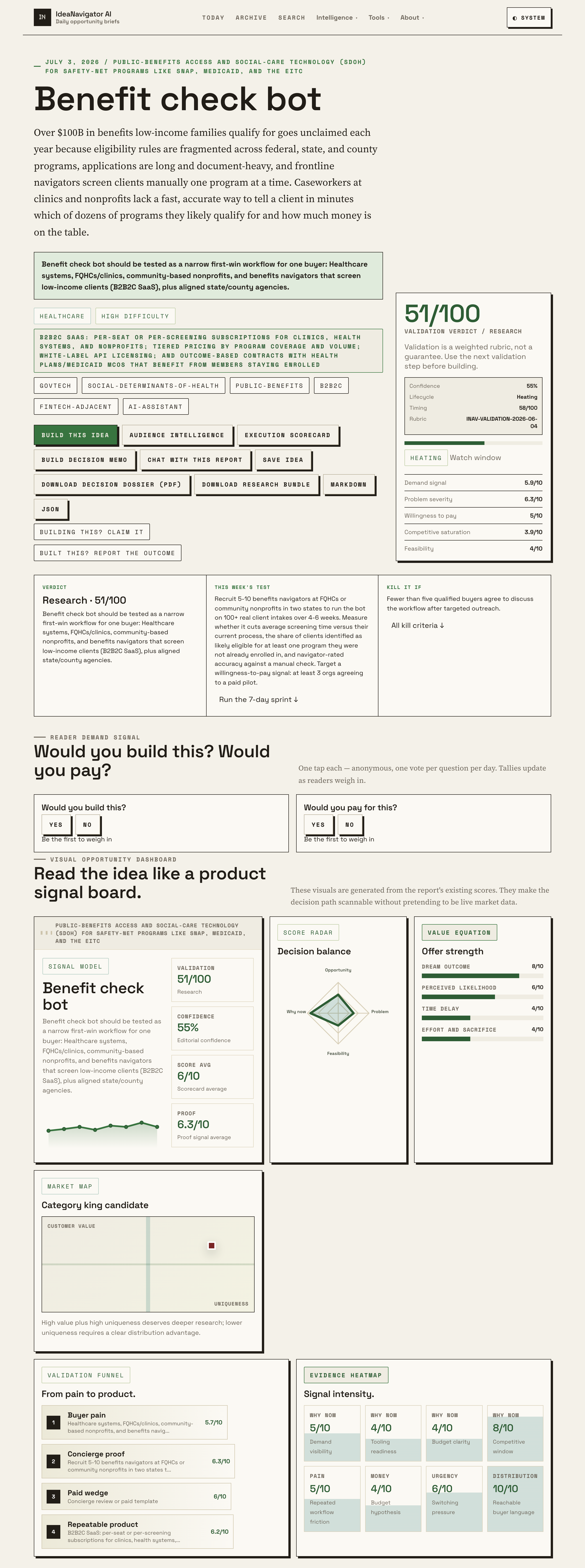
A new AI-powered benefits screening bot is being tested by clinics and nonprofits to streamline eligibility checks for programs like SNAP and Medicaid. This innovation aims to reduce manual screening time and increase access to benefits for low-income families, addressing a significant gap after a major nonprofit closure.
A conversational benefits screening bot is currently being tested by healthcare providers and community organizations to streamline eligibility assessments for public benefit programs. This development aims to address a long-standing challenge of efficiently connecting low-income families with benefits such as SNAP, Medicaid, and EITC. The initiative responds to the recent shutdown of a major nonprofit that historically provided benefits screening across seven states, creating a gap in capacity that health systems and local agencies now seek to fill.
The pilot involves a white-label, AI-powered chatbot that can be embedded on clinic websites or used via SMS, asking clients a short series of yes/no and multiple-choice questions to estimate eligibility for dozens of programs. It returns a list of likely-eligible benefits, including dollar estimates for programs like SNAP, Medicaid, WIC, LIHEAP, and EITC, along with next-step application links and required documents. The initial rollout focuses on two states, with plans to expand based on pilot results.
Developed by a team aiming to create a low-cost, scalable solution, the bot is designed to be used by benefits navigators and frontline staff, reducing manual screening times from hours to minutes. The system logs anonymized screening data for organizational dashboards, allowing agencies to monitor outcomes and improve workflows. The pilot will evaluate whether the tool reduces screening time, increases benefit identification, and maintains accuracy compared to manual checks.
The initiative is part of a broader market effort to improve access to public benefits and social determinants of health (SDOH) programs, which are often underutilized due to complex eligibility rules and cumbersome application processes. The pilot’s success could demonstrate a new model for integrating conversational AI into benefits access workflows, potentially transforming how low-income populations are served.
Potential Impact on Benefits Access Efficiency
This pilot could significantly improve the efficiency and accuracy of benefits eligibility screening, reducing the administrative burden on clinics and nonprofits. By automating initial assessments, the system may enable organizations to serve more clients faster and with fewer errors, increasing the likelihood that eligible families receive benefits they qualify for. This is especially relevant in the context of recent Medicaid redeterminations and the shutdown of a key benefits access nonprofit, which had been a major provider of screening services in multiple states.
Moreover, the technology could lead to broader adoption of AI-driven tools in social care, helping to close the gap in benefits access for vulnerable populations. If successful, it may influence policy and funding decisions around digital solutions for social determinants of health, emphasizing the importance of scalable, low-cost screening methods.
As an affiliate, we earn on qualifying purchases.
Background on Benefits Screening Challenges
For years, low-income families have faced complex eligibility rules across multiple federal, state, and local programs, with applications often requiring extensive documentation and manual processing. Traditionally, benefits navigators or caseworkers review each program individually, a process that can take hours per client and is prone to errors and missed opportunities.
In 2024, the shutdown of a nonprofit that provided benefits screening services across seven states created a significant capacity gap. That organization had been a critical partner for health systems and community nonprofits, helping to identify benefits worth over $100 billion annually that were going unclaimed. Simultaneously, the post-pandemic Medicaid ‘unwinding’ redeterminations have increased the workload for eligibility checks, further straining existing systems.
Recent advances in conversational AI and natural language processing have made it feasible to develop digital screening tools that operate at near-zero marginal costs, offering a promising solution to these longstanding challenges. The pilot aims to test whether such technology can be integrated into existing workflows and improve outcomes.
As an affiliate, we earn on qualifying purchases.
What Aspects of Effectiveness and Scalability Remain Unclear
It is still uncertain how accurately the chatbot will perform across diverse populations and regions, especially considering variations in program rules and client language needs. The pilot’s small scale means results are preliminary, and broader adoption will depend on demonstrated effectiveness and cost savings. Additionally, questions remain about long-term integration with existing case management systems and how data privacy will be maintained at scale.
Medicaid and SNAP eligibility software
As an affiliate, we earn on qualifying purchases.
As an affiliate, we earn on qualifying purchases.
Next Steps for Pilot Expansion and Evaluation
The pilot will run over the next 4-6 weeks with 5-10 benefits navigators testing the system on over 100 client intakes. Results will measure reductions in screening time, increases in benefits identified, and accuracy compared to manual checks. Pending positive outcomes, plans include scaling the tool to additional states and integrating it with broader health and social care platforms. Further research will explore long-term impacts on benefits uptake and client outcomes.
benefits application assistance software
As an affiliate, we earn on qualifying purchases.
As an affiliate, we earn on qualifying purchases.
Key Questions
How does the benefits check bot work?
The bot asks clients a series of simple yes/no and multiple-choice questions to estimate eligibility for multiple programs and provides benefit estimates and next steps.
Who can use this benefits screening tool?
Healthcare providers, community nonprofits, and benefits navigators can embed or use the tool to assist low-income clients in qualifying for benefits.
Will this replace human benefits navigators?
The tool is designed to augment, not replace, human staff by streamlining initial screening and allowing staff to focus on complex cases and application assistance.
What are the main challenges for scaling this technology?
Ensuring accuracy across diverse populations, integrating with existing systems, and maintaining data privacy are key challenges that will need to be addressed in future phases.
When will the results of the pilot be available?
Results are expected after the 4-6 week pilot period, with initial findings shared shortly thereafter to inform potential wider deployment.
Source: IdeaNavigator AI
Fall Picks
fall essentials
As an affiliate, we earn on qualifying purchases.