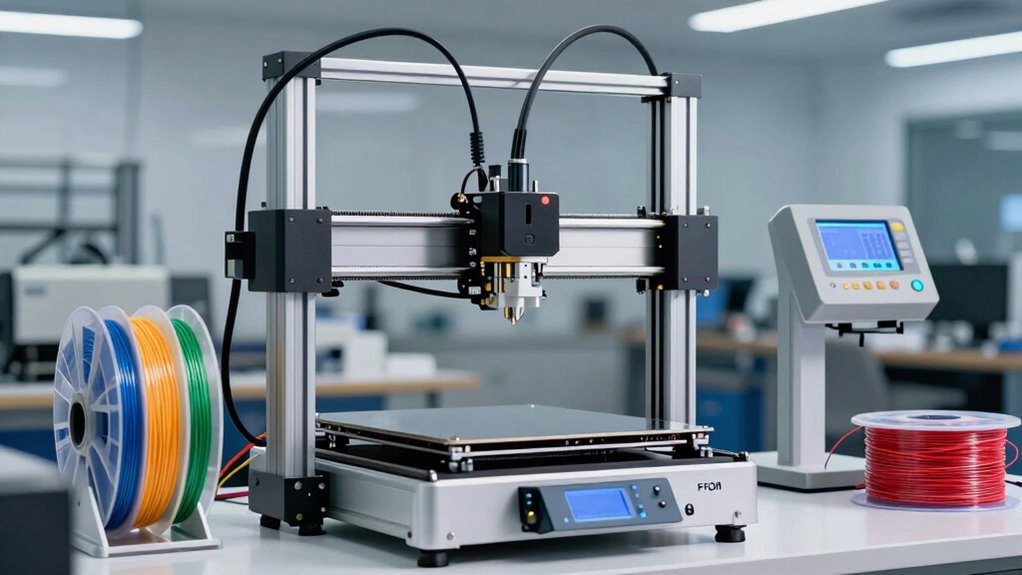
Before buying an industrial FDM printer, ask about its material compatibility to make certain it supports the plastics you need, like ABS or nylon. Check the feed system for reliability to avoid jams or inconsistencies. Consider how easy it is to maintain, replace parts, and calibrate. Think about scalability for future projects and current safety and energy features. If you want to make a well-informed choice, there’s more to explore that can help guide your decision.
Key Takeaways
- Does the printer support a wide range of materials, including engineering plastics and specialty filaments?
- Is the material feed system reliable and capable of preventing jams or uneven extrusion?
- What are the maintenance requirements, and how accessible are parts like nozzles and print beds?
- Can the machine be upgraded or scaled to handle larger or more complex projects in the future?
- How durable is the printer for long-term, heavy-duty use in demanding environments?

Are you considering investing in an industrial FDM printer but unsure where to start? It’s a significant decision, and asking the right questions upfront can save you time and money in the long run. One of the most critical factors to consider is material compatibility. Not all FDM printers can handle the same range of filaments, so you need to determine whether the machine you’re eyeing supports the materials you plan to use. For instance, if you’re working with engineering-grade plastics like ABS or nylon, ensure the printer can reach the necessary temperatures and has a heated build chamber if needed. If your projects involve specialty materials such as composite filaments or flexible plastics, verify whether the printer’s extruder and build platform are compatible. Failing to consider this could result in wasted investment or frequent upgrades down the line. Additionally, understanding the material compatibility of a machine can help you avoid compatibility issues that could hinder your projects. Properly assessing the material range supported by your printer can also influence your choice in future-proofing your setup. It’s also important to evaluate how well the machine’s design supports consistent material feed to prevent issues like jams or uneven extrusion. Analyzing the material feed system can reveal potential weaknesses in the printer’s ability to deliver reliable results. Maintenance requirements are another vital aspect to explore. Industrial FDM printers, especially those used heavily, require regular upkeep to stay in optimal condition. Ask yourself how easy it is to access and replace parts like nozzles, print beds, and extruders. Find out if the manufacturer provides comprehensive maintenance guidelines or support programs. Some models might need more frequent calibration or cleaning, which could impact your productivity if not managed properly. Additionally, consider the availability of spare parts and whether you’ll need specialized tools for maintenance. If a machine demands extensive or complicated upkeep, it may lead to increased downtime and higher operational costs. Conversely, a model designed with ease of maintenance in mind can help you keep production running smoothly. Beyond these technical concerns, think about your future needs and the scalability of the printer. Ask about upgrade options, software compatibility, and whether the machine can handle larger or more complex builds as your projects evolve. Also, consider the safety features and energy consumption, especially if your operation involves continuous use. Knowing the maintenance requirements and material compatibility of an industrial FDM printer helps you assess not just the initial purchase but the long-term sustainability of your investment. It’s about making an informed choice that aligns with your workflow, budget, and project demands. Asking these questions before buying ensures you select a machine that truly meets your needs and minimizes surprises down the road. Additionally, researching machine durability can give you insights into how well the printer withstands prolonged use in demanding environments.

SUNLU PLA 3D Printer Filament PLA Filament 1.75mm, Neatly Wound 3D Printing Filament 1.75mm, Dimensional Accuracy +/- 0.02 mm, Fit Most FDM 3D Printers, 1kg Spool (2.2lbs), Black
①【SUNLU PLA 3D Printer Filament】PLA material is the perfect choice for 3D printing enthusiasts! SUNLU PLA filament is…
As an affiliate, we earn on qualifying purchases.
As an affiliate, we earn on qualifying purchases.
Frequently Asked Questions
What Is the Maximum Build Volume of the Printer?
The maximum build volume of your industrial FDM printer varies by model, so check its specifications carefully. A larger build volume allows you to print bigger parts or multiple components at once. Consider how material compatibility impacts your options for filament types, and remember that a bigger build volume can sometimes mean a trade-off in print resolution. Balance your needs for size, material variety, and detail to choose the right printer.
How Energy-Efficient Is the Industrial FDM Printer?
You’ll find that some industrial FDM printers are as energy-efficient as a light bulb, drastically reducing power consumption. Their advanced design optimizes energy use through smart power management, making them incredibly power-efficient. This means lower energy bills and a smaller carbon footprint. Understanding the printer’s energy consumption helps you choose models that balance high performance with eco-friendliness, ensuring your manufacturing process stays sustainable without sacrificing quality.
What Are the Maintenance Requirements and Costs?
You’ll need to follow a regular maintenance schedule to keep your industrial FDM printer running smoothly. This includes cleaning nozzles, lubricating moving parts, and checking for wear and tear. Costs can add up with replacement parts and routine upkeep, so doing a thorough cost analysis beforehand helps. Keeping up with maintenance prevents costly repairs and downtime, ensuring your investment stays productive and efficient over time.
How Compatible Is the Printer With Different Filament Types?
Did you know that 65% of industrial FDM printers support multiple filament types? You’ll want to check filament compatibility to guarantee the printer handles materials like ABS, PETG, and nylon effectively. Material versatility impacts your project options and cost-efficiency. Look for a printer that offers broad filament compatibility, so you can experiment with different filaments without hassle, maximizing your production flexibility and potential.
What Safety Features Are Included in the Machine?
You should check if the industrial FDM printer includes safety features like safety certifications and an emergency shutdown. These guarantee the machine meets industry standards and can quickly stop operation if needed, reducing risks. An emergency shutdown provides peace of mind during operation, especially when handling high-temperature materials or complex prints. Confirm these features are built-in to keep your workspace safe and compliant with safety regulations.

Comgrow 3D Printer Filament Dryer Box, Comgrow 3D Filament Storages, Keeping Filaments Dry During 3D Printing, Compatible with 1.75mm/2.85mm PLA ABS Material, Filament Dehydrator, Spool Holder
Large Storage Volume -Filament Dry Box Inner Size: 9.29*6.49*9.13 inch. Comgrow dryer box can store 2 rolls of…
As an affiliate, we earn on qualifying purchases.
As an affiliate, we earn on qualifying purchases.
Conclusion
Before making your decision, consider these questions as gentle guiding stars on your journey to an industrial FDM printer. They’ll help you navigate the options with confidence, ensuring you don’t miss subtle yet essential details. Remember, a little curiosity now can lead to a smoother, more satisfying experience later. Trust your instincts, ask the right questions, and soon you’ll find the perfect match that quietly elevates your projects to new heights.

3D Printer Tools Kit, 34pcs 3D Printer Accessories for All FDM/SLA Printers Includes Nozzle Cleaning, Removal Scrapers, Finishing Tools, 5 Types of Files,Brushes, Wire Cutter, Engraving Knife
【3D Printer Tools Expedite Your Workflow, 1-Year Warranty】Designed and Selected by a 15-Year 3D print enthusiasts team, this…
As an affiliate, we earn on qualifying purchases.
As an affiliate, we earn on qualifying purchases.

FLASHFORGE Adventurer 5M 3D Printer with Fully Auto Leveling, Max 600mm/s High Speed Printing, 280°C Direct Extruder with 3S Detachable Nozzle, CoreXY All Metal Structure, Print Size 220x220x220mm
One-Click Automatic Printing: Experience hassle-free 3D printing with the Adventurer 5M Series. Enjoy automatic bed leveling for flawless…
As an affiliate, we earn on qualifying purchases.
As an affiliate, we earn on qualifying purchases.