Laboratory vortex mixers range from palm-sized touch-activated units to multi-tube workhorses, and the right one depends on whether you’re resuspending cell pellets, mixing paint pigments, or shaking adhesive bottles. LACHOI’s 100–3000 rpm digital mixer earns my best overall pick for its broad speed range, LCD display, and both touch and continuous modes — a combination none of the other compact units match. LAB FISH’s VM500PRO stands out for high-throughput labs that need to vortex multiple tubes at once with a digital timer, while ONiLAB’s MX-S offers a dependable balance of simplicity and continuous operation on a budget. The core tradeoff in this category is versatility versus simplicity: wide speed ranges and timers add cost and complexity, while fixed-speed minis are cheap and durable but limited. Read on for the full breakdown, including which budget picks punch above their weight and which ones cut corners that matter.

Get the latest gadgets delivered free with Prime
- Fast, free delivery on millions of items
- Prime Video, Amazon Music and more included
- Member-only deals all year
Complete the kit



Key Takeaways
- Speed range was the biggest differentiator: only LACHOI, Four E’s Scientific, and LAB FISH offer true variable speed down to low rpm, which matters for fragile samples; the fixed-speed minis (VISOSCI, INTLLAB, and both ball-included minis) run at one aggressive setting best suited to tough mixing jobs.
- Touch versus continuous mode splits the lineup by workflow: touch-activated units suit intermittent single-tube work, but labs running repeated protocols will want the continuous modes on the LACHOI, ONiLAB MX-S, and Four E’s models.
- The included stainless steel mixing balls (two of the ten products) are a genuine value-add for viscous liquids like gel polish and nail pigments — but they signal these units are aimed at hobbyist use, not protocol-driven lab work.
- The VISOSCI’s 4-inch platform is the only true multi-container option under the benchtop class, filling the gap between single-tube minis and the LAB FISH’s full multi-tube capacity.
- Several near-identical mini mixers differ mainly in rpm rating and accessories; paying a little more for the ONiLAB MX-S or LACHOI buys continuous mode and better build, which budget touch-only units lack.
| GUNDDIYCLUB Mini Vortex Mixer – Hands-Free Paint Shaker for Model Kits, Nail Polish, and Lab Use | 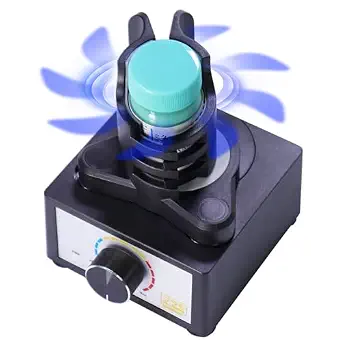 | Best for Hands-Free Batch Mixing | Brand: GUNDDIYCLUB | Model: PMKJ020 | Speed Range: 300–2400 rpm | VIEW ON AMAZON | See Our Full Breakdown |
| LACHOI Lab Vortex Mixer, 100–3000 rpm, LCD, Touch and Continuous Modes |  | Best Overall Precision Control | Speed: 100–3000 rpm | Motor: DC brushless | Operating Modes: Touch and continuous | VIEW ON AMAZON | See Our Full Breakdown |
| FOUR E’S SCIENTIFIC Vortex Mixer, Variable Speed 0-3000 rpm |  | Best Value Workhorse | Brand: FOUR E’S SCIENTIFIC | Model: MI0101002D | Speed Range: 0–3000 rpm | VIEW ON AMAZON | See Our Full Breakdown |
| LABINVO Mini Vortex Paint Mixer with Touch Function (IN-MXMN001) |  | Best Budget Starter Pick | Model: IN-MXMN001 | Manufacturer: LABINVO | Motor: Brushless DC (maintenance-free) | VIEW ON AMAZON | See Our Full Breakdown |
| VISOSCI 2800RPM Fixed-Speed Vortex Mixer with 4-Inch Platform |  | Best for Multiple and Larger Containers | Speed: 2800 RPM (fixed) | Orbital Motion: 4 mm | Platform Size: 4 inches | VIEW ON AMAZON | See Our Full Breakdown |
| LAB FISH VM500PRO Multi-Tube Vortex Mixer |  | Best for Multi-Sample Throughput | Max Speed: 3000 RPM | Motor Type: Brushless | Mixing Modes: Continuous and touch | VIEW ON AMAZON | See Our Full Breakdown |
| Mini Vortex Mixer with 50 Stainless Steel Mixing Balls |  | Best for Viscous Craft Materials | Motor Speed: 3500 RPM fixed | Motor Type: Brushless DC | Operation: Touch start with automatic stop | VIEW ON AMAZON | See Our Full Breakdown |
| ONiLAB Lab Vortex Mixer MX-S |  | Best Overall Versatility | Speed Range: 0–3000 RPM | Modes: Touch start, Continuous | Construction: Aluminum-cast with vacuum suction feet | VIEW ON AMAZON | See Our Full Breakdown |
| INTLLAB Touch-Activated Lab Vortex Mixer |  | Best Budget Pick for Small Tubes | Mixing Method: Touch-activated | Mixing Time: Within 5 seconds | Max Container Size: 50 mL | VIEW ON AMAZON | See Our Full Breakdown |
| ONiLAB Mini Vortex Mixer MX-Mini |  | Best Portable Pick | Model: MX-Mini | Dimensions: 3.9 x 3.9 x 3.1 inches | Weight: 1.1 pounds | VIEW ON AMAZON | See Our Full Breakdown |
| laboratory vortex mixer | Weight | Model | Motor |
|---|---|---|---|
| GUNDDIYCLUB Mini Vortex Mixer | 1.12 lbs | PMKJ020 | — |
| LACHOI Lab Vortex Mixer | 6.7 lbs | — | DC brushless |
| FOUR E’S SCIENTIFIC Vortex Mix | 6.6 lbs | MI0101002D | 12V DC brushless |
| LABINVO Mini Vortex Paint Mixe | 1.28 lbs | IN-MXMN001 | Brushless DC (maintenance-free) |
| VISOSCI 2800RPM Fixed-Speed Vo | 8.36 lbs (3.75 kg) | — | — |
| LAB FISH VM500PRO Multi-Tube V | 7 pounds | — | — |
| Mini Vortex Mixer with 50 Stai | — | — | — |
| ONiLAB Lab Vortex Mixer MX-S | 5.56 pounds | MX-S | — |
| INTLLAB Touch-Activated Lab Vo | — | — | Brushless DC |
| ONiLAB Mini Vortex Mixer MX-Mi | 1.1 pounds | MX-Mini | Brushless DC |
More Details on Our Top Picks
GUNDDIYCLUB Mini Vortex Mixer – Hands-Free Paint Shaker for Model Kits, Nail Polish, and Lab Use
What sets this GUNDDIYCLUB mini mixer apart is the included clip that holds bottles in place, so you can walk away while it works — something none of the touch-activated options like the LABINVO IN-MXMN001 can do, since those stop the moment you lift the container. Three speed stages spanning 300–2400 rpm give it more flexibility than the fixed 2800 RPM VISOSCI, though its top speed falls short of the 3000 rpm mixers in this lineup. The tradeoff for hands-free convenience is a real duty-cycle limitation: after six consecutive cycles it demands a 10-minute cooldown, which will frustrate anyone running back-to-back batches.
Pros:- Hands-free clip holds bottles so you can step away
- Three-stage speed control handles different liquid viscosities
- Suction-cup base keeps the compact unit stable at high speed
- Works across paints, polish, adhesives, and lab solutions
Cons:- Requires a 10-minute rest after six consecutive uses
- Bottle capacity capped at 10–100ml, smaller than platform-style options
Best for: Hobbyists and nail technicians who want to load a bottle, clip it in, and multitask while paints or polishes mix themselves
Not ideal for: Busy labs or production settings running continuous batches — the mandatory cooldown after six uses interrupts workflow
- Brand:GUNDDIYCLUB
- Model:PMKJ020
- Speed Range:300–2400 rpm
- Speed Settings:3
- Bottle Capacity:10–100ml
- Auto-Stop:2 minutes
- Dimensions:3.5 x 6 x 4.1 inches
- Weight:1.12 lbs
Our verdict“Choose this if unattended mixing matters more to you than raw speed or throughput.”
LACHOI Lab Vortex Mixer, 100–3000 rpm, LCD, Touch and Continuous Modes
This LACHOI mixer earns the top spot because it’s the only option here pairing a full 100–3000 rpm range with an LCD readout for both speed and time — you actually see what you’re running instead of guessing, as you must with the dial-only FOUR E’S SCIENTIFIC mixer. Both touch and timed continuous modes mean it handles quick tube mixes and longer unattended runs equally well. The 6.7-pound build with stable feet keeps noise and walk low at high rpm. The catch: it’s rated for containers up to 50 ml, and lidded containers are effectively required, so it’s a precision instrument rather than a bulk paint shaker.
Pros:- Wide 100–3000 rpm brushless motor range
- LCD shows exact speed and time settings
- Both touch-activated and timed continuous operation
- Stable feet and low-noise running at high speed
Cons:- Containers must be lidded to prevent spills
- Recommended limit of 50 ml restricts larger-volume work
Best for: Lab technicians who need repeatable, documented mixing parameters across small sample volumes
Not ideal for: Anyone mixing large bottles or unlidded open containers — the 50 ml ceiling and spill risk rule it out
- Speed:100–3000 rpm
- Motor:DC brushless
- Operating Modes:Touch and continuous
- Display:LCD
- Orbital Diameter:4.5 mm
- Dimensions:5.7 x 6.3 x 4.5 inches
- Weight:6.7 lbs
- Manufacturer:LACHOI
Our verdict“The most controllable mixer in this batch, ideal when precision and repeatability outrank capacity.”
FOUR E’S SCIENTIFIC Vortex Mixer, Variable Speed 0-3000 rpm
The FOUR E’S SCIENTIFIC mixer is the balanced pick: a 0–3000 rpm dial, both continuous and touch modes, and a genuinely stable aluminum base with suction cups at a mid-tier position. Its 35 mm orbital diameter is far more aggressive than the 4.5 mm orbit on the LACHOI, which is why it claims to fully mix a 50 ml container in about 3 seconds — faster results for paints and inks, at the cost of more violent motion that suits lidded or low-fill containers. Compared with the fixed-speed VISOSCI, the analog dial gives real flexibility, but the 12V low-voltage motor can struggle with denser materials, and at 6.6 pounds it’s no lightweight despite the compact footprint.
Pros:- Full 0–3000 rpm adjustable speed range
- Continuous and touch-activated operation modes
- Wide 35 mm orbit mixes 50 ml containers in ~3 seconds
- Brushless 12V DC motor rated for roughly 6x brushed-motor lifespan
Cons:- Heavy at 6.6 pounds for its small footprint
- Low-voltage 12V motor may underpower dense materials
Best for: Buyers who want one mixer to serve both a lab bench and hobby paint desk without paying for digital controls
Not ideal for: Users mixing dense or highly viscous materials — the 12V motor lacks the torque of higher-voltage units
- Brand:FOUR E’S SCIENTIFIC
- Model:MI0101002D
- Speed Range:0–3000 rpm
- Orbital Diameter:35 mm
- Motor:12V DC brushless
- Operation Modes:Continuous, Touch
- Dimensions:4.2 x 5.7 x 6.5 inches
- Weight:6.6 lbs
Our verdict“A dependable all-rounder that trades digital display and raw power for speed range and build stability.”
LABINVO Mini Vortex Paint Mixer with Touch Function (IN-MXMN001)
At just 1.28 pounds, the LABINVO is the lightest and simplest entry here — press the silicone cap to shake, lift to stop, with a maintenance-free brushless motor that mixes 50 ml samples in about 3 seconds. Compared with the GUNDDIYCLUB, it swaps the hands-free clip for a cleaner, faster touch workflow, which suits salons and classrooms better than batch hobby work. The polycarbonate housing wipes clean easily but feels far less rugged than the aluminum FOUR E’S SCIENTIFIC or VISOSCI units. Its quirkiest limitation: you need to leave 60% headspace in test tubes for proper vortex formation, so effective fill volumes are modest.
Pros:- Mixes 50 ml samples fully within 3 seconds
- Maintenance-free brushless DC motor
- Intuitive touch operation: press to shake, lift to stop
- Lightweight, easy-clean design for salons and classrooms
Cons:- Requires 60% empty headspace in tubes, limiting fill volume
- Plastic casing is less durable than metal alternatives
Best for: Nail salons, students, and home users who want fast touch mixing with zero maintenance at minimal cost
Not ideal for: Clumsy or high-traffic workspaces — the plastic casing won’t survive drops the way aluminum-bodied mixers will
- Model:IN-MXMN001
- Manufacturer:LABINVO
- Motor:Brushless DC (maintenance-free)
- Mixing Capacity:50 ml, mixed within 3 seconds
- Operation:Touch function on silicone cap
- Housing Material:Polycarbonate with silicone cap
- Weight:1.28 lbs
Our verdict“The easiest mixer to own and operate — pick it for light-duty touch mixing, skip it for rugged or high-volume needs.”
VISOSCI 2800RPM Fixed-Speed Vortex Mixer with 4-Inch Platform
The VISOSCI solves a problem every other mixer in this batch shares: tiny single-tube heads. Its 4-inch anti-slip rubber platform accepts multiple tubes or larger bottles at once, and at 8.36 pounds with a heavy-duty aluminum casting and suction feet, it’s the most physically planted unit here — steadier than the lighter LABINVO or LACHOI. The tradeoff is stark, though: 2800 RPM is your only speed, with no dial or display, and pressing down too firmly actually stalls the orbital motion, so technique matters. Containers should be filled no more than a third full for a proper vortex, which limits per-run volume despite the big platform.
Pros:- Large 4-inch platform holds multiple or larger containers
- Continuous switch-activated operation needs only light pressure
- Heavy aluminum casting with suction feet minimizes walk and noise
- Handles paints, pigments, adhesives, essential oils, and lab samples
Cons:- Fixed speed only — no adjustable settings at all
- Excessive downward pressure can pause the mixing motion
- Containers work best filled to no more than one-third capacity
Best for: Studios and labs that need to vortex several small containers simultaneously or shake larger bottles on one platform
Not ideal for: Users working with delicate samples that need low-speed mixing — the fixed 2800 RPM offers no adjustability
- Speed:2800 RPM (fixed)
- Orbital Motion:4 mm
- Platform Size:4 inches
- Platform Material:Anti-slip textured rubber
- Housing:Heavy-duty aluminum casting
- Operation Mode:Continuous (switch-activated)
- Weight:8.36 lbs (3.75 kg)
- Brand:VISOSCI
Our verdict“The platform choice when capacity and stability matter more than speed control.”
LAB FISH VM500PRO Multi-Tube Vortex Mixer
Where every other mixer in this lineup handles one tube at a time, the VM500PRO is built around eight removable modules that accept tubes, beakers, flasks, and culture plates. That difference defines who it’s for: labs running batches of samples rather than occasional single-tube mixes. The brushless motor reaching 3000 RPM is quieter and longer-lived than brushed alternatives, and the anti-slip rubber base keeps the unit planted without the suction cups the ONiLAB MX-S relies on — handy if your bench surface is uneven or textured. The digital timer is another edge over simpler touch-only units like the INTLLAB. The tradeoffs are real: at 7 pounds it’s the heaviest option here, eating bench space in crowded setups, and the 1-year warranty is shorter than what serious daily-use buyers might want.
Pros:- Eight swappable modules handle tubes, flasks, beakers, and culture plates
- Brushless motor reaches 3000 RPM with a long service life
- Continuous and touch modes cover both long runs and quick mixes
- Anti-slip rubber base stays stable on surfaces where suction cups fail
Cons:- Heaviest unit in this batch at 7 pounds, occupying valuable bench space
- Only a 1-year limited warranty for a workhorse-class machine
Best for: Lab technicians processing multiple tubes, plates, or flasks simultaneously who need batch throughput
Not ideal for: Solo crafters or hobbyists mixing one nail polish or paint bottle at a time — the multi-tube capacity goes unused and the footprint is wasted
- Max Speed:3000 RPM
- Motor Type:Brushless
- Mixing Modes:Continuous and touch
- Modules Included:8
- Weight:7 pounds
- Warranty:1 year limited
- Manufacturer:LAB FISH
Our verdict“This pick makes the most sense for labs that vortex many samples at once; single-tube users should save money and space with a compact touch model.”
Mini Vortex Mixer with 50 Stainless Steel Mixing Balls
This unit targets a different problem than the lab-focused models. Its 3500 RPM fixed speed is the highest in this batch, and the bundled 50 stainless steel mixing balls are the real story — drop one into a bottle of pigment, adhesive, or ink and the vortex plus agitation tackles low- to medium-viscosity liquids that defeat gentler mixers. Compared with the ONiLAB Mini, which ships with 120 balls but is framed around quick 50 mL lab tubes, this one leans harder into paint and hobby workflows. The touch start with automatic stop makes one-handed operation natural. The rigidity of a fixed speed is the main compromise: there’s no dialing down for delicate samples, and the one-third fill limit means larger working volumes need multiple passes or a bigger machine like the VM500PRO.
Pros:- Highest fixed speed in this batch at 3500 RPM
- 50 reusable stainless steel balls improve mixing of pigmented or settled liquids
- One-handed touch start with automatic stop
- Four silicone suction feet keep the compact body anchored
Cons:- No speed adjustment — 3500 RPM or nothing
- Containers should be filled no more than one-third for effective vortexing
Best for: Model builders, nail technicians, and ink or pigment users who need to re-suspend settled material quickly
Not ideal for: Anyone needing variable speed control or full-tube mixing volumes — the fixed RPM and fill limits get in the way
- Motor Speed:3500 RPM fixed
- Motor Type:Brushless DC
- Operation:Touch start with automatic stop
- Base:Four silicone suction feet
- Included Accessories:50 reusable stainless steel mixing balls
- Suitable Liquids:Low- to medium-viscosity
Our verdict“A strong choice for hobbyists and beauty professionals battling settled pigments; sample-sensitive lab users will want variable speed instead.”
ONiLAB Lab Vortex Mixer MX-S
The MX-S earns the top general-purpose slot because it combines the features most buyers end up wishing they’d paid for: variable speed from 0 to 3000 RPM, both touch and continuous modes, and speed that holds steady under changing load — something the fixed-speed Mini Vortex Mixer simply can’t offer. The aluminum-cast housing feels like lab equipment rather than a gadget, and quiet, low-vibration operation with vacuum suction feet means it won’t walk across the bench mid-run. Compared with the INTLLIB touch-only unit, the MX-S covers timed or hands-off protocols that single-mode mixers can’t. The catch is附件 economics: accessories for tubes, plates, and flasks are optional and sold separately, so the true cost of a full setup climbs. At 5.56 pounds it’s also mid-weight — more bench commitment than the 1.1-pound ONiLAB Mini.
Pros:- Variable 0–3000 RPM control that maintains speed under load
- Touch and continuous modes in one unit
- Durable aluminum-cast construction with stable vacuum feet
- Quiet, low-vibration operation suitable for shared labs
Cons:- Mixing heads and accessories are optional extras, not included
- Heavier than compact alternatives at 5.56 pounds
Best for: General lab users who need one mixer that handles both quick touch mixes and longer continuous runs at controlled speeds
Not ideal for: Buyers on a strict accessory-included budget — heads and adapters cost extra, inflating the real price of a complete kit
- Speed Range:0–3000 RPM
- Modes:Touch start, Continuous
- Construction:Aluminum-cast with vacuum suction feet
- Weight:5.56 pounds
- Package Dimensions:9.49 x 7.72 x 7.6 inches
- Manufacturer:DLAB Scientific Inc
- Model:MX-S
Our verdict“If one mixer has to do everything in a working lab, this is the one to build around — just budget for the add-on accessories.”
INTLLAB Touch-Activated Lab Vortex Mixer
For straightforward tube mixing, the INTLLAB strips everything nonessential and keeps the parts that matter: a durable brushless DC motor, chemical-resistant PC and silicone construction, and touch-activated mixing that finishes most samples within 5 seconds. The chemical resistance is a genuine differentiator at this price point — spills of solvents or reagents that would degrade cheaper plastics wipe right off, which the craft-focused mixers here don’t claim. It accepts test tubes, centrifuge tubes, and Eppendorf tubes up to 50 mL, matching the ONiLAB Mini’s capacity but with a more lab-oriented materials spec. The limitation is hard ceiling: nothing larger than 50 mL, no continuous mode, and no speed control, so anything the INTLLAB can’t do means stepping up to the ONiLAB MX-S or LAB FISH VM500PRO.
Pros:- Chemical-resistant PC and silicone housing survives reagent spills
- Brushless DC motor for long-term reliability
- Compact footprint fits crowded benches or field kits
- Mixes typical samples within 5 seconds
Cons:- Hard 50 mL container size limit with no larger accessories available
- No variable speed or continuous mode
Best for: Students, small labs, and beauty professionals who mix standard small tubes and want chemical resistance without paying for features they won’t use
Not ideal for: Labs working with flasks, bottles, or plates — the 50 mL container ceiling rules those out entirely
- Mixing Method:Touch-activated
- Mixing Time:Within 5 seconds
- Max Container Size:50 mL
- Motor:Brushless DC
- Materials:PC and silicone
- Compatible Containers:Test tubes, centrifuge tubes, Eppendorf tubes
Our verdict“A sensible, no-frills choice if your world is tubes of 50 mL or less; bigger containers or timed runs require a step-up model.”
ONiLAB Mini Vortex Mixer MX-Mini
At 3.9 x 3.9 x 3.1 inches and 1.1 pounds, the MX-Mini is the most portable mixer in the entire roundup — it fits in a drawer, a field kit, or a nail tech’s travel bag. Despite the size, a full 50 mL tube mixes in about three seconds, which is faster than the INTLLAB’s five-second claim for the same capacity, and the bundle of 120 stainless steel mixing balls doubles what the Mini Vortex Mixer includes, giving beauty and hobby users plenty of agitators for polish and pigment bottles. The touch-on, lift-off operation is intuitive for anyone moving between samples quickly. The physics constraint is unavoidable: tubes need to be no more than one-third full, so real working volumes are small, and there’s no speed control for anything demanding gentler handling. It complements rather than replaces a bench unit like the MX-S.
Pros:- Smallest and lightest mixer here at 1.1 pounds
- Mixes a full 50 mL container in roughly three seconds
- 120 included stainless steel balls — the largest bundle in this batch
- Silicone suction cups stabilize it on smooth surfaces
Cons:- One-third fill limit restricts practical working volumes
- No speed adjustment or continuous mode
Best for: Mobile nail technicians, field researchers, and hobbyists who need serious mixing power in a grab-and-go footprint
Not ideal for: Labs mixing fuller tubes or larger volumes — the one-third fill rule caps what a single run can accomplish
- Model:MX-Mini
- Dimensions:3.9 x 3.9 x 3.1 inches
- Weight:1.1 pounds
- Motor:Brushless DC
- Mixing Capacity:50 mL
- Mixing Time:About 3 seconds
- Included Accessories:120 stainless steel mixing balls
Our verdict“Buy it as a portable second mixer or a compact first one for small samples; don’t expect it to replace a full-size bench vortexer.”

How We Picked
I evaluated each mixer against four buyer-relevant criteria. Performance flexibility carried the most weight — speed range, whether speed is adjustable or fixed, and whether the unit offers both touch and continuous operation, since that determines how many protocols one mixer can serve. Capacity and compatibility came next: single-tube minis were judged on cup fit for common tube sizes, while the VISOSCI and LAB FISH were judged on platform coverage and how many containers they handle simultaneously. Build and usability covered foot stability at high rpm, ease of cleaning, control clarity, and noise — cheap mixers that walk across the bench or drown out conversation lose points fast. Finally, I weighed value fit: what a model includes for its class, such as mixing balls with the hobbyist minis or a digital timer with the LAB FISH.
The ranking logic follows intended use rather than raw specs. The LACHOI tops the list because it is the only compact unit combining a wide adjustable speed range, an LCD, and dual modes — the most versatile package for the money. The LAB FISH ranks second for solving a different problem entirely: multi-tube throughput. Fixed-speed and touch-only minis rank lower not because they are bad, but because their narrower feature set fits fewer buyers, and the ordering within that tier reflects included accessories and build quality differences.
Factors to Consider When Choosing Laboratory Vortex Mixers
A vortex mixer is a small purchase that creates daily friction if you get it wrong. Before settling on a model, think through these factors — they explain most of the price gaps in this roundup and most of the buyer’s remorse in this category.Touch Activation vs. Continuous Mode
This is the single most consequential choice, and buyers routinely get it wrong. Touch-activated mixers start when you press the tube against the cup, which is fast and intuitive for occasional single samples — but if your protocol involves dozens of tubes or timed steps, constant pressing becomes tedious and inconsistent. Continuous mode lets the mixer run hands-free while you swap tubes, which matters for serial dilutions, resuspension workflows, or mixing viscous samples that need sustained agitation. The safest buy is a unit offering both modes, like the LACHOI or ONiLAB MX-S; the premium for dual mode is modest compared to replacing a touch-only unit later. A common mistake is buying a cheap touch-only mini for a lab rotation and discovering nobody uses it because it slows down throughput.
Fixed Speed vs. Variable Speed — And Why Low rpm Matters
Fixed-speed mixers (typically 2800–3500 rpm) are simpler and mechanically robust, but full speed is surprisingly aggressive for delicate work. Variable speed down to a few hundred rpm lets you foam less when mixing protein solutions, avoid aerosolizing liquids in uncapped tubes, and handle low-volume samples without splashing. If your work is exclusively tough — paint pigment, cured gel polish, adhesive separation — a fixed-speed unit is honestly fine and often cheaper. But if there is any chance your use will broaden toward biological or analytical samples, the small premium for a 0–3000 rpm model pays for itself. Also check whether speed is analog dial or digital display: digital readouts make protocols reproducible, which analog dials cannot guarantee across users.
Single Tube, Platform, or Multi-Tube Capacity
Capacity determines whether the mixer fits your workflow or fights it. Single-cup minis handle one tube or small vial at a time — ideal for hobbyists and low-volume labs, but a bottleneck beyond a few dozen samples per day. Flat-platform models like the VISOSCI accommodate bottles, multiple loose tubes, and odd container shapes, trading some vortex intensity for versatility. Multi-tube mixers with attachment heads, like the LAB FISH, vortex many tubes simultaneously, which is the only realistic option for plate-based or high-throughput protocols. A frequent purchasing error is sizing capacity to today’s needs with zero headroom; sample volumes in most labs grow within a year, and a mixer is typically kept far longer than planned.
Build Quality, Stability, and Noise
At 3000 rpm, construction flaws become obvious fast. Light plastic bases without suction feet will walk across the bench or transmit vibration to neighboring instruments, and poorly balanced motors develop wobble within months. Look for a weighted base, rubber feet, and a motor housing that doesn’t flex when running at top speed unloaded. Noise is another underrated factor: compact mixers running at 3000+ rpm can be loud enough to be unpleasant in shared spaces, and cheaper motors tend to whine rather than hum. Check whether the cup or platform is replaceable — mixing cups wear, crack, and get contaminated, and a mixer with a sealed non-replaceable head becomes disposable the first time you spill solvent on it.
Timers, Displays, and Protocol Reproducibility
A digital timer sounds like a luxury until you run a protocol where mixing time affects results, such as cell resuspension or reagent reconstitution. Timed operation removes operator variability between staff members and lets you walk away during longer mixes — the LAB FISH’s timer plus platform combination is exactly why it ranks above simpler multi-tube alternatives. An LCD speed display serves the same purpose: ‘setting 5’ on a dial means nothing to the next person, while ‘1500 rpm’ does. If your work is qualitative — paint, polish, glue — skip the electronics and save the money. If any quantitative or biological work is involved, digital controls shift from convenience to quality control, and that is where paying more is justified.
Lab Grade vs. Hobbyist Grade — Matching the Tool to the Setting
Half the mixers in this category are marketed to both labs and hobbyists, and the distinction matters. Hobbyist-grade minis often include mixing balls and are tuned for viscous cosmetics and pigments; they can handle occasional test-tube duty but usually lack the durability rating, mode flexibility, and consistency for daily lab cycling. Lab-grade units from established scientific brands cost more but tend to have better motor bearings, more stable bases, and warranty support that assumes daily use. The honest self-assessment: if the mixer will run a few minutes a day on polish or paint, buy cheap and replace as needed. If it anchors a bench that runs all day, buy once from the lab-grade tier — the failure mode of a cheap motor mid-protocol is far more expensive than the price difference.
Frequently Asked Questions
Is a fixed-speed vortex mixer good enough, or do I need variable speed?
It depends entirely on what you’re mixing. Fixed-speed units around 2800–3500 rpm handle paint, gel polish, adhesives, and robust chemical reconstitution without complaint, and their simpler mechanics mean fewer failure points. Variable speed becomes necessary when you work with foam-prone liquids like protein solutions, low-volume samples that splash at full speed, or anything where gentle initial mixing prevents aerosols. If more than one person uses the mixer or your protocols need reproducibility, adjustable speed with a digital readout is the safer long-term buy. Buyers who start with fixed-speed units for lab work frequently upgrade within a year — factor that into the real cost.
What’s the practical difference between touch operation and continuous mode?
Touch operation means the mixer runs only while you press a container against the cup — great for quick single-sample work, since you never fumble with a switch and can’t accidentally leave it running. Continuous mode keeps the motor running so you can swap tubes rapidly or leave a container mixing hands-free. For workflows involving more than a handful of tubes per session, touch-only units noticeably slow you down and produce inconsistent contact pressure between users. The best hedge is a dual-mode unit like the LACHOI or ONiLAB MX-S, which costs only slightly more than touch-only minis and covers both workflows.
Can I use one mixer for both lab tubes and hobby liquids like nail polish or paint?
Yes, and this dual use is exactly why compact mixers dominate this category — but watch two things. First, cross-contamination: pigments and adhesives are messy, so dedicate a cup or platform surface to hobby use and clean it between applications, or you’ll contaminate lab samples. Second, viscosity: settled pigment and gel polish need sustained high-rpm agitation, sometimes with mixing balls, whereas many lab liquids mix in seconds. The models that ship with stainless steel balls handle the hobby side better; lab-focused units with variable speed handle delicate samples better. If both uses are regular, a dual-mode, variable-speed mixer is the only single purchase that covers both honestly.
Do I need a multi-tube vortex mixer or is a single-tube mini sufficient?
The honest threshold is throughput: a single-cup mini comfortably handles up to roughly a dozen or so mixing events per day, and beyond that the per-tube handling time adds up. Multi-tube units like the LAB FISH VM500PRO vortex an entire rack simultaneously, which changes the math for serial dilutions, extraction batches, or sample prep before analysis. They cost and bench-space considerably more, so buying one for occasional use is overkill. A middle path is a flat-platform model like the VISOSCI, which handles bottles and multiple loose containers at moderate intensity. Project your sample volume a year out, not just this month, before deciding.
What do the included stainless steel mixing balls actually do, and do I need them?
Mixing balls sit inside your container and physically break up settled solids as the vortex agitates the liquid — they make a real difference for heavily pigmented paint, gel polish that has separated, and thick adhesives where vortexing alone leaves unmixed residue at the bottom. For typical lab liquids like buffers or diluted samples, they’re unnecessary and add a contamination and cleaning burden, since each ball must be decontaminated between uses. If your primary use is cosmetics or hobby paint, balls are a genuine value-add and two models in this roundup include them in quantity. If your use is lab work, treat balls as irrelevant to your buying decision and prioritize speed range and modes instead.
Conclusion
After comparing all ten, my recommendations map cleanly to buyer type. For best overall, the LACHOI digital mixer wins on the strength of its 100–3000 rpm adjustable range, LCD, and dual touch/continuous modes — the most capable all-rounder for mixed lab and hobby use. The ONiLAB MX-S takes best value, delivering both operating modes and dependable construction at a lower tier than the feature-matched competition. For premium buyers and high-throughput labs, the LAB FISH VM500PRO is the clear choice, pairing multi-tube capacity with a digital timer that no other model here matches. Beginners and hobbyists get the most from the touch-activated minis — the LABINVO or the INTLLAB are simple, forgiving starting points, and the ONiLAB mini with 120 mixing balls is the best fit specifically for viscous polish and pigment work. If your needs sit between categories — bottles plus tubes, say — the VISOSCI’s platform design fills that gap without stepping up to the LAB FISH’s size and price. Pick based on your actual daily workflow, not the longest spec sheet, and any of these will serve you well.
Halloween Picks
halloween
As an affiliate, we earn on qualifying purchases.