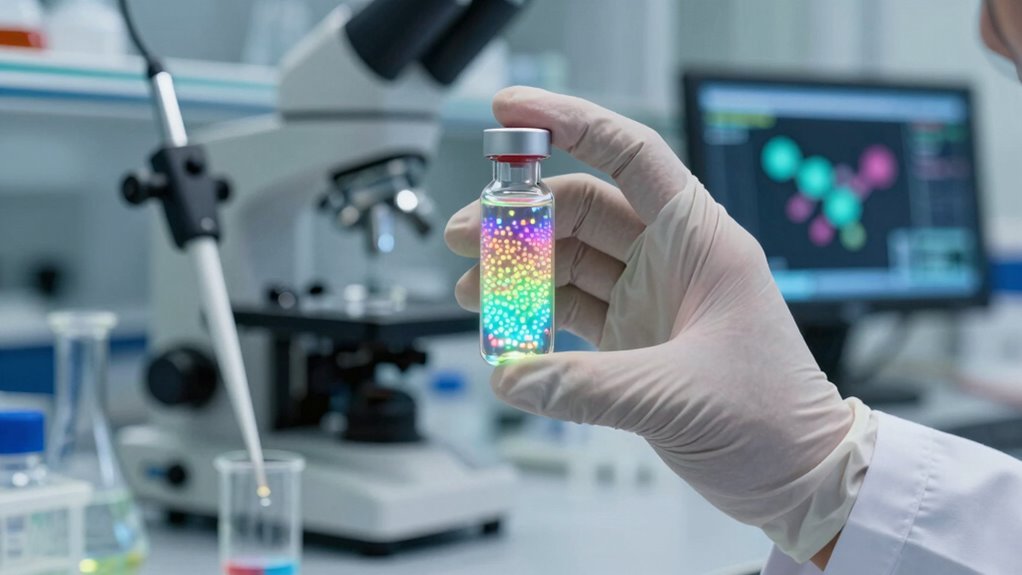

You’ll see carbon dots playing a growing role in research by leveraging their unique fluorescent properties and biocompatibility. They’re used for detecting pollutants, such as heavy metals and pesticides, and in environmentally friendly water and air monitoring. Carbon dots also enhance energy devices like solar cells and batteries while supporting biomedical imaging and sensing applications. If you want to explore how their innovative features are shaping future technologies, there’s plenty more to discover ahead.
Key Takeaways
- Carbon dots are used in bioimaging and sensing due to their bright, tunable fluorescence and biocompatibility.
- They enable monitoring and detection of pollutants like heavy metals and pesticides in environmental samples.
- Carbon dots facilitate photocatalytic degradation of contaminants, supporting environmental remediation efforts.
- They improve energy device performance, such as solar cells and batteries, through enhanced light absorption and charge transfer.
- Green synthesis methods ensure eco-friendly production, promoting sustainable research and applications.
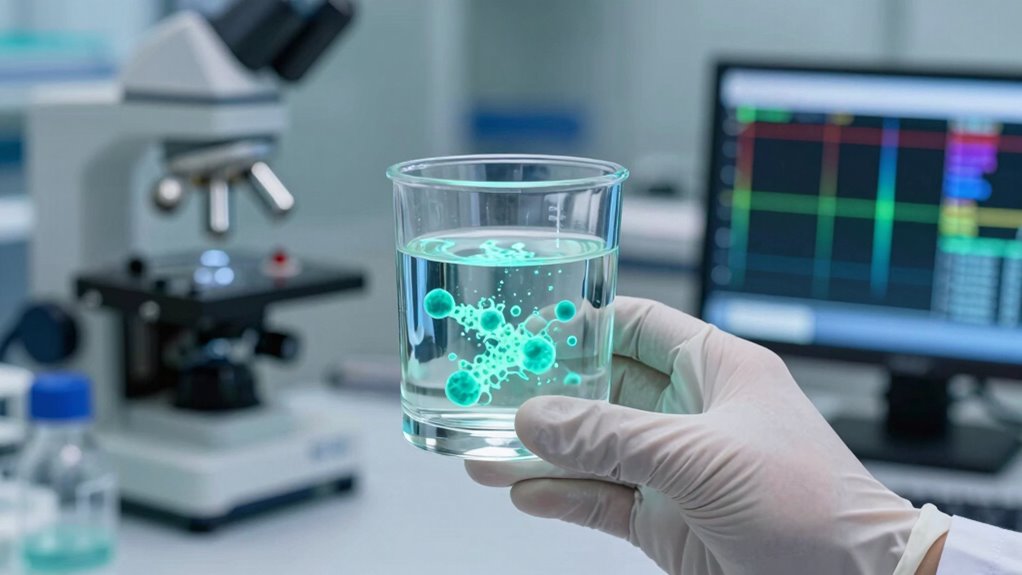
Carbon dots have emerged as versatile nanomaterials with significant potential in various research applications. Their unique quantum properties make them particularly appealing for a range of scientific and technological pursuits. As you explore how these tiny particles are transforming fields, you’ll find that their ability to fluoresce under specific conditions is at the core of many breakthroughs. These quantum properties enable carbon dots to emit bright, tunable light, which can be harnessed in bioimaging, sensing, and optoelectronic devices. Their small size and excellent biocompatibility allow you to use them safely in biological environments, making them ideal for tracking cellular processes or delivering targeted therapies. Furthermore, the quantum confinement effects allow you to fine-tune their emission wavelengths, giving you a customizable tool for various imaging and sensing applications.
In environmental applications, carbon dots are proving to be invaluable. You might use them to monitor pollutants in water, air, or soil, thanks to their high sensitivity and selectivity. For instance, their fluorescence can change in response to specific contaminants, alerting you to the presence of heavy metals, pesticides, or other hazardous substances. This ability to detect even trace amounts of pollutants makes them an effective tool for environmental monitoring and remediation efforts. Additionally, carbon dots can be employed in photocatalysis, helping you break down pollutants under light exposure, which is essential in cleaning up contaminated water bodies or air. Their eco-friendly synthesis process aligns with sustainable development goals, so you can incorporate them into green chemistry initiatives without introducing new environmental risks. Moreover, their sustainable synthesis methods contribute to environmentally responsible research and application. Incorporating green chemistry principles ensures that the production of carbon dots minimizes environmental impact and promotes sustainability. You might also find that their biocompatibility allows for safer integration into biological systems, further broadening their practical applications.
As you explore further into research, you’ll notice that these nanomaterials also offer potential in energy-related areas like solar cells and batteries, thanks to their ability to enhance charge transfer and light absorption. Their quantum properties help optimize performance in various devices, opening new avenues for energy efficiency. The versatility of carbon dots, driven by their quantum properties, positions them at the forefront of nanotechnology innovations. Whether you’re developing advanced sensors for environmental safety or designing new imaging techniques in biomedicine, these tiny particles provide a powerful platform. Their emerging role in environmental applications underscores their importance in creating sustainable solutions while their quantum properties continue to reveal new possibilities in research and technology. As you work with carbon dots, you’ll discover that their adaptability and functional versatility make them a promising and transformative tool across multiple scientific disciplines. Additionally, ongoing research into their synthesis and functionalization expands their potential applications further into the future.

Luminescent Carbon Dots for Sensor and Bioimaging Applications (German Edition)
As an affiliate, we earn on qualifying purchases.
As an affiliate, we earn on qualifying purchases.
Frequently Asked Questions
What Are the Environmental Impacts of Producing Carbon Dots?
You might wonder about the environmental impacts of producing carbon dots, and it’s essential to take into account environmental regulations that limit harmful emissions and waste. Responsible waste management practices help minimize pollution during production, reducing potential hazards. While carbon dot synthesis can be eco-friendly, improper handling or non-compliance with regulations could lead to environmental harm. Adopting sustainable methods ensures production remains environmentally safe and aligns with global efforts to protect ecosystems.
How Cost-Effective Are Carbon Dots for Large-Scale Applications?
You’ll find carbon dots quite cost-effective for large-scale applications due to their impressive economic viability. Their production scalability is high because they can be synthesized from abundant, low-cost materials using straightforward methods. This means you can produce large quantities without significant expense, making them practical for commercial uses like bioimaging, sensors, and optoelectronics. Overall, their affordability and scalable production make them a promising choice for extensive industrial deployment.
Can Carbon Dots Be Used in Medical Diagnostics?
You can definitely use carbon dots in medical diagnostics, especially in bioimaging techniques and disease marker detection. Research suggests they can improve the sensitivity and accuracy of diagnostic tests. Their biocompatibility and unique fluorescence properties make them ideal for tracking cells or detecting specific diseases. While still in development, these features provide promising potential for early diagnosis and personalized medicine, revolutionizing how we approach medical testing.
What Are the Safety Concerns Associated With Carbon Dots?
You should consider safety concerns with carbon dots, especially regarding toxicity assessment, as their small size could pose risks to health and the environment. While research shows they’re generally biocompatible, thorough toxicity evaluation is crucial before widespread use. Regulatory approval processes ensure safety standards are met, but ongoing studies are needed to confirm long-term effects. Stay informed about evolving safety data and regulations related to carbon dots.
How Do Carbon Dots Compare to Other Nanomaterials?
Comparing carbon dots to other nanomaterials, you’ll find they’re quite compelling due to their superb surface functionalization, which allows for tailored applications. They boast high quantum efficiency, making them highly effective in imaging and sensing. Unlike some nanomaterials that can be toxic or unstable, carbon dots are praised for their biocompatibility and stability. Their affordable, eco-friendly nature makes them a smart choice for diverse, dynamic research and practical applications.

Evviva Sciences Mold Test Kit for Home – 10 Easy Detection Tests w/Optional Lab Analysis (Extra Fee), Test HVAC System, Surfaces, & Indoor Air Quality Testing Kit – Downloadable Mold Information Guide
10 SEPARATE TESTS: The Evviva Sciences Mold Testing Kit comes with 10 agar petri dishes, 10 cotton-tipped swabs,…
As an affiliate, we earn on qualifying purchases.
As an affiliate, we earn on qualifying purchases.
Conclusion
As you explore the domain of carbon dots, imagine a lighthouse guiding ships through foggy waters—these tiny particles illuminate new pathways in medicine, sensing, and energy. Their versatility sparks innovation, like stars igniting a dark sky with hope. With each discovery, you’re witnessing a quiet revolution—a beacon of endless possibilities. Just as night turns to dawn, carbon dots promise a future where science and imagination converge, lighting the way for breakthroughs yet to come.

Functional Fluorescent Materials (Advances in Bionanotechnology)
As an affiliate, we earn on qualifying purchases.
As an affiliate, we earn on qualifying purchases.

Solar Energy Harvesting, Conversion, and Storage: Materials, Technologies, and Applications (Solar Cell Engineering)
As an affiliate, we earn on qualifying purchases.
As an affiliate, we earn on qualifying purchases.