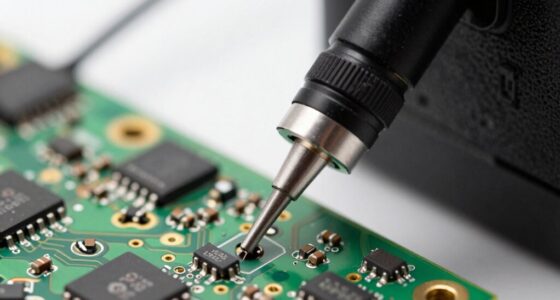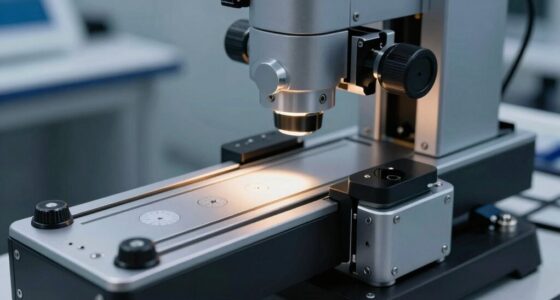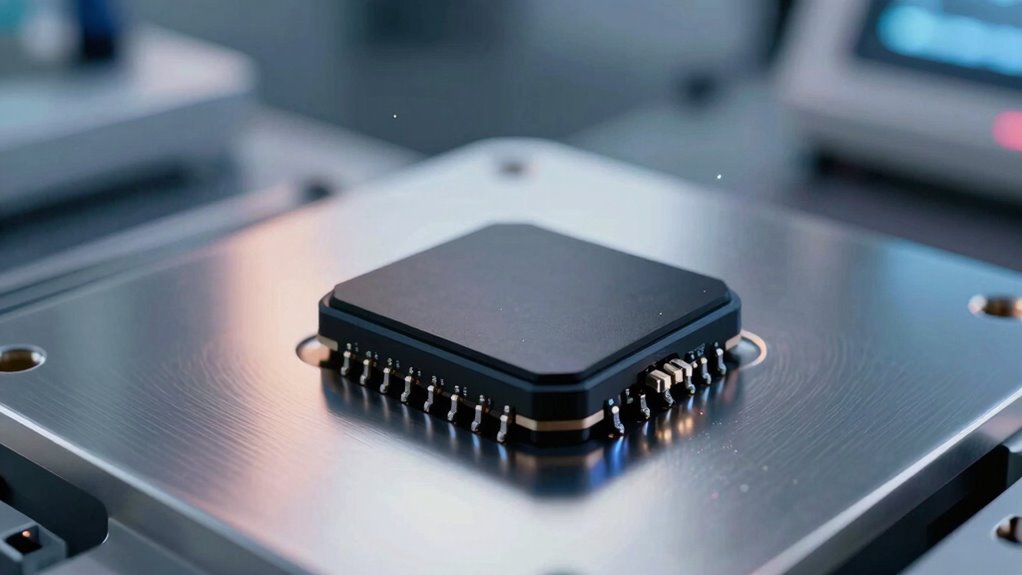
Nano devices improve chemical detection accuracy by utilizing precise fabrication techniques that create highly tailored sensors with increased surface area and active sites. They amplify signals through nanostructures, making target chemicals easier to detect even at low concentrations. Functionalized surfaces increase selectivity for specific compounds, reducing false positives. Their ability to enable real-time, portable detection systems means you can achieve faster, more reliable results. Keep exploring to uncover how these advancements are transforming detection methods across various fields.

Get the latest gadgets delivered free with Prime
- Fast, free delivery on millions of items
- Prime Video, Amazon Music and more included
- Member-only deals all year
Key Takeaways
- Nano devices utilize advanced fabrication techniques for precise, tailored sensor architectures, enhancing detection accuracy.
- Signal amplification at the nanoscale increases sensitivity, enabling detection of low-concentration chemicals with fewer false negatives.
- High surface-to-volume ratios on nanostructures provide more active sites, improving molecule capture and detection thoroughness.
- Functionalization of nanostructures enhances selectivity for specific compounds, reducing false positives and increasing reliability.
- Integration of real-time detection capabilities in nano devices allows continuous monitoring for faster, more accurate chemical analysis.
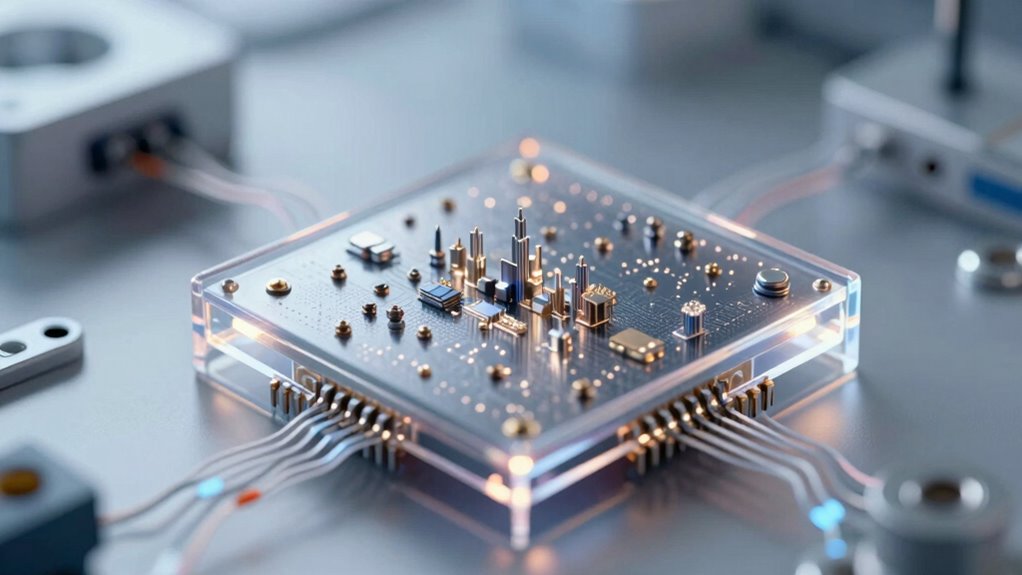
Nano devices have revolutionized chemical detection by enabling highly sensitive and rapid analysis at the molecular level. This breakthrough hinges on advancements in nano fabrication techniques, which allow you to engineer materials and structures with extraordinary precision. By manipulating materials at the nanoscale, you can create sensors with specific surface properties and tailored functionalities, dramatically increasing detection capabilities. This precise control enhances the interaction between the sensor and target molecules, resulting in more accurate and reliable readings.
Nano devices enable highly sensitive, precise chemical detection through advanced fabrication and tailored nanostructures.
One of the key ways nano devices improve detection accuracy is through signal amplification. When you work at such a small scale, even tiny quantities of a chemical can generate detectable signals. Nano fabrication enables you to design structures that boost these signals, making it easier to distinguish real signals from background noise. For example, incorporating nanostructures like nanowires or nanoparticles can amplify the interaction between the target molecule and the sensor surface. This increased interaction leads to stronger, more measurable signals, which directly translates to higher sensitivity and fewer false negatives. Additionally, nano devices can leverage their unique physical properties to enhance detection precision. For instance, their high surface-to-volume ratio means you can load more active sites onto a sensor, increasing the likelihood of capturing target molecules. This results in a more thorough detection process and reduces the chances of missing low-concentration chemicals. Furthermore, the ability to functionalize nanostructures with specific chemical groups allows you to tailor sensors for particular compounds, boosting selectivity and sensitivity. The integration of nano fabrication with signal amplification strategies also opens doors for real-time detection and continuous monitoring. You can develop portable, miniaturized sensors that provide immediate feedback, which is essential for applications like environmental monitoring or medical diagnostics. As you optimize these nano devices, the combination of precision nano fabrication and effective signal amplification ensures that detection is not just faster, but also more accurate, consistent, and dependable. Exploring advanced materials can further enhance sensor performance and durability in various environments.
As an affiliate, we earn on qualifying purchases.
Frequently Asked Questions
What Are the Main Challenges in Developing Nano-Based Chemical Sensors?
Developing nano-based chemical sensors faces challenges like precise Nano fabrication, which requires advanced techniques to create consistent, reliable structures. Signal enhancement is also vital, as detecting tiny chemical quantities demands amplified signals without noise interference. You must guarantee stability and reproducibility of these sensors in various environments, which involves overcoming issues like material degradation and scalability. Addressing these challenges is key to advancing nano sensor technology for accurate chemical detection.
How Do Nano Devices Compare Cost-Wise to Traditional Detection Methods?
Nano devices tend to be more cost-effective than traditional detection methods because miniaturization advances reduce material and manufacturing costs. As technology progresses, cost reduction strategies like mass production and simplified designs further lower expenses. You’ll find that nano sensors are not only smaller and more efficient but also more affordable in the long run, making them accessible for widespread use in various fields, from environmental monitoring to healthcare diagnostics.
Are Nano Sensors Safe for Environmental and Human Health?
Like a butterfly delicately landing, nano sensors seem gentle, but their safety isn’t guaranteed. You should consider nanoparticle toxicity and environmental impact, as some nanomaterials may pose risks to human health and ecosystems. While many nano sensors are designed to be safe, ongoing research is essential to guarantee they don’t cause harm. Proper regulation and testing help mitigate potential risks, making these devices safer for both people and the environment.
How Long Do Nano-Based Chemical Sensors Typically Last?
Nano-based chemical sensors typically last between several months to a few years, depending on their Nano durability and operating conditions. You should consider factors like exposure to harsh environments or chemical drift, which can shorten the sensor’s lifespan. Proper maintenance and calibration can extend their Sensor lifespan. While some advanced nano sensors are designed for long-term use, others may require replacement more frequently for peak accuracy.
Can Nano Devices Detect Multiple Chemicals Simultaneously?
Think of nano devices as a symphony conductor capable of managing multiple instruments at once. They can perform multi-analyte detection and sensor multiplexing, allowing you to detect several chemicals simultaneously. This capability enhances efficiency and accuracy in chemical sensing, making it easier to identify complex mixtures. With nano devices, you gain a powerful tool that orchestrates multiple chemical signals effortlessly, improving detection precision and speeding up analysis processes.
portable chemical detection device
As an affiliate, we earn on qualifying purchases.
As an affiliate, we earn on qualifying purchases.
Conclusion
Imagine a world where nano devices revolutionize chemical detection, making it so precise that you’ll never miss a harmful substance again. These tiny marvels could detect toxins faster than you blink, saving countless lives in the process. With such legendary accuracy, you’ll wonder how we ever survived without them. Nano technology isn’t just improving detection; it’s transforming the very future of safety and health—an unstoppable force that’ll change everything for good!
nanostructure sensor for chemicals
As an affiliate, we earn on qualifying purchases.
As an affiliate, we earn on qualifying purchases.
high sensitivity chemical detector
As an affiliate, we earn on qualifying purchases.
As an affiliate, we earn on qualifying purchases.
Columbus Day / Indigenous Peoples' Day Picks
long weekend sales
As an affiliate, we earn on qualifying purchases.