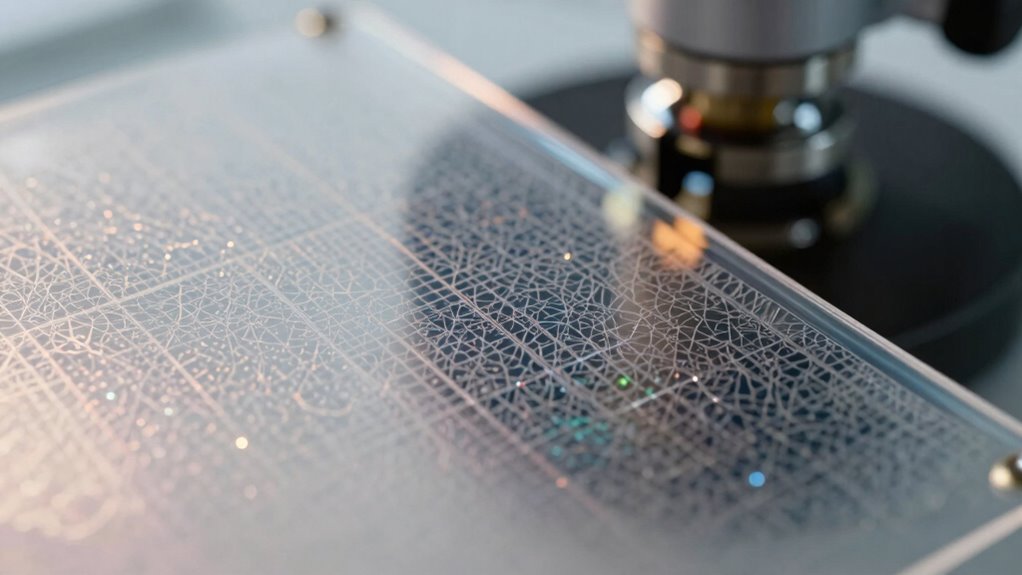

Nanofilms matter more than their thin appearance suggests because they pack powerful physical and chemical effects into an ultra-narrow layer. You benefit from unique quantum phenomena that change how materials behave, like improved electrical, optical, and magnetic properties. Their high surface-to-volume ratio also makes surface interactions essential, influencing durability, reactivity, and device performance. By harnessing these effects, nanofilms drive innovations in electronics, energy, and materials. If you look further, you’ll discover just how impactful these tiny layers really are.
Key Takeaways
- Nanofilms exhibit quantum effects that give rise to unique electrical, optical, and magnetic properties not found in bulk materials.
- Their high surface-to-volume ratio enables significant surface interactions, influencing reactivity, adhesion, and catalytic performance.
- The quantum confinement in nanofilms allows precise tuning of their functionalities for specific technological applications.
- Despite their thinness, nanofilms enable breakthroughs in device miniaturization and energy efficiency.
- Their ability to harness physical and chemical phenomena at the nanoscale makes them fundamental to advanced material and device innovations.

Despite their delicate, nearly invisible appearance, nanofilms play a fundamental role in modern technology and industry. These ultra-thin layers, often just a few nanometers thick, are more than simple coatings; they influence how devices perform at a basic level. When you look at a nanofilm, it’s tempting to dismiss it as insignificant due to its size. However, at this scale, the rules of classical physics give way to quantum effects, which dramatically alter how these films behave. This shift leads to quantum confinement, where electrons are restricted within such tiny dimensions, leading to unique electrical, optical, and magnetic properties. This means nanofilms can be engineered to have specific characteristics that are impossible with bulk materials, making them essential in semiconductors, sensors, and energy devices.
Nanofilms, just a few nanometers thick, harness quantum effects to revolutionize electronics and energy technologies.
Surface interactions are equally pivotal in determining a nanofilm’s function. Because of their small size, a large proportion of atoms in a nanofilm are on the surface rather than in the interior. This high surface-to-volume ratio means surface interactions dominate the material’s overall behavior. When you apply a nanofilm to a substrate or interface, the way it interacts with its surroundings—such as adhesion, chemical reactivity, and friction—becomes critical. These interactions influence everything from the durability of coatings to the efficiency of catalytic processes. For example, in electronics, surface interactions can affect how well a nanofilm insulates or conducts electricity, which directly impacts device speed and reliability. Additionally, the ability to precisely control surface chemistry and quantum states enables the development of tailored functionalities that can significantly enhance device performance. For instance, by adjusting surface chemistry, you can enhance a nanofilm’s ability to repel water or resist corrosion. Understanding quantum effects also allows for the fine-tuning of electronic properties, which can lead to breakthroughs in energy efficiency and device miniaturization.
In essence, nanofilms are more than just thin layers—they’re gateways to new physical phenomena and technological advancements. Their importance hinges on their ability to harness quantum effects and surface interactions to deliver superior performance in countless applications. The tiny size amplifies their influence, proving that thinness isn’t a limitation but a powerful feature. When you consider the potential of nanofilms, it’s clear they’re shaping the future of materials science and electronics far beyond what their appearance suggests.

Screen Protector For 2022-2025 2026 Ford Transit – 2 Pcs Nano-film 12-Inch Navigation Protector For 2022-2026 Transit(Passenger Van XL/XLT/Cargo Van/Crew Van) Accessories – HD Clear & Easy to Install
[Perfect Fit for Ford Transit] ECOZEN Nano-film screen protector for 2022-2025 2026 Ford Transit(Passenger Van XL/XLT/Cargo Van/Crew Van)….
As an affiliate, we earn on qualifying purchases.
As an affiliate, we earn on qualifying purchases.
Frequently Asked Questions
How Are Nanofilms Manufactured at Such a Tiny Scale?
You manufacture nanofilms through processes like chemical vapor deposition, atomic layer deposition, or sputtering, which allow precise control at the atomic level. These methods enable you to create thin, uniform layers ideal for nanofilm applications. However, you should also consider nanofilm limitations, such as fragility or difficulty scaling up production. Despite these challenges, their unique properties make nanofilms essential in electronics, coatings, and biomedical fields.
What Are the Environmental Impacts of Nanofilm Production?
You might not realize it, but nanofilm production can substantially impact the environment. While advancements aim to reduce harmful emissions, inadequate waste management and lax environmental regulations can lead to pollution. The tiny scale doesn’t eliminate risks—chemical use and waste disposal matter. It’s essential to follow strict environmental guidelines, minimize chemical waste, and implement sustainable practices to lessen the ecological footprint of nanofilm manufacturing, ensuring progress doesn’t come at nature’s expense.
Can Nanofilms Be Recycled or Reused Effectively?
You can recycle and reuse nanofilms, but recycling challenges often hinder effective processes due to their tiny size and specialized materials. However, their reuse potential remains promising, especially in high-tech applications where durability is key. To improve sustainability, researchers are developing better recycling methods and exploring ways to extend nanofilm lifespan. While not yet widespread, with innovation, nanofilms could become more environmentally friendly through enhanced recycling and reuse practices.
What Industries Benefit Most From Nanofilm Technology?
Imagine nanofilms as the silent guardians of innovation, quietly transforming industries. You’ll find them excelling in electronics, aerospace, and packaging, where their durability keeps devices safe, and their aesthetics enhance visual appeal. Their strength and transparency make them invaluable. By harnessing nanofilm durability, industries improve product longevity, while their sleek aesthetics elevate design. You benefit from smarter, more resilient products, all thanks to these thin yet mighty layers.
Are Nanofilms Safe for Consumer Products and Human Health?
Nanofilms are generally safe for consumer products and human health when properly tested. While nanofilm toxicity depends on materials used and application methods, rigorous safety assessments help guarantee consumer safety. Manufacturers must follow strict regulations, minimizing potential health risks. As a user, you can trust that quality-controlled nanofilm products are designed with safety in mind, but ongoing research continues to monitor and address any emerging concerns about nanofilm toxicity.
Advanced Materials for Electrochemical Energy Conversion and Storage Devices
As an affiliate, we earn on qualifying purchases.
As an affiliate, we earn on qualifying purchases.
Conclusion
Don’t let their delicate look fool you—nanofilms pack a powerful punch in technology and science. While they seem tiny, their applications revolutionize everything from electronics to medicine, offering strength, flexibility, and innovation. You might think their thinness makes them fragile, but in reality, they’re incredibly resilient and versatile. So, next time you see a nanofilm, remember it’s more than just a thin layer—it’s a game-changer hiding in plain sight, ready to transform the future.

Innovations in Green Nanoscience and Nanotechnology (Emerging Materials and Technologies)
As an affiliate, we earn on qualifying purchases.
As an affiliate, we earn on qualifying purchases.
nanofilm surface treatment
As an affiliate, we earn on qualifying purchases.
As an affiliate, we earn on qualifying purchases.