Nanopores are transforming molecular detection by providing rapid, label-free analysis of individual molecules with high sensitivity. They act as tiny gateways, detecting DNA, proteins, and other biomolecules in real time, often with just a small sample. This technology simplifies processes and bypasses traditional, time-consuming steps. As advancements continue, nanopores promise more accessible and faster diagnostics. Keep exploring to discover how these innovations could revolutionize health, science, and safety.
Key Takeaways
- Nanopores enable real-time, label-free detection of individual molecules, significantly reducing analysis time.
- They facilitate portable, cost-effective devices for rapid DNA sequencing and biosensing applications.
- Continuous technological improvements enhance accuracy and speed in molecular detection.
- Nanopores produce specific electrical signals, allowing immediate identification of diverse biomolecules.
- Integration with digital technologies streamlines data analysis, accelerating diagnostics and environmental monitoring.
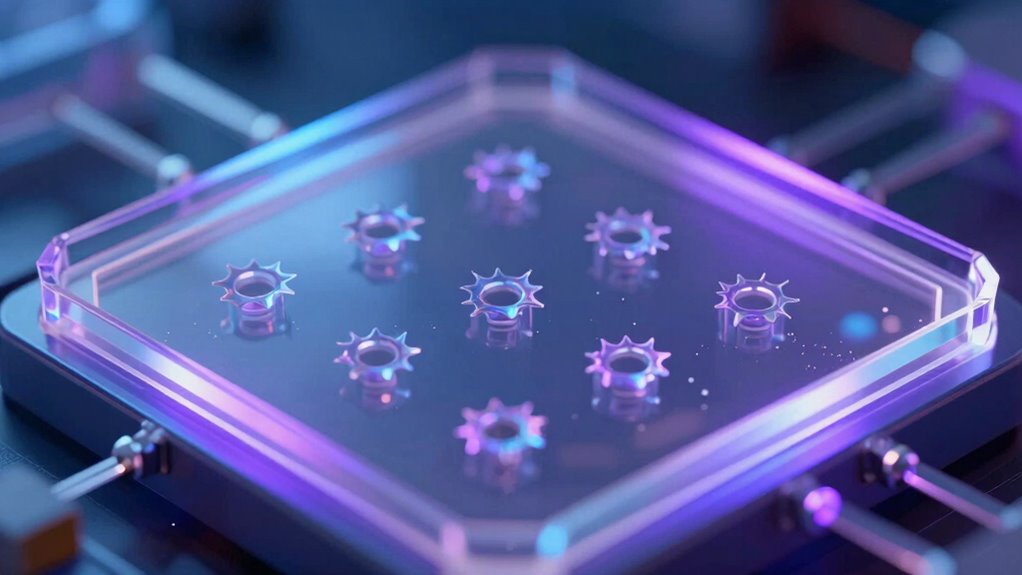
Have you ever wondered how scientists can detect individual molecules with such remarkable precision? The answer lies in the fascinating world of nanopores—tiny holes at the nanoscale that serve as gateways for molecules passing through them. These nanopores act as highly sensitive sensors, allowing scientists to identify and analyze molecules one by one. This capability is transforming fields like DNA sequencing and biosensing applications, where rapid, accurate detection is essential. Unlike traditional methods that often require bulky equipment or extensive sample preparation, nanopores offer a streamlined approach that can deliver real-time results with extraordinary detail.
Nanopores are tiny, highly sensitive gateways enabling real-time, detailed analysis of individual molecules.
In DNA sequencing, nanopores have revolutionized the process by enabling rapid reading of genetic material. When a strand of DNA passes through a nanopore, each nucleotide disrupts the electric current in a unique way. By monitoring these disruptions, scientists can determine the sequence of bases in real time. This method bypasses the need for chemical labeling or amplification, markedly speeding up genetic analysis. As a result, DNA sequencing with nanopores can be performed on a portable device, making genome analysis more accessible and cost-effective. The ability to quickly decode genetic information opens up new possibilities in personalized medicine, diagnostics, and even forensic science.
Beyond DNA sequencing, nanopores are also making a noteworthy impact in biosensing applications. They can detect a wide range of biomolecules—proteins, viruses, small metabolites—by measuring how each molecule interacts with the nanopore. Because these interactions produce specific electrical signals, nanopores can identify molecules with high specificity. This rapid detection capability is essential for early disease diagnosis, environmental monitoring, and food safety testing. Instead of waiting hours or days for lab results, you get immediate insights, which can be lifesaving or critical for timely decision-making.
What makes nanopores particularly promising is their ability to be integrated into portable, low-cost devices. This means that, in the near future, you could carry a handheld sensor capable of detecting pathogens or analyzing your own DNA on the spot. The potential to redefine fast molecular detection lies in their simplicity, speed, and versatility. As researchers continue to refine nanopore technology, expect more breakthroughs that will make molecular analysis quicker, more accurate, and accessible to everyone. This rapid evolution suggests a future where understanding and monitoring molecules becomes as straightforward as using your smartphone today, fundamentally changing how we approach health, science, and safety. Additionally, advancements in digital concepts are helping to optimize nanopore performance and data analysis, further accelerating progress in this field.

Gene Sequencing Genome Sequencing DNA Sequence T-Shirt
Lightweight, Classic fit, Double-needle sleeve and bottom hem
As an affiliate, we earn on qualifying purchases.
As an affiliate, we earn on qualifying purchases.
Frequently Asked Questions
Can Nanopores Detect All Types of Molecules Simultaneously?
No, nanopores can’t detect all types of molecules simultaneously. You need to take into account molecular specificity, which varies among different molecules, and pore customization, which allows you to tailor nanopores for specific targets. By customizing nanopores, you improve their ability to distinguish between molecules, but detecting every molecule at once remains challenging. Focus on designing specific nanopores for your molecules of interest to achieve accurate, efficient detection.
What Are the Main Limitations of Current Nanopore Technology?
You’ll find that current nanopore technology faces limitations like complex sample preparation and the need for signal amplification. Preparing samples often requires meticulous steps to guarantee accurate detection, which can be time-consuming. Additionally, the weak signals generated by some molecules demand amplification techniques, adding complexity. These issues hinder real-time, high-throughput analysis, but ongoing innovations aim to simplify sample prep and enhance signal clarity to overcome these challenges effectively.
How Do Environmental Factors Affect Nanopore Accuracy?
Environmental interference, like temperature fluctuations and vibrations, can disrupt signal stability in nanopore sensors, reducing accuracy. These factors cause noise and fluctuations in the electrical signals, making it harder to distinguish between different molecules. To improve reliability, you need to control environmental conditions carefully, such as maintaining stable temperatures and minimizing vibrations. This guarantees consistent signal stability, allowing nanopores to detect molecules more accurately and rapidly.
Are Nanopores Reusable or Single-Use Devices?
Nanopores are typically reusable, but their longevity depends on material durability and proper device sterilization. You can clean and sterilize them to maintain performance, although repeated use may cause wear or clogging. Some materials withstand sterilization better, extending device lifespan. Always follow manufacturer guidelines for sterilization to guarantee accurate results and prevent contamination, making your nanopore device both cost-effective and reliable over multiple uses.
What Is the Expected Cost of Nanopore-Based Detection Systems?
Like finding a needle in a haystack, estimating nanopore detection system costs can be complex. Currently, costs vary based on technology and application, but overall, they’re expected to decrease as market potential grows. Initial setups might be expensive, but mass production and technological advancements will likely make these systems more affordable, broadening access. This evolving cost estimation hints at a promising future for widespread, cost-effective molecular detection.
nanopore biosensor kit
As an affiliate, we earn on qualifying purchases.
As an affiliate, we earn on qualifying purchases.
Conclusion
You can see how nanopores might revolutionize molecular detection, making it faster and more accurate. Imagine identifying diseases in seconds—currently, it takes hours or days. Remarkably, researchers have already achieved detection speeds up to 100 times faster than traditional methods. As this technology advances, you’ll likely find it becoming an essential tool in healthcare, environmental monitoring, and more. It’s an exciting time where nanopores could truly transform how we understand and respond to molecular information.

Teyleten Robot PH Value Data Detection and Acquisition Sensor Module Acidity and Alkalinity Sensor Monitoring and Control ph0-14 for Arduino
Heating voltage: 5 plusmn 0.2V (AC middot DC)
As an affiliate, we earn on qualifying purchases.
As an affiliate, we earn on qualifying purchases.

Formal Approaches to Software Testing: Third International Workshop on Formal Approaches to Testing of Software, FATES 2003, Montreal, Quebec, Canada, … (Lecture Notes in Computer Science, 2931)
As an affiliate, we earn on qualifying purchases.
As an affiliate, we earn on qualifying purchases.