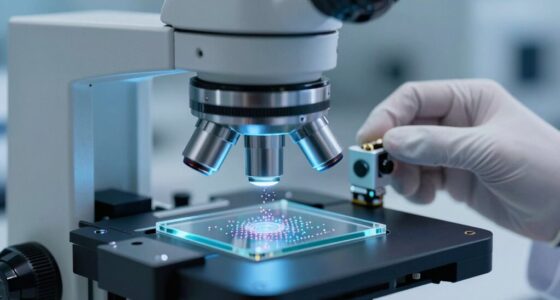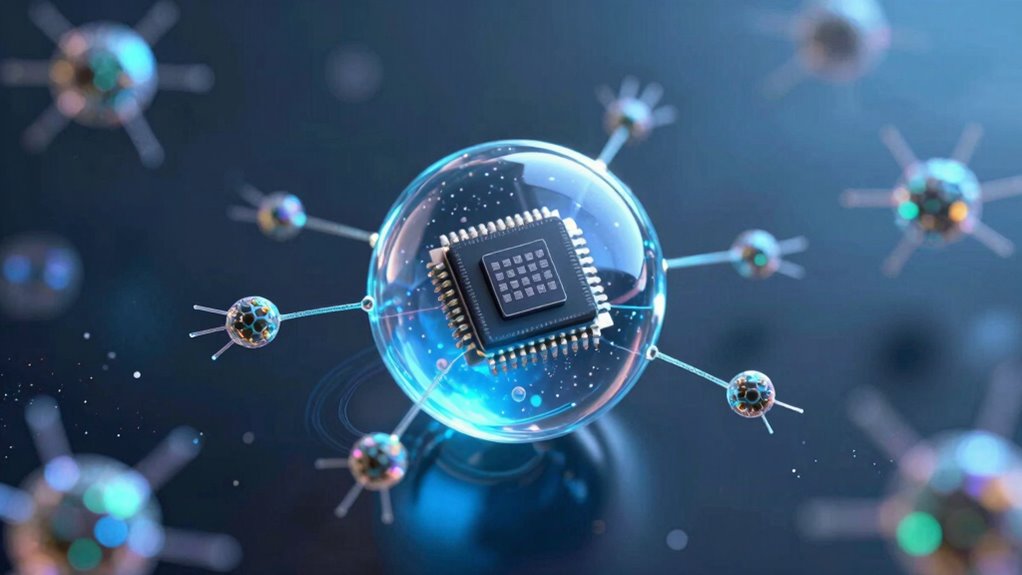

Nano-assisted drug monitoring offers the promise of more personalized, effective treatments that precisely target your body’s specific needs. By using nanoparticles, doctors can deliver medications directly to affected areas and track your response in real time. This reduces side effects and improves outcomes, making therapies safer and more tailored. With ongoing advancements, this technology is set to revolutionize healthcare. Stay with us to discover how these innovations could impact your future treatments.

Get the latest gadgets delivered free with Prime
- Fast, free delivery on millions of items
- Prime Video, Amazon Music and more included
- Member-only deals all year
Key Takeaways
- Enables real-time tracking of drug delivery and body response for personalized treatment adjustments.
- Improves drug targeting, increasing effectiveness while reducing side effects and damage to healthy tissues.
- Facilitates the development of smarter, adaptive therapies tailored to individual biological profiles.
- Advances in nanoparticle design aim to mitigate toxicity and enhance safety in clinical applications.
- Promises to transform healthcare into highly precise, minimally invasive, and more effective medical practices.

Have you ever wondered how modern medicine guarantees that drugs work effectively without causing harmful side effects? The answer lies in the revolutionary field of nano-assisted drug monitoring. This technology uses tiny particles called nanoparticles to track, deliver, and manage medication with incredible precision. By doing so, it transforms how treatments are tailored to individual patients, making therapies more effective and safer. But, as with any innovation, it’s essential to contemplate potential challenges, such as nanoparticle toxicity, which can arise if these particles aren’t carefully designed or managed. Understanding and addressing nanoparticle toxicity is vital to guarantee that nano-assisted drug monitoring truly benefits patients without introducing new risks.
With nano-assisted drug monitoring, you gain the ability to observe how your body responds to a medication in real time. Instead of relying on broad, one-size-fits-all dosages, your treatment becomes personalized. Nanoparticles can be engineered to target specific cells or tissues, releasing drugs exactly where needed and minimizing exposure elsewhere. This targeted approach reduces side effects and improves the drug’s effectiveness. For example, in cancer treatments, nanoparticles can deliver chemotherapy directly to tumor cells, sparing healthy tissue and reducing adverse effects. Such precision supports the trend toward personalized treatment, where therapies are customized based on your unique biological makeup.
Nano-assisted drug monitoring enables personalized, targeted treatments that improve effectiveness and reduce side effects.
However, integrating nanoparticles into medicine isn’t without its hurdles. Nanoparticle toxicity remains a concern, as these tiny particles may interact unpredictably with biological systems. If not properly designed, they could induce inflammation, damage cells, or accumulate in organs, leading to unforeseen health issues. That’s why ongoing research focuses heavily on understanding and mitigating nanoparticle toxicity. Developers are working to create biocompatible, biodegradable nanoparticles that break down safely in the body, reducing the risk of long-term side effects. Additionally, the development of regenerative practices in nanoparticle design can help improve their safety and functionality. This careful approach guarantees that the promise of nano-assisted drug monitoring doesn’t come at the cost of patient safety. Moreover, advances in material science are continually enhancing the safety profiles of these particles, ensuring they are both effective and safe for widespread medical use. Furthermore, the integration of advanced testing techniques allows researchers to better predict and monitor how nanoparticles interact within the body, further enhancing safety measures. The importance of comprehensive regulatory standards cannot be overstated to ensure consistent safety and efficacy across different applications.
Ultimately, the real promise of nano-assisted drug monitoring is its potential to revolutionize healthcare by making treatments smarter, safer, and more tailored to each person. You could benefit from therapies that adapt to your body’s responses, delivering effective doses precisely when and where they’re needed. As researchers continue to refine nanoparticle design and address safety concerns, this technology is poised to become a cornerstone of personalized medicine. It’s an exciting future where medicine becomes more precise, less invasive, and ultimately, more effective in managing your health.
As an affiliate, we earn on qualifying purchases.
Frequently Asked Questions
How Do Nano Sensors Compare to Traditional Drug Monitoring Methods?
Nano sensors outperform traditional drug monitoring methods by offering greater durability and real-time data, making it easier for you to track medication levels accurately. Their durability ensures consistent performance over time, while they often improve patient compliance by providing seamless, minimally invasive monitoring. Unlike conventional methods, nano sensors give instant feedback, helping you manage your treatment more effectively and confidently, ultimately enhancing your overall health outcomes.
What Are the Potential Long-Term Safety Concerns of Nano-Based Monitoring?
Did you know that over 90% of new drugs fail due to safety concerns? With nano-based monitoring, long-term safety risks like toxicity and environmental impact are major concerns. You might worry about unknown toxicity risks from nano particles accumulating in your body or ecosystems. It is crucial to thoroughly study these factors to prevent potential health hazards and environmental damage as nano technology becomes more widespread.
Can Nano-Assisted Monitoring Be Integrated With Existing Healthcare Systems?
Yes, nano-assisted monitoring can be integrated into existing healthcare systems, but you’ll need to address data privacy and ethical considerations. You must guarantee secure data transmission and storage, safeguarding patient information. Additionally, establishing clear ethical guidelines is crucial to prevent misuse or unintended consequences. While integration is feasible, ongoing oversight and adherence to privacy standards will be essential to protect patients and maintain trust in the technology.
How Cost-Effective Is Nano-Assisted Drug Monitoring Technology?
Nano-assisted drug monitoring can be cost-effective, especially as advances in nano fabrication lower manufacturing costs over time. It enhances patient compliance by providing real-time data, reducing hospital visits and medication errors. While initial investments might seem high, the long-term savings and improved health outcomes make it a promising solution. The true potential lies in balancing upfront costs with the future benefits of precision, efficiency, and better patient adherence.
What Are the Regulatory Challenges for Nano-Assisted Medical Devices?
You face regulatory challenges with nano-assisted medical devices, primarily due to complex regulatory pathways and approval hurdles. Agencies require thorough safety and efficacy data, which can be difficult to compile for nanotechnology-based tools. You must navigate evolving standards and demonstrate clear benefits over existing solutions. Staying updated on regulatory guidelines and engaging early with authorities can help you streamline approval processes and bring innovative nano-enabled devices to market more efficiently.
nanoparticle medical monitoring devices
As an affiliate, we earn on qualifying purchases.
As an affiliate, we earn on qualifying purchases.
Conclusion
Imagine a future where tiny nano messengers dance through your body, whispering secrets about your health. With nano-assisted drug monitoring, you hold the key to personalized care that’s as precise as a master artist’s brushstroke. This breakthrough isn’t just science; it’s a symphony of hope, promising a world where diseases are caught early and treated with the gentle touch of innovation. Together, you’re stepping into a brighter, healthier tomorrow, painted with the colors of endless possibility.
biocompatible nanoparticles for medicine
As an affiliate, we earn on qualifying purchases.
As an affiliate, we earn on qualifying purchases.
targeted cancer therapy nanoparticles
As an affiliate, we earn on qualifying purchases.
As an affiliate, we earn on qualifying purchases.
Halloween Picks
halloween
As an affiliate, we earn on qualifying purchases.