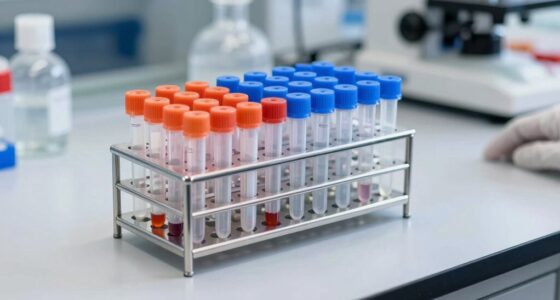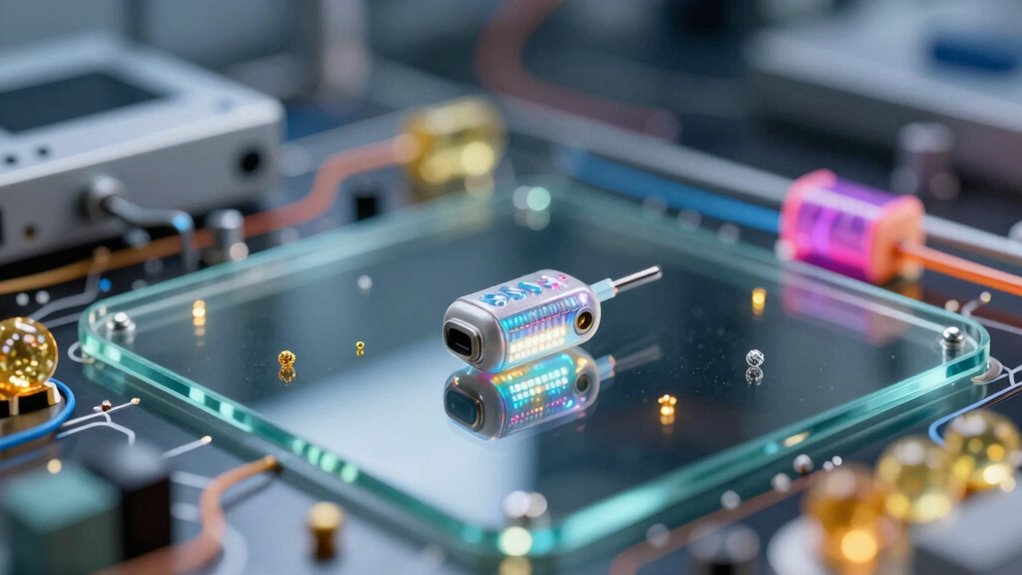

Nano diagnostics stand out from traditional tools because they use nanoparticles to detect specific molecules with incredible precision. They can identify even tiny differences, allowing for earlier disease detection and reducing false results. These tiny particles amplify signals and work quickly, often with less sample needed, making tests faster and more reliable. Plus, they’re adaptable for various diseases and can be integrated into portable devices. If you want to explore how this technology is transforming healthcare further, keep exploring.

Get the latest gadgets delivered free with Prime
- Fast, free delivery on millions of items
- Prime Video, Amazon Music and more included
- Member-only deals all year
Key Takeaways
- Nano diagnostics use nanoparticles to achieve highly specific and sensitive detection of molecular biomarkers.
- They can identify single molecules or very low concentrations, enabling earlier disease diagnosis.
- Signal amplification via nanoparticles results in faster, more reliable results with minimal sample volume.
- The technology is highly adaptable, allowing customization for detecting various diseases and biomarkers.
- Advances in nanoparticle engineering enhance precision, making nano diagnostics more accessible and effective than traditional tools.
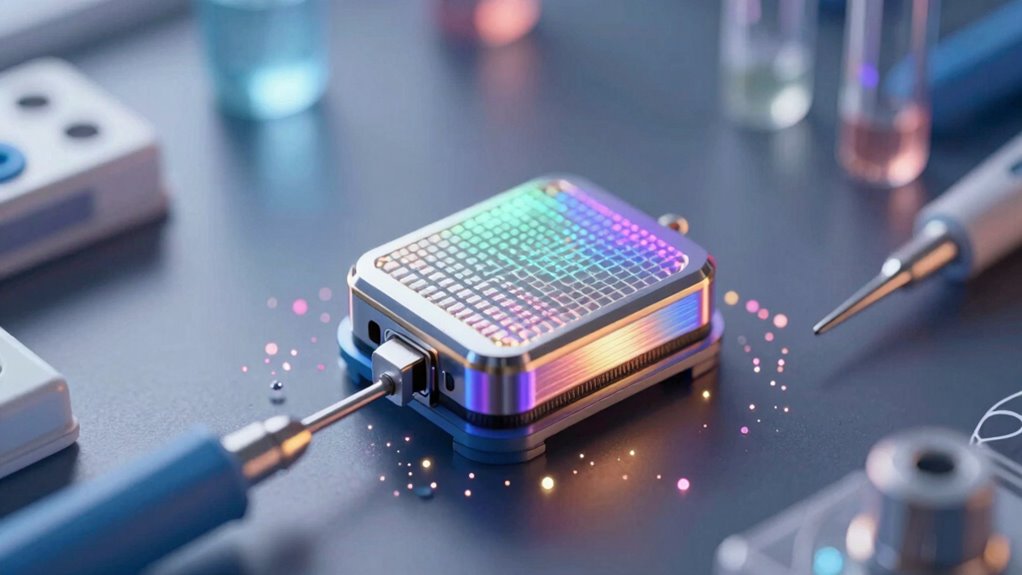
Nano diagnostics represent a game-changer in medical testing, offering a level of precision that conventional tools can’t match. Unlike traditional methods, which often rely on larger samples or less targeted detection, nano diagnostics utilize nanoparticles to identify specific molecules with remarkable accuracy. This approach hinges on nanoparticle interactions—where tiny particles bind selectively to targeted biomarkers—allowing you to detect diseases at much earlier stages. When working at such a small scale, these interactions become incredibly precise, reducing false positives and negatives. This heightened specificity is possible because nanoparticles can be engineered to recognize even the smallest molecular differences, which greatly boosts molecular sensitivity.
With conventional tests, you’re often limited by the size of the detection tools and the complexity of biological samples. In contrast, nano diagnostics operate on a scale that aligns with biological molecules, granting you the ability to pinpoint specific markers with unparalleled detail. The molecular sensitivity in nano diagnostics is so refined that it can detect a single molecule or a few molecules present in a sample. This level of detection is essential for early diagnosis, especially for conditions like cancer or infectious diseases, where early intervention dramatically improves outcomes. Advancements in nanoparticle engineering continue to improve the precision and capabilities of these diagnostic tools, making them more accessible and effective.
You’ll notice that nano diagnostics often use engineered nanoparticles—such as gold or silver particles—that amplify signals when they bind to target molecules. This signal amplification enhances detection even when the target molecules are in extremely low concentrations. As a result, you get faster, more reliable results, often with less sample volume required. Moreover, the small size of nanoparticles enables integration into portable devices, making point-of-care testing feasible. This means you won’t need to wait for lab results, which can take days; instead, you get immediate feedback, improving diagnosis and treatment decisions.
Another critical aspect is the adaptability of nanoparticle interactions. You can tailor these particles to target specific biomarkers, making nano diagnostics incredibly versatile. Whether it’s detecting a virus, a cancer cell, or a metabolic marker, the technology adjusts to meet your needs. This flexibility, combined with high molecular sensitivity, sets nano diagnostics apart from traditional testing methods, which are often less adaptable and less sensitive. Overall, by harnessing the power of nanoparticle interactions and molecular sensitivity, nano diagnostics open doors to faster, more accurate, and earlier disease detection—revolutionizing how you approach healthcare.
As an affiliate, we earn on qualifying purchases.
Frequently Asked Questions
What Are the Cost Differences Between Nano Diagnostics and Conventional Tools?
You’ll find that nano diagnostics often have higher initial costs compared to conventional tools due to advanced technology and specialized materials. However, their cost comparison can be favorable over time because they typically offer faster results, higher accuracy, and require less sample volume, which can reduce overall expenses. Affordability factors include long-term savings on reagents and labor, making nano diagnostics a cost-effective choice for many healthcare applications.
How Accessible Are Nano Diagnostic Technologies Globally?
Nano diagnostic technologies are like rare gems—exciting but not yet everywhere. You’ll find them more accessible in developed countries with strong infrastructure, but in many parts of the world, infrastructure challenges act like barriers, limiting their reach. Global distribution remains uneven, making it harder for some populations to benefit from these innovations. Expanding access requires investing in infrastructure and fostering collaborations worldwide.
Are Nano Diagnostics Safe for Widespread Clinical Use?
Nano diagnostics are generally safe for widespread clinical use when they follow strict safety protocols and obtain regulatory approval. You should guarantee that these devices undergo rigorous testing to confirm biocompatibility and accuracy. Regulatory agencies, like the FDA, evaluate safety data thoroughly before granting approval. As long as these standards are met, nano diagnostics can safely enhance disease detection and treatment, offering precise results with minimal risk to patients.
What Training Is Required to Operate Nano Diagnostic Equipment?
To operate nano diagnostic equipment, you need specialized training in nano fabrication techniques and equipment calibration. You’ll learn how to handle delicate instruments, guarantee precise measurements, and maintain safety protocols. This training typically involves hands-on workshops and theoretical courses, emphasizing the importance of accuracy and safety. By mastering these skills, you’ll effectively use nano diagnostic tools, making sure they deliver reliable results for clinical applications.
How Long Does It Take to Develop New Nano Diagnostic Tests?
Developing new nano diagnostic tests typically takes several months to a few years, depending on the complexity and innovation challenges involved. You’ll need to navigate a development timeline that includes research, prototype testing, and validation. The process demands patience and precision, as addressing innovation challenges like stability and sensitivity is essential. Overall, your effort in overcoming these hurdles will determine how quickly you can bring a new nano diagnostic test to market.
As an affiliate, we earn on qualifying purchases.
Conclusion
Nano diagnostics open a new frontier in healthcare, acting like a finely tuned microscope that reveals hidden details traditional tools miss. They’re faster, more precise, and capable of catching diseases early, long before symptoms appear. Think of them as the lighthouse guiding us through the fog of illness, illuminating paths to better health. With this technology, you’re not just fighting disease—you’re outsmarting it at its smallest, most elusive level, paving the way for a brighter, healthier future.
point of care molecular testing devices
As an affiliate, we earn on qualifying purchases.
As an affiliate, we earn on qualifying purchases.
early disease detection nanoparticle
As an affiliate, we earn on qualifying purchases.
As an affiliate, we earn on qualifying purchases.
Evergreen bestsellers Picks
bestsellers
As an affiliate, we earn on qualifying purchases.