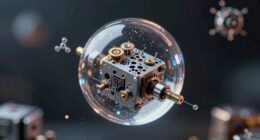

Brownian motors are tiny devices that harness random thermal motion to produce directed movement. Instead of relying on external forces, they use environmental asymmetries and energy gradients to bias particle motion, transforming chaotic fluctuations into useful work. This process enables molecular transport and energy conversion at microscopic scales, similar to natural systems. If you explore further, you’ll discover how these innovative mechanisms mimic biological functions and open new possibilities in nanotechnology.
Key Takeaways
- Brownian motors are microscopic devices that convert random thermal motion into directed, useful movement.
- They operate by exploiting environmental asymmetries and energy gradients without external macroscopic forces.
- These motors harness thermal fluctuations and structural asymmetry to bias particle transport.
- They facilitate molecular transport within cells and are inspired by natural biological systems.
- Their ability to turn chaos into order makes them important for nanotechnology and understanding biological processes.

Have you ever wondered how tiny particles move randomly but can be directed to perform useful tasks? That’s the fascinating world of Brownian motors. These microscopic devices harness the seemingly chaotic motion of particles to achieve specific functions, making them essential in fields like nanotechnology and biological systems. At the core of their operation is molecular transport, where they guide molecules or particles in a controlled manner despite the randomness of their environment. Imagine a tiny engine that, instead of traditional fuel, uses fluctuations and thermal energy to move molecules precisely where they’re needed. This process is a prime example of energy conversion at the molecular level, transforming random thermal motion into directed work.
Tiny particles move randomly but can be directed to perform useful tasks through Brownian motors.
Brownian motors work by exploiting asymmetries and fluctuations in their environment. They don’t rely on external forces in the way macroscopic engines do; instead, they use thermal noise and energy gradients to produce directional movement. When energy input, often from chemical reactions or temperature differences, is introduced, these motors effectively convert that energy into mechanical motion. This conversion process is vital because it allows for the transportation of molecules within cells or across nanodevices, all powered by the subtle interplay of thermal energy and structural asymmetry. By doing so, Brownian motors demonstrate how nature turns random energy into organized motion, a principle that scientists are eager to replicate in artificial systems. Understanding these mechanisms also highlights the significance of molecular transport for advancing nanotechnologies.
Understanding how these motors perform molecular transport involves examining their structural design and the energy landscapes they navigate. They often feature asymmetric potentials, which bias the random motion of particles, nudging them in a preferred direction. When energy is supplied, it alters these potentials, enabling the motor to push molecules forward—an elegant example of energy conversion in action. This ability to harness thermal fluctuations and convert them into useful work means Brownian motors are remarkably efficient at microscopic scales, where traditional machinery would fail. Their design principles inspire new ways to develop nanoscale machines for drug delivery, molecular sorting, or energy harvesting.
As you explore the science behind Brownian motors, you’ll see how they embody a fundamental principle: turning chaos into order. Their capacity for molecular transport and energy conversion at tiny scales not only deepens our understanding of biological processes but also opens up innovative avenues for technology. These motors remind us that even in the seemingly random world of particles, there’s potential for precise, purposeful movement—if you know how to harness the energy of fluctuations. In the end, Brownian motors aren’t just about tiny particles; they’re about transforming randomness into functionality, paving the way for breakthroughs across science and engineering.
Brownian motor nanoscale device
As an affiliate, we earn on qualifying purchases.
As an affiliate, we earn on qualifying purchases.
Frequently Asked Questions
How Do Brownian Motors Compare to Traditional Engines?
Brownian motors differ from traditional engines by harnessing molecular movement and random energy transfer to generate motion. Instead of relying on combustion or external power sources, they convert thermal fluctuations into directed work at a microscopic scale. You’ll find them in biological systems, where they perform tasks efficiently without conventional energy input. Unlike traditional engines, they operate through subtle energy transfers, making them essential for cellular processes and nanotechnology innovations.
What Are Practical Applications of Brownian Motors Today?
You can find practical applications of Brownian motors in molecular machines that perform tasks at the nanoscale, such as targeted drug delivery. These motors help transport drugs precisely within the body, improving treatment efficiency. Researchers also explore their use in developing tiny, energy-efficient devices. By harnessing the natural movement of molecules, Brownian motors enable innovations in medicine and nanotechnology, making them crucial tools for advancing healthcare and miniaturized systems today.
Can Brownian Motors Operate in Extreme Environmental Conditions?
You’ll find that brownian motors can operate in extreme environmental conditions, thanks to their remarkable resilience. For instance, some nanoscale devices withstand temperatures over 500°C, showcasing their adaptability. This environmental resilience permits them to function in extreme temperatures, radiation, and chemical exposure, making them suitable for space missions, deep-sea exploration, or harsh industrial environments. Their robust nature ensures reliable performance where traditional machines often fail.
What Are the Main Challenges in Developing Nanoscale Brownian Motors?
You face significant challenges when developing nanoscale Brownian motors, especially with scaling challenges and energy efficiency. As you shrink these devices, maintaining precise control becomes harder, and efficiency drops because thermal noise dominates. You must innovate materials and design to overcome these hurdles, ensuring the motors operate reliably at tiny scales. Overcoming these challenges will allow you to harness nanoscale Brownian motors for practical applications effectively.
How Does Temperature Influence the Efficiency of Brownian Motors?
You’ll find that temperature critically impacts the efficiency of Brownian motors because thermal noise increases with temperature, causing more random energy transfer. As temperature rises, the increased thermal fluctuations can disrupt directed motion, reducing efficiency. Conversely, at lower temperatures, less thermal noise allows for more controlled energy transfer, improving motor performance. However, extremely low temperatures can also hinder energy transfer, so ideal temperature balances are essential for maximizing efficiency.

NANOELECTRONICS: A MOLECULAR VIEW (World Scientific Nanoscience and Nanotechnology)
As an affiliate, we earn on qualifying purchases.
As an affiliate, we earn on qualifying purchases.
Conclusion
Now that you understand Brownian motors, you’ll see how tiny particles harness random motion to do work. Did you know that these motors operate efficiently at scales smaller than a human hair? This fascinating mechanism could revolutionize nanotechnology and medicine. By mastering how Brownian motors function, you’re stepping into a future where microscopic machines perform tasks once thought impossible. Keep exploring—these tiny engines might just hold the key to incredible innovations ahead.
energy harvesting nanomachine
As an affiliate, we earn on qualifying purchases.
As an affiliate, we earn on qualifying purchases.
artificial Brownian motor
As an affiliate, we earn on qualifying purchases.
As an affiliate, we earn on qualifying purchases.