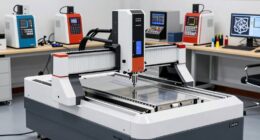

Molecular nanotechnology is a groundbreaking field that lets you manipulate and assemble individual molecules to create tiny devices with remarkable precision. It uses molecular assembly to build structures from the bottom up, replacing traditional manufacturing methods. This approach enables innovations in medicine, electronics, and materials, allowing you to develop nanoscale tools that can navigate bloodstreams or act as tiny computers. The potential is vast—exploring further reveals how these innovations are transforming multiple industries.
Key Takeaways
- Molecular nanotechnology involves designing and assembling molecules to create precise nanoscale structures and devices.
- It uses bottom-up manufacturing, guiding individual molecules to form complex functional systems.
- This technology enables the development of tiny devices with unique properties for medicine, electronics, and materials.
- Molecular assembly techniques allow atomic-level manipulation for scalable and reliable nanoscale fabrication.
- It holds the potential to revolutionize fields by enabling tasks impossible for larger-scale technologies.

Have you ever wondered how scientists manipulate matter at an atomic level? The field of molecular nanotechnology makes this possible by focusing on the precise control and arrangement of individual molecules. At its core, molecular assembly involves guiding molecules to assemble into specific structures, much like building with tiny, intricate Lego blocks. This process enables the creation of nanoscale devices—machines and tools so small that they operate at a scale invisible to the naked eye. These devices can perform tasks with extraordinary precision, opening doors to innovations across medicine, electronics, and material science.
Molecular assembly allows precise control of molecules to create nanoscale devices with remarkable capabilities.
Molecular assembly is the foundation of nanotechnology because it allows you to engineer matter at a level that was once thought impossible. Instead of relying on bulk materials or traditional manufacturing, you design molecules to fit together in predetermined ways. Think of it as programming at the molecular level, where the interactions between atoms are harnessed to build complex structures from the bottom up. This bottom-up approach contrasts sharply with conventional top-down manufacturing, offering unprecedented control and efficiency. For example, scientists can now assemble molecules into specific arrangements to form nanoscale devices with functions tailored to particular needs, such as targeted drug delivery systems or ultra-sensitive sensors.
When you explore nanoscale devices, you realize how transformative this technology can be. These tiny machines can perform tasks that are impossible for larger devices, like navigating through bloodstreams to deliver medication precisely where it’s needed or acting as tiny computers within electronic circuits. Because of their minuscule size, nanoscale devices often exhibit unique properties, such as increased strength, lighter weight, or enhanced reactivity. The ability to manipulate matter at this level means you can design devices with extraordinary precision, ensuring they perform reliably and efficiently. Molecular assembly techniques are crucial in enabling scalable and precise manufacturing processes of these devices.
Frequently Asked Questions
What Are the Ethical Concerns Surrounding Molecular Nanotechnology?
You should consider that molecular nanotechnology raises ethical concerns like privacy issues, as tiny devices could monitor you without consent. Additionally, you might worry about environmental impacts, since uncontrolled nanomaterials could harm ecosystems or cause pollution. Responsible development is essential to prevent misuse, protect your privacy, and minimize environmental risks. Addressing these concerns early helps ensure nanotechnology benefits society without compromising safety or ethical standards.
How Close Are We to Achieving Functional Nanomachines?
You might be surprised to learn that functional nanomachines are closer than you think, thanks to rapid advances in molecular assembly and atomic precision. Researchers have already created simple nanoscale structures, and ongoing developments aim to build more complex devices. While fully operational nanomachines are still in progress, the pace suggests that, within a decade or two, you could see practical applications transforming medicine, energy, and manufacturing.
What Industries Could Be Most Transformed by Nanotechnology?
You’ll find nanotechnology most transformative in healthcare and environmental sectors. In drug delivery, nanomachines enable targeted treatments, reducing side effects and improving effectiveness. For environmental cleanup, nanotech can break down pollutants and detect hazardous substances more efficiently. As you explore these industries, you’ll see how nanotechnology’s precision and adaptability revolutionize solutions, making processes faster, safer, and more sustainable for everyone.
Are There Health Risks Associated With Nanomaterials?
Yes, nanomaterials pose potential health hazards, causing concern about their environmental impact and regulatory challenges. You might worry about inhaling tiny particles or skin exposure that could lead to health issues. As nanotechnology advances, strict safety standards and regulations are essential to prevent problems. Staying informed and cautious helps protect your health and the environment while enjoying innovative nanotech benefits.
How Does Molecular Nanotechnology Differ From Traditional Nanotechnology?
Molecular nanotechnology differs from traditional nanotechnology by achieving molecular precision through nanoscale engineering. You can manipulate individual molecules to build precise structures, unlike traditional nanotech, which often works with larger nanoparticles. This allows for highly controlled, atom-by-atom assembly, enabling innovations in medicine, materials, and electronics. With molecular nanotechnology, you gain unprecedented control, leading to more advanced and tailored nanodevices and systems at the atomic level.
Conclusion
Now that you understand the potential of molecular nanotechnology, imagine a future where you can create, repair, and transform at the molecular level. Picture a world of endless possibilities, where innovation and discovery drive progress. Feel inspired to explore, to dream, and to push the boundaries of what’s possible. Embrace the power of molecular nanotechnology, and let it ignite your passion to shape a better, brighter tomorrow.