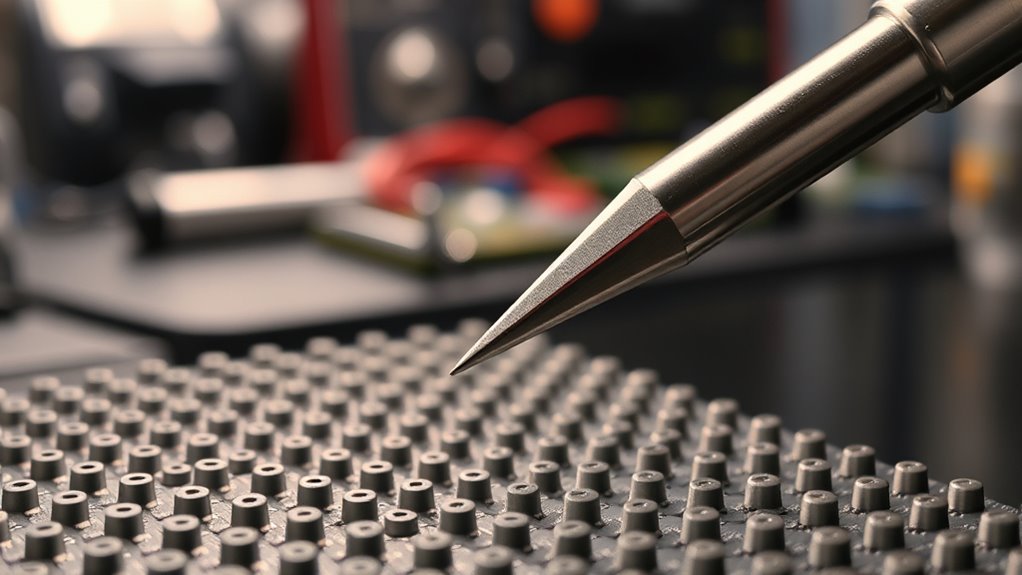

In nanoscience, tools like Atomic Force Microscopy (AFM) are essential because they allow you to visualize and manipulate surfaces at the atomic and molecular levels. These tools help you observe minute surface features, measure material properties, and even construct tiny structures. By using specialized instruments that detect forces and force interactions, you can explore nanoscale phenomena in detail. Keep exploring these tools further to uncover the fascinating capabilities helping advance this cutting-edge science.

Get the latest gadgets delivered free — and shop member deals
- Fast, free delivery on millions of items
- Access to Prime Big Deal Days deals on October 6–7
- Prime Video, Amazon Music and more included
Key Takeaways
- Scanning Probe Microscopy (SPM) techniques, including Atomic Force Microscopy (AFM), enable high-resolution surface imaging at the nanoscale.
- AFM uses a cantilever with a sharp tip to measure surface topography, mechanical properties, and molecular interactions.
- Tools like AFM can operate in various environments, such as liquids, to study biological molecules under native conditions.
- Nanoscience tools facilitate manipulation, assembly, and analysis of individual atoms and molecules for nanostructure creation.
- Advanced tools are increasingly integrated with AI for efficient data analysis and understanding of nanoscale phenomena.

Nanoscience relies on specialized tools that allow researchers to observe, manipulate, and analyze materials at the atomic and molecular levels. Among these tools, scanning probe microscopy stands out as a fundamental technique. This method involves using a sharp probe that scans across a sample’s surface, providing detailed images and measurements of structures at nanometer resolution. By moving the probe just nanometers above the surface, you can detect variations in height, electrical properties, or magnetic forces, revealing surface details that are invisible to traditional microscopes.
Scanning probe microscopy reveals nanoscale details invisible to traditional microscopes.
A key form of scanning probe microscopy is atomic force microscopy (AFM). With AFM, you operate a tiny cantilever with a sharp tip that interacts with the sample’s surface. As you gently drag the tip across the material, the cantilever deflects in response to atomic-scale forces. These deflections are measured with laser beams reflected off the cantilever, translating physical interactions into high-resolution images. This technique not only visualizes surface topography with incredible precision but also enables you to measure mechanical properties like stiffness and adhesion, making AFM a versatile tool in nanoscience.
Using atomic force microscopy, you can study a wide array of materials—from biological molecules to nanomaterials—without damaging the sample. Its ability to operate in different environments, including liquids, allows you to investigate biological specimens in their native conditions. When you want to understand how a nanoparticle interacts with its environment or how a biomolecule folds, AFM provides real-time, nanoscale insights that are impossible with conventional microscopes. Additionally, advances in AI-driven analysis are increasingly helping you interpret complex nanoscopic data more efficiently.
The versatility of scanning probe microscopy extends beyond imaging. You can also use it for manipulation, such as pushing or pulling individual atoms or molecules to build tiny structures or to study their behavior under different forces. This capability opens doors for customizing nanodevices and exploring fundamental questions about matter at the smallest scales.
In essence, tools like scanning probe microscopy and atomic force microscopy empower you to see the unseen and to work at the limits of what’s physically possible. They provide the detailed, atomic-level view needed to push nanoscience forward, whether you’re investigating new materials, developing nanotechnologies, or exploring the fundamental properties of matter. Without these tools, much of what you learn about the nanoscale would remain out of reach, making them indispensable in your scientific toolkit.
As an affiliate, we earn on qualifying purchases.
Frequently Asked Questions
How Do Nanoscience Tools Compare in Cost and Accessibility?
You’ll find that nanoscience tools vary widely in cost and accessibility. High-end instruments like electron microscopes are expensive and often limited to specialized labs, making them less accessible. Conversely, more affordable options like atomic force microscopes offer greater accessibility, but still require technical expertise. When comparing costs, consider not just the initial investment but ongoing maintenance and training, which also impact overall accessibility factors.
What Safety Precautions Are Necessary When Using Nanoscience Instruments?
Are you aware of the safety precautions needed when handling nanoscience instruments? You should always wear personal protective equipment like gloves, lab coats, and eye protection to shield yourself from potential hazards. Also, maintain strict contamination control to prevent nanoscale particles from spreading. Do you realize that neglecting these steps can compromise both your safety and your experiment’s integrity? Always follow proper protocols to ensure a safe and successful nanoscience experience.
Can These Tools Be Used for Educational Purposes at Home?
You can try DIY nanoscience experiments at home, but prioritize home safety first. Many advanced tools require specialized knowledge and equipment, making them unsuitable for casual use. Instead, consider beginner kits designed for educational purposes, which emphasize safety and simplicity. Always follow instructions carefully, keep a clean workspace, and avoid handling tiny particles without proper precautions. This way, you can explore nanoscience safely and enjoyably at home.
How Often Do Nanoscience Tools Require Calibration or Maintenance?
You should calibrate nanoscience tools regularly, typically every few months or as specified by the manufacturer, to guarantee accuracy. Maintenance requirements vary depending on the equipment, but usually involve cleaning, checking for wear, and software updates. Staying on top of calibration frequency and routine maintenance helps keep your tools reliable and precise, preventing errors in experiments and extending their lifespan. Always follow specific guidelines provided with your equipment for best results.
Are There Environmental Impacts Associated With Nanoscience Tools?
You might think nanoscience tools are eco-friendly, but they can pose environmental toxicity risks if not managed properly. You need to take into account waste disposal practices to prevent nanoparticle contamination. Although many tools are designed for minimal environmental impact, improper handling or disposal can lead to pollution. By following strict waste management protocols, you can reduce environmental harm and ensure responsible use of nanoscience technology.
As an affiliate, we earn on qualifying purchases.
Conclusion
In the world of nanoscience, these tools are your magic wands, revealing the universe at its tiniest secrets. With each microscope and scanner, you become an explorer charting uncharted domains, transforming invisible wonders into tangible discoveries. Embrace these instruments as your loyal companions, unblocking endless possibilities. As you explore deeper, remember that in this minuscule universe, even the smallest tool can open doors to monumental breakthroughs—turning tiny sparks into blazing innovations.
Nanoscale surface imaging microscope
As an affiliate, we earn on qualifying purchases.
As an affiliate, we earn on qualifying purchases.
As an affiliate, we earn on qualifying purchases.
Fall Picks
fall essentials
As an affiliate, we earn on qualifying purchases.