
Solar sails use large, reflective surfaces to harness sunlight’s photon pressure, providing continuous propulsion without fuel. Advanced nano-coatings protect sails from space hazards, boost reflectivity, and prevent degradation, making long journeys feasible. Missions like LightSail 2 prove their potential for deep-space travel. Cutting-edge innovations in deployment and control are paving the way for faster interplanetary and even interstellar exploration. Keep exploring to discover how these technologies could take you to the stars.
Key Takeaways
- Nano-coatings enhance solar sail reflectivity, durability, and resistance to space environmental damage, enabling longer missions toward the stars.
- Advanced nano-coatings protect sails from UV radiation, micrometeoroids, and atomic oxygen, preserving optimal performance over time.
- Improved nano-coatings increase photon momentum transfer efficiency, boosting propulsion for interstellar travel.
- Self-healing nano-coatings can automatically repair minor damages, maintaining sail integrity during extended space voyages.
- Innovations in nano-coatings support larger, lighter, and more resilient sails, facilitating faster, more efficient navigation to distant stars.
solar sail nano-coatings
As an affiliate, we earn on qualifying purchases.
As an affiliate, we earn on qualifying purchases.
How Solar Sails Harness Sunlight for Propulsion
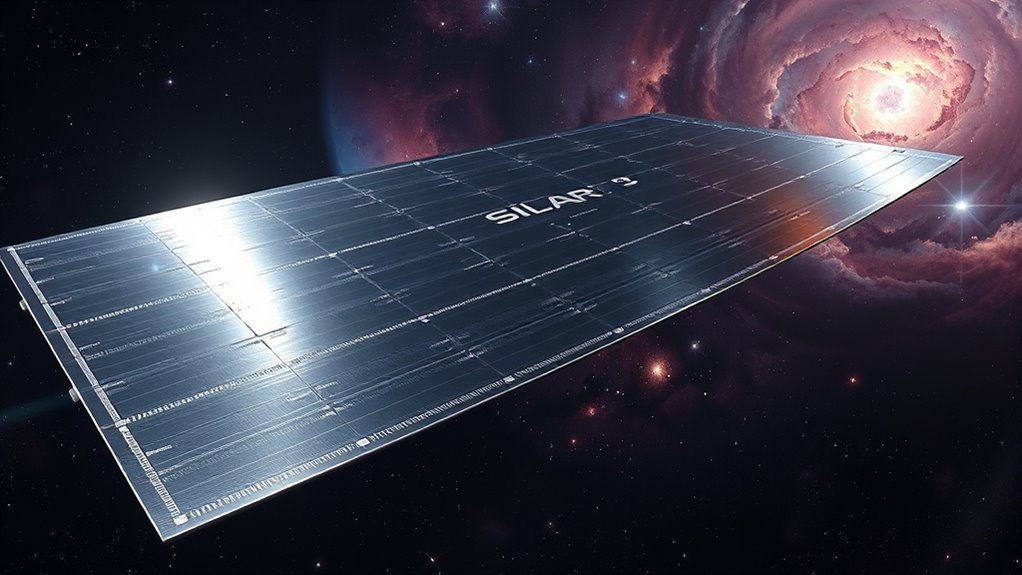
Solar sails harness sunlight for propulsion by using their large, highly reflective surfaces to capture the momentum of photons emitted from the Sun. When sunlight hits the sail, photons transfer their momentum, creating a gentle but continuous push. Unlike traditional engines that burn fuel, solar sails rely solely on this radiation pressure, providing a fuel-free way to move through space. The larger and more reflective the sail, the more photons it can catch, resulting in greater thrust. Since photons carry momentum but no mass, the sail gains speed over time without needing to carry extra fuel. This method allows for sustained acceleration, making solar sails ideal for long-duration missions where gradual, continuous thrust can eventually achieve high velocities across the solar system. Additionally, advances in nano-coatings can improve the reflectivity and durability of the sails, further enhancing their efficiency and lifespan. Moreover, ongoing research into materials science aims to develop even more effective coatings that maximize photon reflection and protect against space environment degradation. Improvements in coating technologies also help to reduce the degradation caused by space radiation and micrometeoroid impacts, extending the operational lifespan of the sails. Developing advanced materials that combine lightweight and high durability remains a key focus to improve overall performance.

Manicer Blacklight Space Astronaut Mouse Pad – UV Reactive Neon Galaxy Mat, Glow in The Dark Extended Gaming Mousepad with Colorful Cosmic Art for Office, Gamers & Room Decor – 31.5" x 11.8"
UV Reactive Astronaut Galaxy Art: Features a stunning space astronaut holding a glowing planet, designed with vibrant neon…
As an affiliate, we earn on qualifying purchases.
As an affiliate, we earn on qualifying purchases.
Advancements in Nano-Coatings for Enhanced Performance
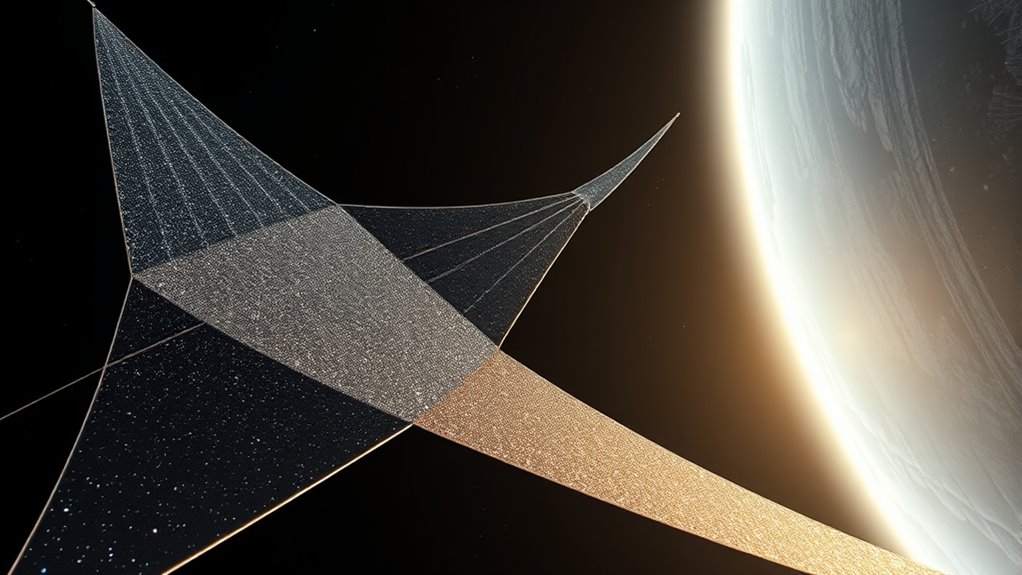
Advancements in nano-coatings are transforming the efficiency and durability of solar sails, enabling them to perform better in the harsh environment of space. These coatings protect sails from UV radiation, atomic oxygen, and micrometeoroid impacts, extending their lifespan. They also improve reflectivity, maximizing radiation pressure for propulsion. Here are key developments:
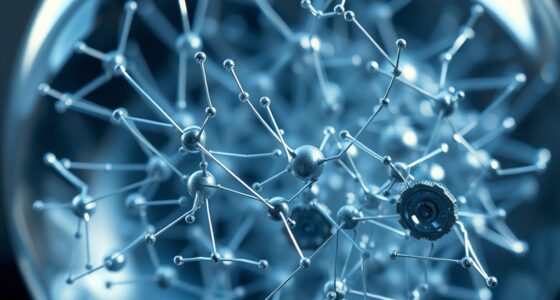
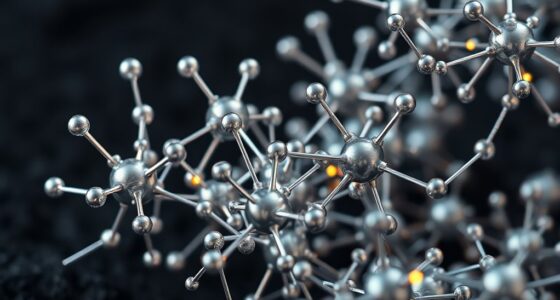
Nano-coatings enhance solar sail durability and reflectivity, boosting space propulsion efficiency.
- Ultraviolet-Resistant Coatings: Shield sails from damaging UV rays, preventing degradation over long missions. Incorporating UV protection technologies enhances the longevity of sails exposed to prolonged sunlight.
- Self-Healing Layers: Repair minor damages automatically, maintaining sail integrity. This innovation minimizes the need for maintenance and ensures continuous operation.
- Enhanced Reflectivity Films: Increase momentum transfer by reducing absorption and scattering. Improved reflectivity directly correlates with better propulsion efficiency.
- Anti-Contamination Coatings: Prevent dust and debris buildup, preserving ideal performance. These coatings are essential for maintaining optimal reflectivity in dusty or debris-rich environments.
These nano-coatings make sails more resilient, efficient, and ready for extended journeys across the solar system. Additionally, ongoing research into Free Floating systems offers promising avenues for deploying and maintaining sails in deep space.
self-healing nano-coatings for space sails
As an affiliate, we earn on qualifying purchases.
As an affiliate, we earn on qualifying purchases.
Key Missions Demonstrating Solar Sail Capabilities
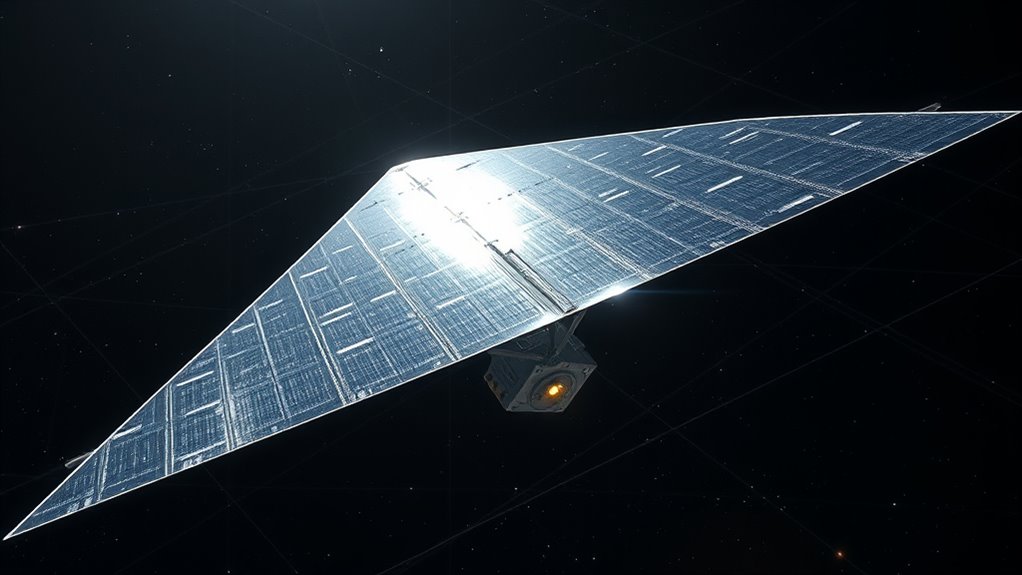
Numerous missions have showcased the practical potential of solar sails, moving beyond theoretical concepts to real-world applications. NASA’s Advanced Composite Solar Sail System (ACSSS) successfully tested sail deployment and stabilization using sunlight pressure, with an 80-square-meter sail deployed via composite booms. The Planetary Society’s LightSail 2, operational from 2019 to 2022, used sunlight to slow orbital decay and briefly raise its orbit, demonstrating controlled maneuvering with minimal propulsion. The MESSENGER probe employed solar panels for precise trajectory adjustments around Mercury. Early efforts like NanoSail-D and IKAROS laid the groundwork for CubeSat sail technology, proving deployment, control, and durability in space. These missions validate solar sails as a viable propulsion method for future deep-space exploration and high-speed missions.
spacecraft reflectivity films
As an affiliate, we earn on qualifying purchases.
As an affiliate, we earn on qualifying purchases.
Technological Innovations in Sail Deployment and Control
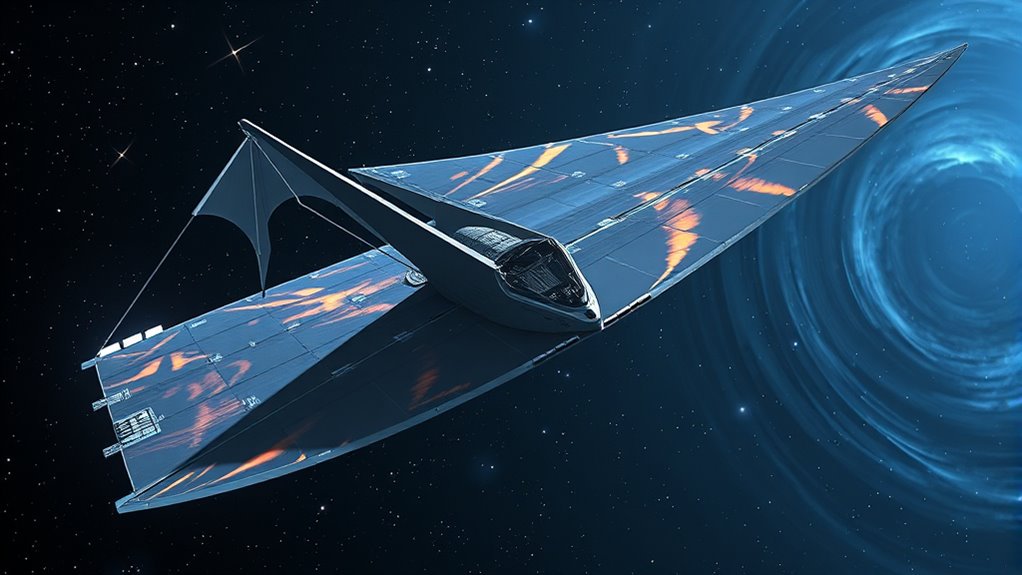
Innovative technologies have revolutionized the way solar sails are deployed and controlled in space. You now benefit from advanced methods that make sail deployment faster and more reliable. Here are four key innovations:
- Composite booms: These unroll to stretch the sail diagonally, fitting compactly for launch and deploying in about 25 minutes.
- Spin deployment: Simplifies mechanisms by using rotation, eliminating complex moving parts, and ensuring steady unfolding. This method reduces the risk of deployment failures and enhances overall sail stability.
- Liquid crystal panels: Control attitude by diffusing or reflecting sunlight, allowing precise, mechanical-free maneuvering. Additionally, these panels can be dynamically adjusted for optimal solar radiation management.
- Integrated thin-film solar cells: Power spacecraft systems while enabling sail orientation adjustments, improving efficiency. Understanding precision control techniques is crucial for optimizing sail performance and maneuverability in space.
Future Perspectives: From Solar System Exploration to Interstellar Travel
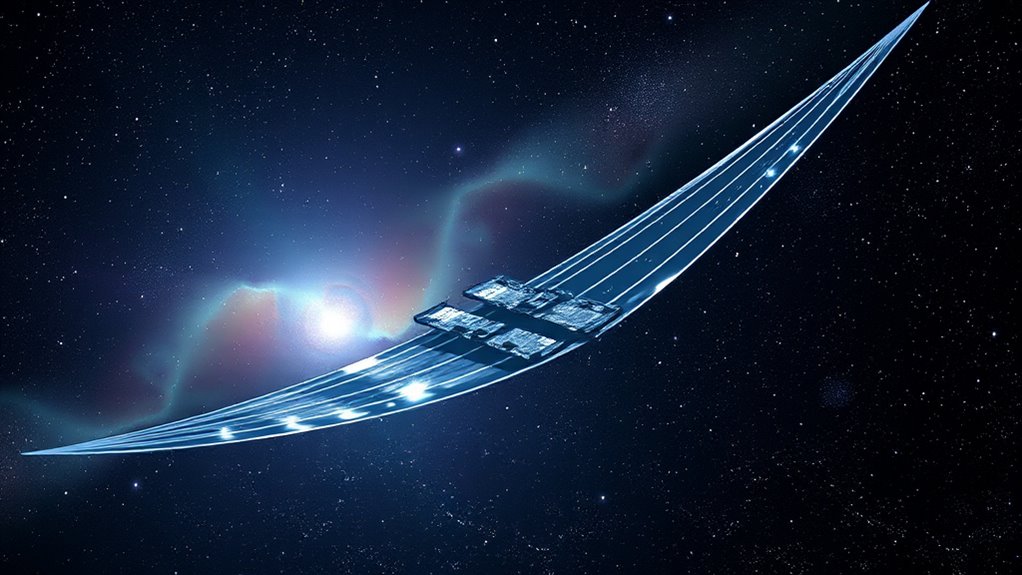
Building on recent breakthroughs in sail deployment and control, the future of solar sailing aims to extend our reach beyond the confines of our solar system. You’ll see these sails increasingly used for interplanetary missions, reaching outer planets faster and more efficiently. As materials improve, sails will become lighter and more durable, enabling higher velocities and longer missions. Laser propulsion technology could push spacecraft to a significant fraction of the speed of light, making interstellar travel feasible within your lifetime. Nano-coatings will enhance sail reflectivity and resistance, reducing degradation over time. You’ll also leverage advanced navigation systems, like laser beaming and autonomous control, to steer these sails accurately over vast distances. Ultimately, solar sails could carry you to nearby star systems, transforming humanity’s exploration of the galaxy.
Frequently Asked Questions
What Are the Main Materials Used in Creating Ultra-Light Solar Sails?
You mainly use ultra-lightweight materials like mylar or Kapton for solar sails, as these films are highly reflective and flexible. Advanced composites and thin-film solar cells are also integrated to improve performance and power generation. These materials are chosen because they combine low mass with durability, allowing the sail to efficiently harness sunlight, maneuver precisely, and sustain long-duration missions without adding unnecessary weight that could hinder acceleration.
How Do Nano-Coatings Improve the Durability of Solar Sails?
Nano-coatings substantially boost solar sail durability, with some coatings increasing resistance to space radiation by up to 50%. You’ll find that these ultra-thin layers shield the sail’s surface from micrometeoroid impacts, UV degradation, and temperature extremes. This protection extends the sail’s lifespan, ensuring it maintains its reflective and structural properties during extended missions, making spacecraft more reliable and cost-effective for long-term exploration.
Can Solar Sails Operate Effectively Beyond the Orbit of Mars?
Yes, solar sails can operate beyond Mars, but their effectiveness decreases with distance from the Sun due to the inverse square law. As you move farther out, sunlight weakens, reducing thrust. However, with advanced materials and control systems, you can still generate enough propulsion for gradual acceleration. These sails are ideal for long-term missions where continuous, fuel-free thrust can eventually reach distant targets or even escape the solar system.
What Are the Challenges in Scaling up Solar Sail Size for Interstellar Missions?
Scaling up solar sails is like trying to stretch a delicate spiderweb across a canyon—you face structural and deployment challenges. You need larger, ultra-lightweight materials that won’t tear or warp in space. Deployment mechanisms become more complex, risking failure. Maintaining sail shape and stability during maneuvering is harder. Plus, the decreasing sunlight intensity farther out reduces thrust, making it tough to generate enough momentum for interstellar journeys.
How Do Solar Sails Compare Cost-Wise to Traditional Chemical Propulsion Systems?
You’ll find solar sails are generally more cost-effective than chemical propulsion because they don’t require expensive fuel or complex engines. Their lightweight design reduces launch costs, and once deployed, they use sunlight for propulsion, saving ongoing expenses. While initial development and deployment can be costly, especially for large sails, the long-term savings and simplicity make solar sails a budget-friendly option for many space missions.
Conclusion
Imagine gliding effortlessly through space, powered only by sunlight and cutting-edge nano-coatings. With ongoing advancements, you can see how solar sails could someday carry you beyond our solar system. Isn’t it amazing to think that, with these innovations, we’re not just dreaming of reaching the stars but actively designing the tools to make it happen? As technology progresses, the universe becomes your playground—are you ready to sail into the cosmic future?