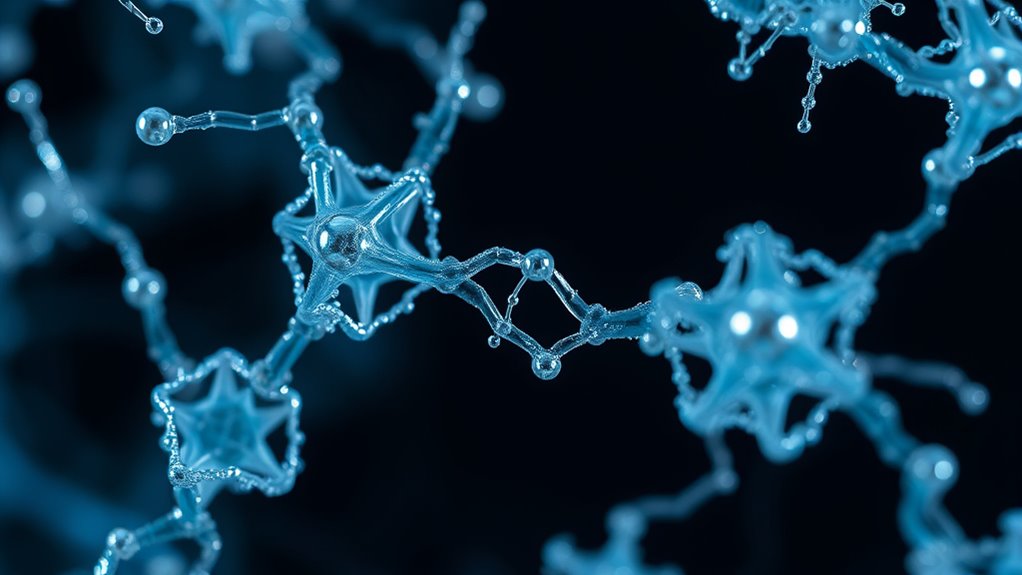

Building nanobots from proteins involves designing specific amino acid sequences that fold into shapes capable of self-assembling into tiny, functional machines. You leverage natural biological processes like hydrogen bonding and hydrophobic effects to create these structures, which can perform precise tasks such as targeted drug delivery. By controlling protein design and assembly, you can harness nature’s efficient, scalable methods. If you keep exploring, you’ll discover more about how this cutting-edge technology is revolutionizing nanoscience.
Key Takeaways
- Proteins can be designed with specific sequences to fold into shapes that self-assemble into nanobot structures.
- Computational tools predict protein folding, enabling precise design before synthesis and assembly.
- Protein interactions like hydrogen bonds and hydrophobic effects drive the spontaneous self-assembly of nanobot components.
- Synthesized proteins naturally recognize and connect with each other, forming functional nanobots through biological processes.
- These biologically assembled nanobots are scalable, biocompatible, and suitable for applications like targeted drug delivery.

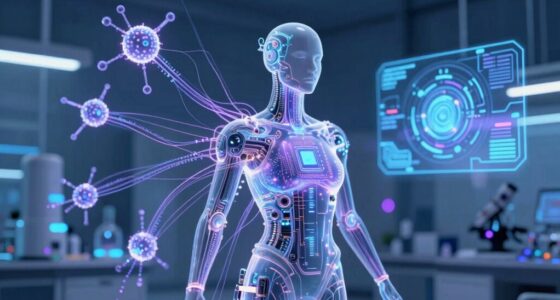
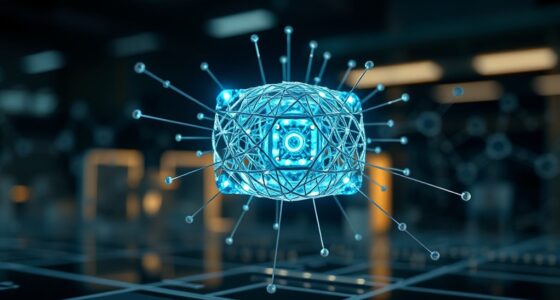
Scientists are now harnessing the power of proteins to build tiny, functional robots known as nanobots. These microscopic machines could revolutionize medicine, environmental cleanup, and manufacturing. The key to creating these nanobots lies in understanding how proteins fold and how they can be assembled into precise structures. Protein folding is a natural process where chains of amino acids twist and bend into specific shapes, forming the functional units of life. By controlling this folding process, scientists can design proteins that self-assemble into nanobots with desired functions. This approach allows for a high degree of customization, as each protein’s shape and behavior can be tailored through sequence design. Additionally, advances in protein design techniques enable more accurate prediction and creation of these complex structures. Nanobot assembly involves guiding these folded proteins into complex, functional structures. Instead of building each component manually, you leverage the proteins’ inherent ability to assemble themselves based on their amino acid sequences. This self-assembly process, driven by molecular interactions like hydrogen bonds, hydrophobic effects, and electrostatic forces, ensures the nanobots are constructed with remarkable precision. You can think of it as programming proteins to recognize and connect with each other, forming a larger, functional device. This biological approach to assembly offers advantages over traditional manufacturing, such as scalability and biocompatibility. You don’t need complicated machinery; instead, you design the proteins, and nature takes care of the rest. To make this happen, you start by designing specific protein sequences that will fold into the desired shapes. Advances in computational biology allow you to simulate how these sequences will fold, ensuring they achieve the correct structure before synthesis. Once synthesized, these proteins can spontaneously assemble into nanobots through their natural affinity for certain shapes and binding partners. This process is akin to building with Lego blocks, but on a molecular scale, where each piece fits perfectly based on its shape and chemical properties. The ability to control protein folding and nanobot assembly at this level opens up exciting possibilities for targeted drug delivery, where nanobots can navigate to specific cells and release medication precisely where needed. Ultimately, by mastering protein folding and nanobot assembly, you’re harnessing nature’s own tools to create tiny machines that could perform tasks too small or complex for traditional engineering. This fusion of biology and nanotechnology promises a future where custom-designed nanobots could operate inside your body or in the environment, performing tasks with unprecedented accuracy and efficiency.
protein nanobot kits
As an affiliate, we earn on qualifying purchases.
As an affiliate, we earn on qualifying purchases.
Frequently Asked Questions
What Are the Potential Risks of Nanobot Deployment in Humans?
You should be aware that deploying nanobots in humans poses risks like ethical concerns and unintended consequences. These tiny machines might malfunction or cause immune reactions, leading to health issues. There’s also worry about privacy and consent, as nanobots could be used maliciously or without proper oversight. Always consider these potential dangers before advancing nanobot technology, ensuring safety and ethical standards are prioritized to avoid harm or misuse.
How Long Does It Take to Develop Functional Protein-Based Nanobots?
Developing functional protein-based nanobots typically takes years due to manufacturing timelines and development challenges. For example, scientists working on targeted drug delivery nanobots estimate it can take 5 to 10 years to optimize design and guarantee safety. You’ll face hurdles like protein stability and precise control, which extend the timeline. Progress depends on advances in biochemistry, engineering, and rigorous testing, making it a lengthy but potentially rewarding process.
Can Protein Nanobots Be Reused or Recycled After Use?
Yes, protein nanobots can often be reused or recycled after use. You can employ specialized recycling methods like denaturation and renaturation, which allow you to recover and restore their functionality. Their reuse potential depends on how well you maintain their structural integrity during operations. Proper recycling techniques ensure you maximize their lifespan, reduce waste, and make your nanobot applications more sustainable and cost-effective.
What Are the Costs Involved in Producing These Nanobots?
You’ll find that producing protein nanobots involves significant costs, as you need specialized equipment and precise conditions. The production costs can add up quickly, especially when trying to scale up, facing challenges like maintaining consistency and purity. Visualize tiny protein structures assembled layer by layer, demanding meticulous work. Scalability challenges make it tricky to mass-produce efficiently, but advancements could eventually lower costs and streamline the process.
How Do Protein Nanobots Communicate Within Biological Systems?
You can think of protein nanobots communicating through molecular signaling, which enables cellular communication. They send and receive signals like chemical messengers, triggering specific responses within the biological system. This process involves receptors on cell surfaces that detect signals from nanobots, allowing precise control and coordination. By mimicking natural cellular communication, these nanobots can effectively interact with their environment, making them highly adaptable for medical and biological applications.
biocompatible nanobot components
As an affiliate, we earn on qualifying purchases.
As an affiliate, we earn on qualifying purchases.
Conclusion
By harnessing the incredible versatility of proteins, you’re revealing a future where nanobots could revolutionize medicine and technology. Imagine building tiny robots that can repair organs or clean up pollution—these aren’t just dreams anymore, but realities taking shape. With proteins as your building blocks, you hold the power to create nanobots more complex than the most advanced machines. The possibilities are endless, and you’re standing on the brink of transforming the world in ways that are almost too incredible to believe.

Introduction to Proteins: Structure, Function, and Motion, Second Edition (Chapman & Hall/CRC Computational Biology Series)
As an affiliate, we earn on qualifying purchases.
As an affiliate, we earn on qualifying purchases.
targeted drug delivery nanobots
As an affiliate, we earn on qualifying purchases.
As an affiliate, we earn on qualifying purchases.