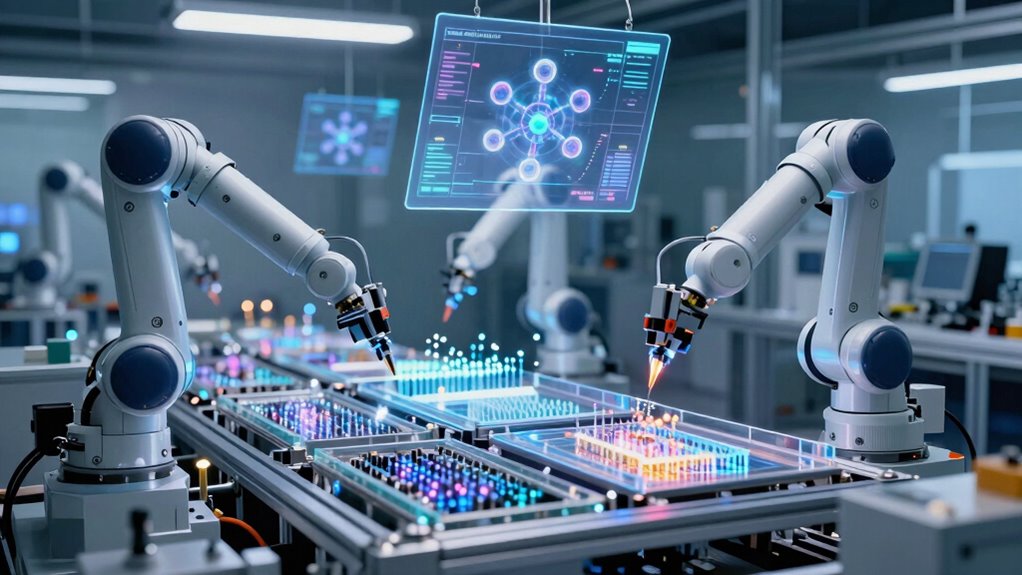

Inside a nanofactory, atomic manufacturing is indeed possible through advanced nanotechnology and precise mechanosynthesis techniques. You would use programmable nanomachines to manipulate individual atoms, building materials atom by atom with extraordinary accuracy. These systems rely on hierarchical assembly, combining nanoblocks into larger structures under ultra-high vacuum or inert environments. As you explore further, you’ll discover the potential challenges and groundbreaking applications that make atomic manufacturing a future reality.
Key Takeaways
- Atomic manufacturing is theoretically possible using mechanosynthesis techniques that position atoms with atomic precision.
- Nanofactories utilize hierarchical assembly of nanoblocks to build macroscale objects atom-by-atom.
- Ultra-high vacuum and advanced control systems are essential to prevent contamination and ensure atomic accuracy.
- Scaling from molecular blocks to complex, macroscopic products remains a significant technical challenge.
- Ongoing research aims to develop reliable, efficient nanomachines capable of precise atomic-level manufacturing.
atomic manufacturing nanofactory
As an affiliate, we earn on qualifying purchases.
As an affiliate, we earn on qualifying purchases.
What Is a Nanofactory and How Does It Work?

A nanofactory is a compact, highly precise manufacturing system that builds complex diamondoid products atom by atom. You control it through programmable nanomachines that perform mechanosynthesis, placing atoms exactly where needed. This system fits on a desktop but can produce macroscale items by assembling nanoblocks hierarchically. It differs from traditional nanomanufacturing, which uses top-down or bottom-up methods, by employing full atom-by-atom control. The process relies on mechanochemical fabricators operating in ultra-high vacuum or inert fluids to prevent unwanted reactions. These fabricators follow programmed instructions to add or remove transfer atoms, creating nanoblocks that are then assembled into larger structures. Power, feedstock, and cooling are essential inputs, while the output is precise, atomically perfect diamondoid products. Advances in nanomanufacturing techniques continue to push the boundaries of what is possible with atomic-level assembly. Moreover, researchers are exploring scalability and efficiency improvements to enable practical atomic manufacturing applications in the future. Additionally, ongoing research aims to improve the precision and control of these systems, making atomic manufacturing increasingly feasible for practical applications.
programmable nanomachines for atom manipulation
As an affiliate, we earn on qualifying purchases.
As an affiliate, we earn on qualifying purchases.
The Core Techniques of Molecular Assembly
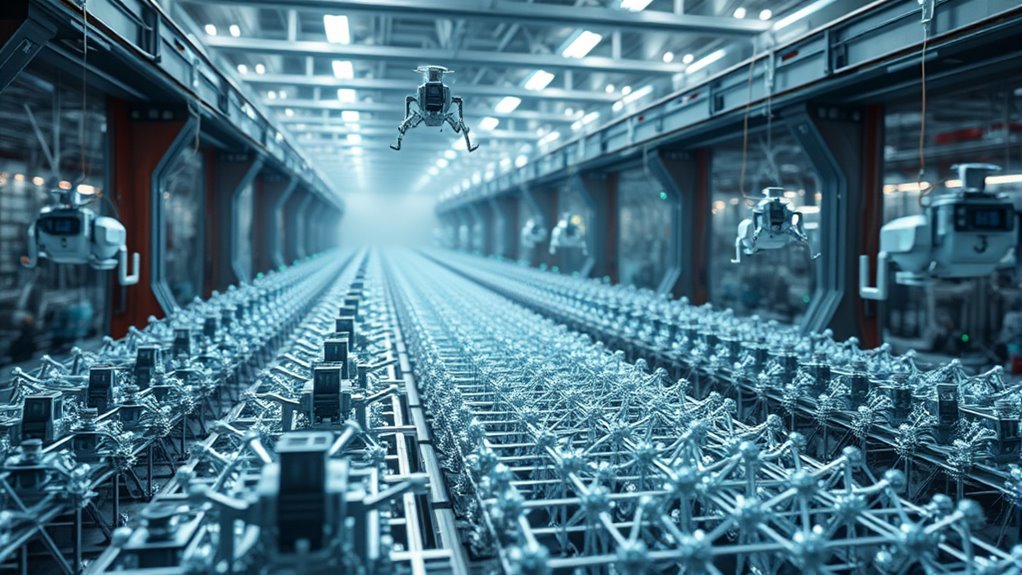
To build at the molecular level, you need to master precise atomic positioning, ensuring each atom lands exactly where it should. Controlled molecular reactions allow you to add or remove atoms selectively, guiding the assembly process. Mechanosynthesis techniques provide the mechanical control necessary to execute these reactions with atomic accuracy. Molecular assembly is fundamental to developing reliable nanofactories capable of constructing complex structures from the atomic scale. Achieving this level of control also depends on advanced atomic manipulation methods that enable precise adjustments at the individual atom level. Developing these techniques requires a deep understanding of juice extraction techniques and their applications in health and nutrition, which exemplify the importance of precision control at small scales.
Precise Atomic Positioning
Precise atomic positioning lies at the heart of molecular assembly in nanofactories, enabling the construction of complex diamondoid structures with atomic-level accuracy. You control the location of each atom during mechanosynthesis, ensuring correct bonding and structure. Techniques like scanning probe microscopes and mechanochemical tools manipulate atoms directly, using force and feedback systems. These tools allow you to position atoms within fractions of a nanometer, essential for building reliable, functional nanostructures.
| Technique | Key Feature |
|---|---|
| Atomic Force Microscopy | Precise force control for atom placement |
| Mechanochemical Fabrication | Mechanical forces guide atom addition or removal |
| Self-assembly Guidance | Templates and surface patterns direct atom positioning |
Controlled Molecular Reactions
Controlled molecular reactions form the backbone of the nanofactory’s assembly process, enabling you to manipulate individual atoms with high precision during fabrication. You use mechanochemical fabricators to perform positional DMS, adding or removing transfer atoms under complete control. These operations occur in ultra-high vacuum or inert fluids to prevent side reactions. Your programmed tooltips guide the fabricator through reaction sequences, constructing diamondoid parts like gears or bearings atom by atom. You precisely control bond formation and breaking, ensuring each step’s accuracy. By manipulating transfer atoms with atomic-scale precision, you build nanoblocks that serve as modular units for larger structures. This process allows you to assemble complex, atomically perfect products from simple hydrocarbon feedstocks, laying the foundation for true molecular manufacturing. Atomic-scale manipulation is fundamental to achieving the precision required for reliable nanofactory fabrication, which is essential for integrating these processes into advanced smart manufacturing systems that ensure quality and safety. Additionally, maintaining reaction environment control is critical to prevent unintended side reactions and ensure process fidelity.
Mechanosynthesis Techniques
Mechanosynthesis techniques form the core of atom-by-atom assembly in the nanofactory, enabling you to manipulate individual atoms with unmatched precision. You achieve this through controlled mechanical interactions, such as tip-based atomic placement. Key methods include:
- Mechanical transfer, where nanomachines physically position transfer atoms onto target sites. Precision control is vital to ensure accurate placement and avoid unintended atomic interactions.
- Bond formation control, ensuring chemical bonds form only when atoms are correctly aligned.
- Selective removal, allowing you to detach atoms or molecules to shape the structure.
- Feedback systems, providing real-time monitoring and adjustments for atomic accuracy. Environmental control is essential to maintain the necessary conditions for successful assembly. Additionally, environmental stability ensures that external factors do not interfere with the delicate processes involved. By combining precise mechanical forces with automated control, you can build complex nanostructures layer by layer, laying the foundation for atomic manufacturing. Achieving this level of precision often requires advanced instrumentation, which relies on high-resolution detection to detect and respond to atomic-scale changes in real time.

nanoblock – Foods – Tonkotsu Ramen, Collection Series Building Kit
Tonkotsu Ramen from Nanoblock's mini collection Series stands approximately 2.55" tall on average and has 360 pieces
As an affiliate, we earn on qualifying purchases.
As an affiliate, we earn on qualifying purchases.
Materials and Inputs for Atomic-Precision Manufacturing

Materials and inputs are the fundamental building blocks for atomic-precision manufacturing in a nanofactory. Your primary feedstocks include hydrocarbons like natural gas, propane, or acetylene, which supply carbon atoms for diamondoid structures. You also need trace molecules containing oxygen, nitrogen, or silicon to incorporate other elements into the products. To guarantee precision and prevent unwanted reactions, these materials are introduced in ultra-high vacuum or inert fluids. Electricity powers the mechanosynthesis processes, while cooling systems maintain stable conditions during fabrication. The inputs are carefully controlled to provide a steady, pure supply of atoms, enabling nanomachines to position each atom accurately. These inputs directly influence the quality, atomic accuracy, and scalability of the final diamondoid products, making material selection and input purity critical for successful manufacturing at the atomic scale. Additionally, maintaining material purity is essential to avoid contamination that could compromise the structural integrity of the nanoscale components. The use of ultra-high vacuum environments is crucial to minimize the presence of unwanted particles that could interfere with atomic assembly.

Kelvin Probe Force Microscopy: From Single Charge Detection to Device Characterization (Springer Series in Surface Sciences Book 65)
As an affiliate, we earn on qualifying purchases.
As an affiliate, we earn on qualifying purchases.
Hierarchical Construction and Product Assembly
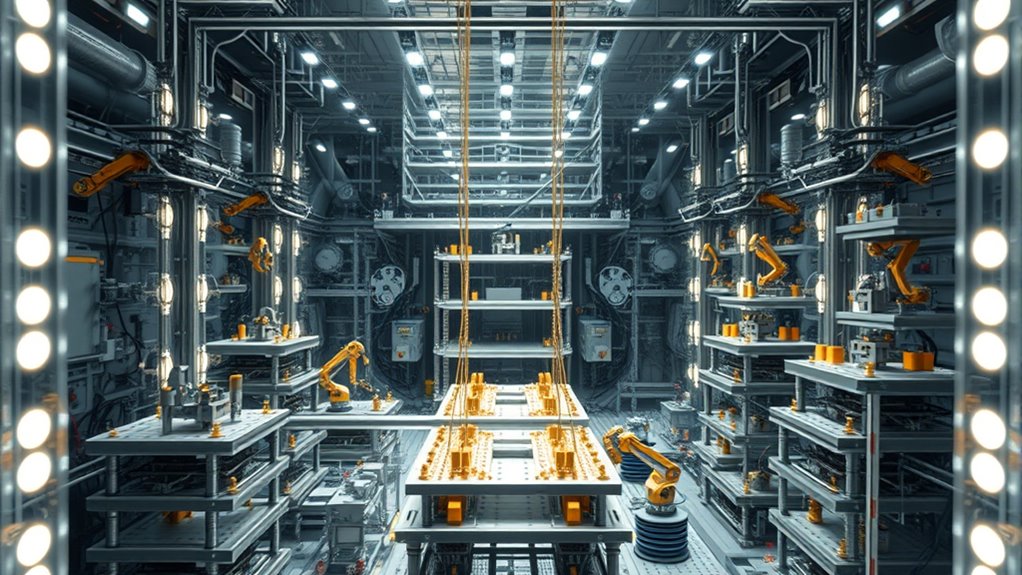
To build complex diamondoid products, nanofactories use a hierarchical construction process that assembles nanoblocks into larger structures. You start with tiny nanoblocks formed through mechanosynthesis, which are then combined step by step. The process involves:
- Forming sub-blocks—smaller structures assembled from individual nanoblocks.
- Joining sub-blocks—using precision machinery to connect eight into a larger block.
- Scaling up—repeating the process to double the size of the product through successive stages.
- Convergent assembly—stacking and aligning multiple blocks in three dimensions to create macroscopic items.
This method ensures atomic precision at each level, enabling the production of increasingly large, complex objects from nanoscale components in a controlled, reliable manner.
Scaling From Molecular Blocks to Macroscopic Items

You can scale up from tiny molecular blocks to full-sized products by stacking and connecting hierarchical structures. Repeating modular units allows for consistent, precise building blocks that grow larger with each stage. Through doubling and assembling these blocks, you can reliably create macroscopic items from nanoscale components. This process relies on precise control of assembly, ensuring that each connection maintains the integrity necessary for larger structures. Additionally, self-assembly techniques are crucial for achieving the desired accuracy and functionality during scaling, leveraging the inherent molecular recognition properties of nanoscale materials. Furthermore, hierarchical design enables the systematic expansion from molecular to macroscopic scales while maintaining structural integrity. The integration of feedback mechanisms can also enhance the robustness of the assembly process by correcting errors in real-time.
Hierarchical Block Assembly
Hierarchical block assembly enables the transformation of tiny, atomically precise nanoblocks into large, functional macroscopic items by systematically combining smaller units into progressively larger structures. You start with nanoblocks produced by fabricators, then assemble them through a multi-level process. This process involves:
- Precise joining of nanoblocks into intermediate sub-structures.
- Repeated layering and branching to form larger modules.
- Using three-dimensional assembly techniques to ensure structural integrity.
- Integrating multiple modules into complex, human-scale products.
Each step leverages programmable nanomachines to ensure accuracy and control. The hierarchical approach allows you to scale from molecular building blocks to macroscale objects efficiently, maintaining atomic precision throughout. This method maximizes modularity and enables the construction of increasingly complex items from simple, nanometer-scale components.
Repeating Modular Structures
Repeating modular structures form the backbone of scaling from nanometer-scale blocks to macroscopic items by stacking and connecting identical units in a systematic pattern. You can think of these structures as building with molecular LEGO bricks, where each nanoblock is engineered for precise fit and function. By assembling multiple copies of these blocks hierarchically, you create larger, more complex components without redesigning each part. This modular approach simplifies manufacturing, as the same basic units are used repeatedly, ensuring consistency and precision at every level. As you combine these modules, the structure grows exponentially, enabling the production of larger items from small, controllable building blocks. This method leverages the predictability and uniformity of modular units, making it fundamental for scaling nanofactory capabilities toward macroscopic products. Additionally, understanding scaling from molecular to macroscopic is essential for developing effective nanofactory systems capable of producing real-world items.
Scaling Through Doubling
Scaling from molecular blocks to macroscopic items relies on a process of systematic doubling, where each stage combines existing nanoblocks to form larger, more complex structures. This method allows you to build progressively bigger products through hierarchical assembly. First, you start with small nanoblocks created by fabricators. Then, you:
- Join eight nanoblocks into a larger sub-block.
- Use these sub-blocks as building units for even bigger blocks.
- Repeat the process, doubling the size at each step.
- Assemble multiple larger blocks into full-sized, atomically precise products.
Each cycle doubles the size and complexity, enabling you to scale from atomic detail to macroscopic dimensions efficiently. This iterative multiplication ensures precision while maintaining control, making large-scale manufacturing possible from nanoscale components.
Challenges and Technical Barriers in Building a Nanofactory

Building a nanofactory presents significant technical challenges because controlling molecular assembly with atomic precision requires advanced mechanochemistry, reliable nanoscale machinery, and precise environmental conditions. You need to develop nanoscale tools capable of positional control at the atomic level, which is currently beyond existing technology. Managing ultra-high vacuum or inert fluid environments to prevent side reactions adds complexity. Ensuring robustness and repeatability of programmable nanomachines is critical, yet they remain conceptual. Power delivery, heat dissipation, and radiation damage control at such scales are major hurdles. Additionally, integrating thousands of fabricators into a cohesive, scalable system demands precise synchronization and error correction. Overcoming these barriers is essential for transforming the nanofactory from a theoretical idea into a practical manufacturing platform.
Current Technologies and Progress Toward Molecular Manufacturing

Current technologies have made significant strides in nanoscale fabrication, laying the groundwork for molecular manufacturing. You can now manipulate materials at the atomic level using methods like chemical vapor deposition (CVD) and atomic layer deposition (ALD), which produce nanoscale structures efficiently. Progress includes:
- Developing nanoparticles, such as carbon nanotubes and graphene, with precise control over size and properties.
- Achieving template-based assembly that reduces costs to a fraction of traditional manufacturing, with production times shortened dramatically.
- Advancing lithography and etching techniques that create nanoscale features, though not yet atom-by-atom.
- Creating programmable nanodevices capable of specific tasks, demonstrating emerging control over molecular-level processes.
While these technologies are promising, they currently serve as stepping stones toward full mechanosynthesis and atomically precise manufacturing systems.
Potential Applications and Impacts of Nanofactory Products

Nanofactory products promise to revolutionize multiple industries by enabling the production of atomically precise materials and components at a macroscale. You could create ultra-strong, lightweight materials for aerospace, reducing weight and increasing efficiency. In medicine, you might produce highly specific drug delivery devices or biocompatible implants tailored to individual patients. Electronics could benefit from atomically perfect semiconductors, boosting performance and durability. You could also manufacture advanced mechanical parts, such as nanoscale gears and bearings, for nanorobotics or precision machinery. Environmental impacts include cleaner catalysts and filters that improve pollution control. Overall, nanofactory products could transform manufacturing, healthcare, energy, and environmental management, offering unprecedented control over material properties and reducing waste. This potential could lead to more sustainable, innovative, and high-performance solutions across multiple sectors.
Future Prospects and the Path Toward Realizing Atomic Manufacturing

Advances in nanotechnology and materials science are gradually paving the way for atomic manufacturing to become a practical reality. To reach this goal, you need to focus on several key developments:
Progress in nanotech and materials science is steadily bringing atomic manufacturing closer to reality.
- Improving mechanosynthesis techniques for precise atomic placement, reducing errors.
- Scaling up from small prototypes to fully functional nanofactories capable of continuous production.
- Developing reliable, energy-efficient power sources and cooling systems to support extensive operations.
- Establishing robust protocols for self-replication and hierarchical assembly to enable mass manufacturing.
Achieving these milestones involves overcoming technical challenges, such as controlling molecular interactions and minimizing side reactions. As research progresses, you’ll see incremental breakthroughs that bring atomic manufacturing closer to practical application, transforming manufacturing industries and enabling unprecedented material precision.
Frequently Asked Questions
How Close Are We to Developing Fully Operational Nanofactories?
You’re still a ways off from developing fully operational nanofactories. While research on nanoparticles and nanoscale manufacturing techniques advances rapidly, creating a compact, programmable system capable of atomically precise assembly remains theoretical. Current technologies like CVD and ALD produce nanoscale materials, but a true nanofactory with full mechanosynthesis, hierarchical assembly, and self-duplication is still in the conceptual stage, requiring significant breakthroughs before practical implementation.
What Are the Primary Safety Concerns With Atomic Manufacturing Systems?
Your primary safety concerns with atomic manufacturing systems include uncontrolled self-replication, which could lead to runaway growth or environmental damage. You also worry about accidental release of nanomachines into ecosystems, potential misuse for malicious purposes, and radiation effects from the fabrication process. Ensuring strict control protocols, fail-safes, and containment measures are essential to prevent these risks and protect both people and the environment.
Can Nanofactories Produce Complex Biological or Organic Molecules?
You can’t yet produce complex biological or organic molecules with nanofactories, but the technology’s potential is promising. Currently, nanofactories excel at assembling diamondoid products, but fabricating intricate biomolecules involves delicate stereochemistry and functional group control. Scientific advances are necessary to adapt mechanosynthesis for organic chemistry. If achieved, nanofactories could revolutionize medicine and materials, with some estimates suggesting they could produce custom drugs or proteins with atomic precision in the future.
What Is the Estimated Cost of Building a Functional Nanofactory Today?
You’d likely spend billions of dollars to build a functional nanofactory today. The costs include advanced materials, precision manufacturing equipment, extensive research, and specialized infrastructure. Developing the required programmable nanomachines, ultra-high vacuum systems, and power supplies adds to the expense. Since the concept remains theoretical and not commercially realized, expect costs to be high, with significant investments needed before such a factory becomes feasible.
How Will Nanofactories Impact Global Resource Consumption?
Nanofactories will considerably reduce global resource consumption by enabling precise manufacturing with minimal waste. You’ll use feedstocks like natural gas efficiently, producing complex products atom-by-atom. This precision limits excess material and lowers energy costs compared to traditional manufacturing. As a result, you’ll see a shift toward sustainable resource use, less environmental impact, and more efficient production systems, ultimately conserving Earth’s finite resources while meeting global demand.
Conclusion
While building a nanofactory seems like science fiction, rapid advancements bring it closer to reality. You can imagine a future where atomic manufacturing transforms industries, creating ultra-precise products with minimal waste. But are we ready to harness such power responsibly? As technology progresses, staying informed and ethical becomes essential. After all, isn’t shaping the future at the atomic level one of the most exciting challenges we face today?