🔍 Read the full analysis: 13 Best Portable SSDs For Convenient Storage, Wherever Work Takes You In 2027 on ThorstenMeyerAI.com

Get the latest gadgets delivered free with Prime
- Fast, free delivery on millions of items
- Prime Video, Amazon Music and more included
- Member-only deals all year
TL;DR
A buying guide from ThorstenMeyerAI.com compares 13 portable SSD listings, highlighting the Samsung T7 1TB as a balanced everyday choice and the Samsung T9 and SanDisk Extreme 4TB models for heavier storage needs. The guide warns that advertised speeds are maximum claims: reaching up to 2,000 MB/s requires compatible USB 3.2 Gen 2×2 hardware.
ThorstenMeyerAI.com has published a 13-model portable SSD buying guide for people who need storage away from a desk, recommending the Samsung T7 1TB as a balanced starting point and pointing to higher-capacity or faster models for larger workloads. The guide says buyers should check their device’s USB specification before paying for advertised speed, because the Samsung T9’s up-to-2,000 MB/s claim depends on compatible hardware.
The guide compares drives by advertised transfer speed, capacity, connection requirements and portability, rather than treating one specification as decisive, similar to this look at portable SSDs. It describes the T7’s USB 3.2 Gen 2 interface and 1TB capacity as a practical match for everyday transfers. The publication says the T7 does not depend on a USB 3.2 Gen 2×2 port to be useful, though real-world transfer rates still depend on the computer, cable and workload.
The guide’s 13 entries include variants from Samsung’s T7 and T9 families and SanDisk’s Portable SSD and Extreme lines, with portable drives also considered for AI data storage. It highlights the T9 in 1TB, 2TB and 4TB capacities, each listed with speeds of up to 2,000 MB/s. SanDisk options span a 500GB Portable SSD and larger 2TB and 4TB choices, including Extreme models. The source does not provide a complete model-by-model table in the supplied material, so the exact identity and specifications of every entry cannot be independently enumerated here.
ThorstenMeyerAI.com cautions that listings with similar names and capacities can show different speed claims, particularly among SanDisk Extreme products. Its advice is to verify the exact model number and specification rather than buying on brand or capacity alone. Advertised maximum speeds are not guarantees for every transfer: port capability, cable, file size and sustained workload can all affect results.
The 13 picks
- 1
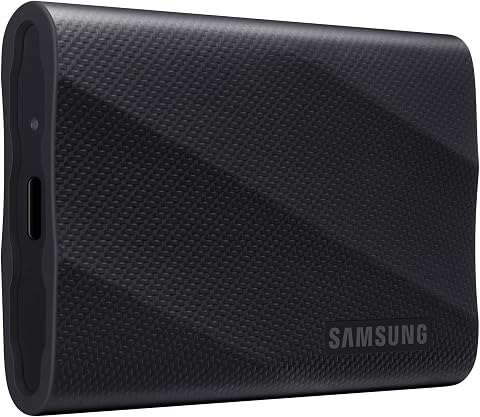 Samsung T9 Portable SSD 4TB, USB 3.2 Gen 2×2 External Solid State DriveView on Amazon →
- 2
 SanDisk Extreme Portable SSD, 4TB, Up to 2000MB/sView on Amazon →
- 3Samsung T9 Portable SSD 2TB, USB 3.2 Gen 2×2, Up to 2,000 MB/sView on Amazon →
- 4SanDisk Extreme Portable SSD, 2TB, Up to 2000MB/sView on Amazon →
- 5
 SanDisk Extreme 2TB Portable SSDView on Amazon →
- 6
 SanDisk 2TB Portable SSD, Up to 1000 MB/s Read Speed, BlackView on Amazon →
- 7Samsung T9 Portable SSD 1TB, USB 3.2 Gen 2×2, Up to 2,000 MB/sView on Amazon →
- 8SanDisk Extreme Portable SSD, 1TB, Up to 2000MB/sView on Amazon →
- 9
 Samsung T7 Portable SSD 1TB Titan Gray, USB 3.2 Gen 2, Up to 1,050MB/sView on Amazon →
- 10SanDisk 1TB Extreme Portable SSD, Up to 1050MB/sView on Amazon →
- 11SanDisk 1TB Portable SSD, Up to 1000MB/s Read Speed, BlackView on Amazon →
- 12SanDisk 500GB Portable SSD, Up to 1000MB/s Read Speed, BlackView on Amazon →
- 13
 SSK Portable SSD 500GB External Solid State Drive USB-C/USB-AView on Amazon →
Match SSD Speed to Your Setup
The buying decision affects both transfer time and cost. A faster model may be worthwhile for large video files or frequent project transfers, but a computer without USB 3.2 Gen 2×2 cannot make full use of the T9’s stated maximum. A lower speed tier may be a better fit when the host device is the limiting factor.
Capacity also changes the day-to-day value of a portable drive. The guide positions 500GB for lighter carry needs, while 1TB and 2TB options offer room for active work and larger media collections. Its 4TB recommendations are aimed at people handling substantial libraries or projects. Buyers who carry a drive frequently may also weigh the Extreme models’ tougher design against a simpler, potentially less specialized option.
Popular right now

Dyson Airstrait Styling Brush

Vitamix VX1 Professional-Grade Blender, 64 oz, Black

Vitamix 5200 Blender with 64 oz Container, Black
As an affiliate, we earn on qualifying purchases.
What the Guide Compares
The source frames its ranking as a buying guide, not a laboratory test. It says its order favors balanced utility over headline speed and evaluates capacity variants for the users they are intended to serve. The supplied material does not include benchmark results or independent durability testing, so its performance descriptions should be read as comparisons of published specifications and expected use cases.
USB-C refers to a connector shape, not a guaranteed transfer rate. The guide distinguishes USB 3.2 Gen 2 from Gen 2×2 and advises readers to check the host device’s specifications. It also recommends checking file-system compatibility when moving a drive between computers, tablets or phones. Reformatting can erase existing data, so files should be copied elsewhere first.
“The Samsung T7 is the balanced starting point.”
— ThorstenMeyerAI.com buying guide
Limits of the Speed Claims
The supplied source does not state when each product listing was last checked, provide test conditions, or report independent measurements. It is therefore unclear how closely any model’s published maximum speed matches a particular buyer’s everyday results. The guide itself notes that host port, cable and workload affect transfers.
The source also flags SanDisk listings with similar names and capacities but different stated speeds. Without the full model identifiers and specification sheets for all 13 entries, the precise differences between those listings remain unclear. Buyers should check current manufacturer and retailer details before ordering; availability and specifications can change.
Check Models Before Buying
Readers can use the guide’s comparisons to narrow choices, then confirm the exact model number, capacity and interface against current product documentation. The practical next step is to check the computer or mobile device’s USB standard, confirm cable and operating-system compatibility, and estimate storage from the largest ongoing project.
For important files, the guide advises keeping another copy elsewhere: a portable SSD should not be treated as the only backup. The source provides no announced testing update or later publication milestone.
Key Questions
Which portable SSD does the guide recommend for most buyers?
ThorstenMeyerAI.com names the Samsung T7 1TB as its balanced starting point, citing its USB 3.2 Gen 2 connection and everyday capacity.
Can every computer reach the Samsung T9’s advertised speed?
No. The guide says speeds of up to 2,000 MB/s require a compatible USB 3.2 Gen 2×2 host connection and cable. A USB-C socket alone does not establish that support.
How much portable SSD capacity should I choose?
The guide presents 500GB as an option for lighter needs and larger capacities such as 1TB, 2TB or 4TB for expanding work and media libraries. The right size depends on the files you expect to carry.
Are SanDisk Extreme listings interchangeable?
The source warns that listings with similar names and capacities can have different advertised speed figures. Check the exact model and specification before purchasing.
Does a portable SSD replace a backup?
No. The guide advises keeping a second copy of irreplaceable files elsewhere rather than relying on one portable drive.
Source: ThorstenMeyerAI.com