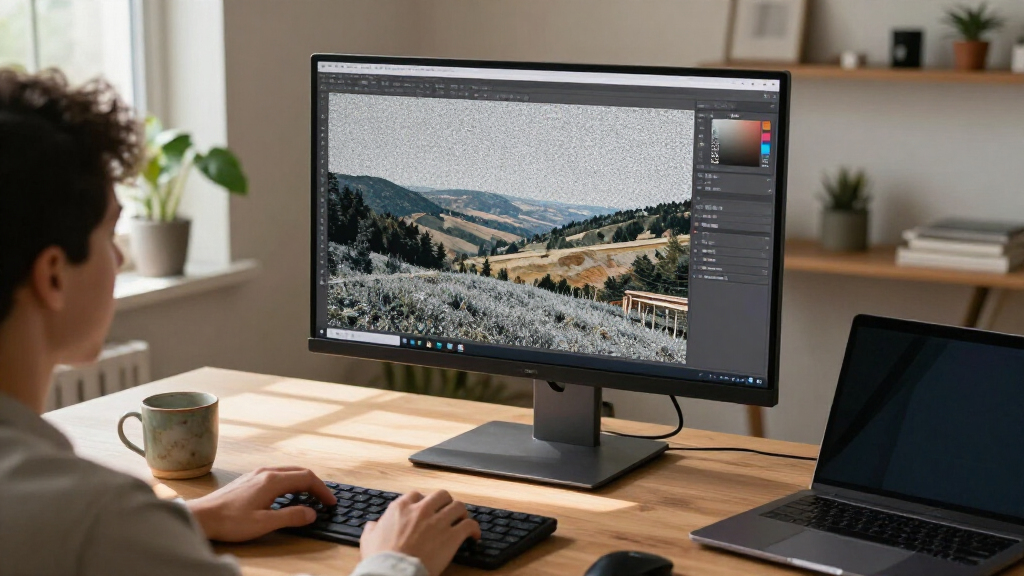
🔍 Read the full analysis: How AI Diffusion Models Refine Noise Into An Image on ThorstenMeyerAI.com

Get the latest gadgets delivered free with Prime
- Fast, free delivery on millions of items
- Prime Video, Amazon Music and more included
- Member-only deals all year
TL;DR
A November 23, 2026, explainer from ThorstenMeyerAI.com describes how image diffusion models learn to predict and remove noise, then use that process in reverse to generate images from text prompts. The account draws on published research and Stable Diffusion documentation; it also notes that image accuracy, memorization and copyright questions remain unresolved or contested.
ThorstenMeyerAI.com published an explainer on November 23, 2026, describing how text-to-image diffusion models turn random noise into pictures by repeatedly estimating and removing noise. The report draws on published diffusion research and Stable Diffusion documentation to explain how prompts guide generation, while outlining known weaknesses such as inaccurate text and object placement.
The article’s central point is that a diffusion model does not retrieve a matching picture or construct an image one brushstroke at a time. In training, it takes existing images, adds noise in stages and teaches a neural network to predict the noise at each stage. During generation, it begins with random noise and applies learned predictions to gradually form an image. The article attributes this account to foundational research by Jascha Sohl-Dickstein and colleagues in 2015 and to the 2020 paper “Denoising Diffusion Probabilistic Models” by Jonathan Ho, Ajay Jain and Pieter Abbeel.
In the 2020 paper, the researchers used a process with 1,000 noise steps. The explainer says the model learns from a noisy image and a step indicator, with the added noise known because it was deliberately introduced. It cites Stable Diffusion v1-4 documentation describing the training objective as comparing the noise added to a latent representation with the U-Net’s prediction. At generation time, the model repeatedly estimates noise and removes part of it; broad image features form before finer details.
The article also describes latent diffusion, which reduces the amount of data the model processes by working on a compressed representation of an image. A text encoder turns a prompt into numerical information used to guide generation. The explainer says stronger guidance can make results adhere more closely to the prompt, but may come with a quality trade-off. It also flags recurring limitations: models may struggle with lettering, counting and precise spatial relationships, and research has found cases where models reproduce near-copies of training images.
How Noise Shapes Image Results
The explanation matters because it connects a model’s design to both its capabilities and its errors. A diffusion system builds an image through repeated predictions rather than following a precise object-by-object plan. That helps explain why a prompt can produce a convincing overall scene while getting a small but important detail wrong, such as the number of objects or which one is on top.
For users, the process also clarifies why changing a prompt or guidance setting may affect the result without guaranteeing exact control. For developers and researchers, the training objective provides a concrete way to understand what the network is optimized to do: predict added noise, not directly reproduce a user’s intended scene. The article’s discussion of near-copies and copyright adds a separate concern: learning a general process does not, by itself, settle whether a model can retain or reproduce material from its training data.
These points are useful when judging claims about image-generation systems. A visually coherent output is not proof that the model understands every relationship in a prompt, and the presence of a denoising objective does not settle questions about memorization or legal responsibility.
Popular right now

Dyson HushJet Compact Air Purifier, White/Silver

Vitamix 5200 Blender with 64 oz. Container, Black

Breville Barista Touch Espresso Machine, Brushed Stainless Steel
As an affiliate, we earn on qualifying purchases.
From 2015 Research to Latent Models
The explainer traces the method to a 2015 paper by Jascha Sohl-Dickstein and colleagues, which proposed gradually destroying structure in data and learning a process to restore it. The approach became more practical with Ho, Jain and Abbeel’s 2020 paper, which described denoising diffusion probabilistic models and used 1,000 steps in its experiments. Those research milestones provide the basis for the article’s account of training and image generation.
Later systems have sought to reduce the cost of generation. The source describes latent diffusion as a way to perform denoising in a compressed representation rather than directly across every image pixel. It gives Stable Diffusion v1 as an example and says a 512-by-512 image is represented with 48 times fewer numbers. That figure applies to the example cited by the source, not necessarily to every diffusion model or version.
The explainer also distinguishes the image model from the language models used elsewhere in AI. For text-to-image generation, a text encoder supplies numerical representations of the prompt, while attention mechanisms help connect those representations to image-generation steps. The source’s account is an educational report, not a new experimental paper or a fresh evaluation of a model.
“The loss is a reconstruction objective between the noise that was added to the latent and the prediction made by the UNet.”
— Stable Diffusion v1-4 model card, as quoted by ThorstenMeyerAI.com
Limits, Memorization and Copyright
The explainer identifies several limits but does not establish how often each appears across current image-generation products. It gives no new benchmark results, model-by-model comparison or independent measurement of prompt accuracy. Its reference to a widely used open-source pipeline running 50 steps by default is presented as an example, not a universal setting for image models.
The source says researchers have extracted near-copies of training images from models, but the excerpt does not identify the studies, their methods or how common such reproduction is. It also reports that a UK court found in 2025 that Stable Diffusion itself is not an “infringing copy.” That statement does not resolve every copyright issue involving training data, generated images or other jurisdictions. The legal implications and the scope of the ruling remain distinct questions.
The supplied source text ends partway through its discussion of faster generation. It does not provide the full account of later step-reduction methods or enough detail to verify every implementation-specific claim. Readers should treat the article’s numerical examples as tied to the cited papers and model version, not as rules for all systems.
What Users and Researchers Can Check
The immediate next step for readers is to match claims about a particular image generator to its model version, documentation and settings. Step counts, compression methods and prompt-guidance behavior can differ across systems, so the examples in the explainer should not be assumed to describe every current product.
Further evidence would be needed to quantify how reliably models follow spatial instructions, render lettering or reproduce training images. Researchers can test those behaviors across defined prompts and datasets; model developers can publish clearer evaluations and disclose relevant training and generation details. Legal questions will continue to depend on the facts of particular disputes and rulings, rather than on the denoising mechanism alone.
ThorstenMeyerAI.com presents the piece as part of an explainer series on how AI works. The article itself does not announce a new model, experiment or court decision; it summarizes established research and points readers toward the technical and legal issues that remain under discussion.
Key Questions
Does a diffusion model start with an existing picture?
Not during ordinary generation, according to the explainer. It starts with random noise and repeatedly estimates and removes noise to form an image. Existing images are used in training, where the model learns to predict noise added to them.
Why do diffusion models sometimes get words or object positions wrong?
The article says these systems generate images through repeated denoising and can struggle with lettering, counting and spatial relationships. A coherent-looking image does not guarantee that every detail in a prompt has been followed accurately.
What does latent diffusion mean?
Latent diffusion performs the denoising process on a compressed representation of an image rather than directly on the full image. The source gives Stable Diffusion v1 as an example, but the stated compression figure should not be applied to every model.
Does the denoising process settle whether training images are copied?
No. The method explains how models are trained and generate images, but it does not settle whether a model can reproduce material from its training data or determine the legal status of training and outputs. The source describes those as separate questions.
Source: ThorstenMeyerAI.com