TL;DR

Get the latest gadgets delivered free with Prime
- Fast, free delivery on millions of items
- Prime Video, Amazon Music and more included
- Member-only deals all year
Nord Quantique CEO Julien Camirand Lemire described how the company uses microwave photons in superconducting cavities to encode error-corrected qubits, aiming to reduce the hardware overhead associated with quantum error correction. In an interview published Oct. 31, 2026, he discussed the company’s GKP and Tesseract code demonstrations, a four-qubit system expected to enter operation this year and a longer-term error-rate target; these are company-reported developments and goals.
Nord Quantique CEO and co-founder Julien Camirand Lemire described the company’s effort to encode error-corrected quantum information using microwave photons held in superconducting cavities, an approach intended to reduce the number of physical qubits needed for error correction. In an interview published by The Quantum Insider on Oct. 31, 2026, he discussed the company’s GKP and Tesseract code demonstrations, a four-qubit system planned to enter operation this year and a longer-term target of error rates between 10-7 and 10-9 by 2032.
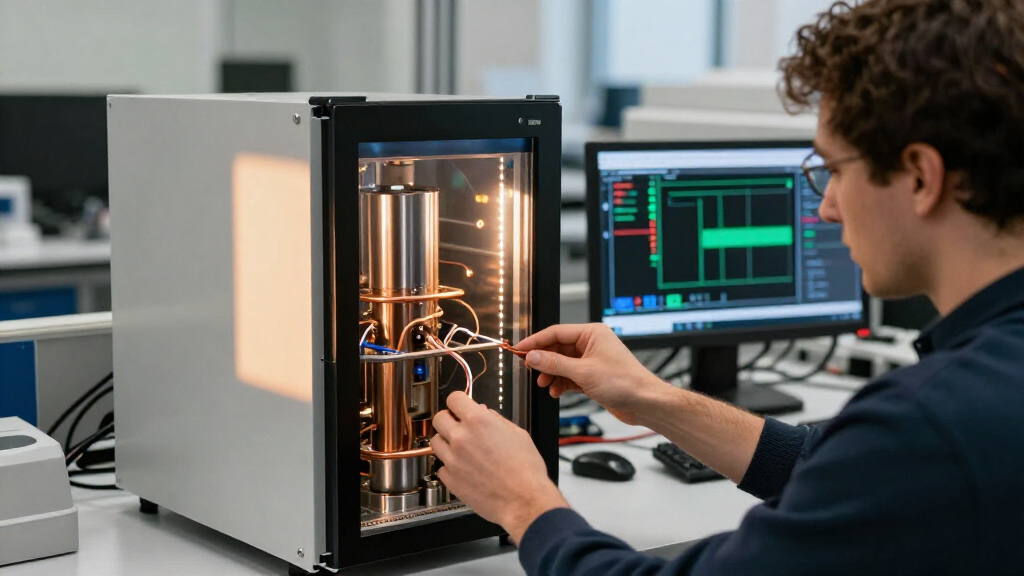
Camirand Lemire said Nord Quantique’s hardware uses bosonic codes: quantum information is stored in states of microwave photons trapped in superconducting resonators, also called cavities. A cavity can hold multiple photons, he said, providing redundancy within one physical device rather than relying only on a much larger count of separate qubits. The company’s stated goal is to lower the hardware overhead required to detect and correct errors during computation.
In the interview with host Yuval Boger, Camirand Lemire distinguished Nord Quantique’s grid-state approach from cat-qubit approaches. He said the company demonstrated a GKP qubit in early 2024, with correction of both X- and Z-type errors described in its paper. He also cited a Tesseract code demonstration released in 2025, which uses multiple modes—different photon frequencies within a cavity—to encode information. These descriptions and performance characterizations come from the CEO’s account in the interview.
Camirand Lemire said the company’s quantum error-correction gain had more than doubled since 2024. The interview summary does not specify the metric, measurement conditions or comparison values behind that statement. He also said a four-qubit system is expected to enter operation in 2026, and described a roadmap aiming for error rates from 10-7 to 10-9 by 2032. The source does not provide technical specifications or independent validation for those future targets.
Reducing Error-Correction Hardware Overhead
Quantum processors are vulnerable to noise, and errors can corrupt computations as they run. Error correction is designed to identify and correct those errors, but it generally requires redundancy: additional physical resources are used to represent and protect the logical information. Camirand Lemire said overhead in many approaches can mean roughly 100 to 1,000 physical qubits for the resources associated with error correction. That range is his broad characterization in the interview, not a universal benchmark for every code or system.
If a cavity-based design can protect useful quantum information with fewer physical components, it could ease a major scaling burden. The potential is especially relevant because increasing a processor’s qubit count alone does not guarantee reliable computation; the quality of operations, error rates and ability to correct faults also matter. Nord Quantique’s demonstrations therefore speak to a wider engineering question: whether error-correction resources can be built into the encoding of a qubit rather than supplied primarily by adding many separate qubits.
The reported demonstrations do not establish that the company has a fault-tolerant machine or that its approach will outperform competing architectures in practical workloads. The significance for readers is the direction of the research and the tests still ahead: a smaller overhead would matter only if the encoded qubits can be controlled, connected and operated with sufficiently low errors as systems grow.
Popular right now

Apple AirPods Pro 3 Wireless Earbuds with Active Noise Cancellation

Vitamix Propel Series 510 Professional-Grade Blender, 3 Programs, Black

KitchenAid Artisan Series 5-Quart Tilt-Head Stand Mixer, Dried Rose (KSM150PS)
As an affiliate, we earn on qualifying purchases.
From Sherbrooke Research to Hardware
Nord Quantique was incorporated in 2020 and spun out of the quantum research ecosystem in Sherbrooke, Quebec, according to Camirand Lemire. The company also has offices in Montreal. He credited the region’s research and institutional network with helping the firm build its technology while remaining capital-efficient, though the interview did not give financial figures or compare its spending with other companies.
The company’s approach sits within a broader effort to address error correction in quantum computing. Bosonic codes use the many possible states of an oscillator, such as photons in a resonator, to encode information. Different bosonic-code designs protect against different error patterns. Camirand Lemire said Nord Quantique’s grid-state work is intended to correct both X and Z errors, while other approaches, including the cat-qubit work referenced in the interview, are designed around different error properties.
The company’s stated progression runs from its 2024 GKP demonstration to the 2025 Tesseract demonstration, followed by the planned four-qubit system and longer-range error-rate goals. The interview also discussed high-rate codes and scaling challenges for transmon-based systems, but supplied no detailed comparative results that would establish one architecture as superior.
“The great thing about them is that you can trap multiple microwave photons inside a single cavity or single resonator, which provides you with the redundancy you need to do quantum error correction in a single cavity.”
— Julien Camirand Lemire, Nord Quantique co-founder and CEO
Performance Claims Await More Detail
The interview does not provide the underlying data needed to assess the reported more-than-doubled error-correction gain since 2024. It gives no exact baseline, measurement window, definition of the gain or system conditions. The statement should therefore be treated as the CEO’s characterization rather than a complete performance comparison.
It is also unclear from the source what the four-qubit system’s operating status will entail, which error rates it is expected to achieve, or whether the stated 2032 range refers to physical-qubit, logical-qubit or another system-level error measure. No details are supplied on independent replication, computational demonstrations at scale, or how the hardware will connect multiple cavities. The interview presents company plans and results but does not establish that the long-term targets have been met.
Four-Qubit System Is the Next Test
The next stated milestone is the four-qubit system, which Camirand Lemire said would enter operation in 2026. Further public information about its specifications, test results and error-correction performance would help show how the single-cavity demonstrations translate into a larger working system.
Nord Quantique’s longer-term roadmap points to error rates of 10-7 to 10-9 by 2032. Those figures remain targets, not reported outcomes. The company’s progress will be judged by future measurements and by whether it can demonstrate that its codes operate reliably as hardware scales. The interview did not identify dates for additional publications or independent evaluations.
Key Questions
What did Nord Quantique announce or report?
The company’s CEO described its bosonic-code approach and discussed GKP and Tesseract demonstrations, a four-qubit system planned for 2026 and error-rate targets for 2032. The development was presented in an interview, not as a new technical paper in the source material.
What does “one cavity, one error-corrected qubit” mean?
Nord Quantique stores information in microwave photons inside a superconducting cavity. Multiple photon states can provide redundancy within a resonator, which the company aims to use for error correction without relying solely on a large number of separate physical qubits.
What are the GKP and Tesseract codes?
They are code designs discussed by Camirand Lemire. He said Nord Quantique demonstrated a GKP grid-state qubit in 2024 and a multimode Tesseract code in 2025. The interview says the GKP work addressed both X and Z errors but does not include detailed results or test conditions.
Has Nord Quantique reached its 2032 error-rate target?
No. The range of 10-7 to 10-9 was described as a roadmap target for 2032. The interview does not report that the company has achieved those rates.
What is the next milestone?
Camirand Lemire said Nord Quantique’s four-qubit system is entering operation in 2026. The source does not give a specific operating date or detailed performance results for that system.
Source: thequantuminsider.com