TL;DR

Get the latest gadgets delivered free with Prime
- Fast, free delivery on millions of items
- Prime Video, Amazon Music and more included
- Member-only deals all year
The Quantum Kid has released an episode filmed inside Microsoft’s quantum lab in Lyngby, Denmark, showing how the company fabricates and tests Majorana chips. Microsoft is pursuing topological qubits designed to resist errors, but the scientific validation of its approach remains under debate.
The Quantum Kid, a video series produced by Tesseract Quantum, has released an episode filmed inside Microsoft’s quantum lab in Lyngby, Denmark, showing how the company fabricates and tests chips for its Majorana-qubit program. The tour, led by Microsoft Quantum fabrication vice president Lauri Sainiemi, offers a look at the hardware behind Microsoft’s effort to build quantum bits designed to resist errors.
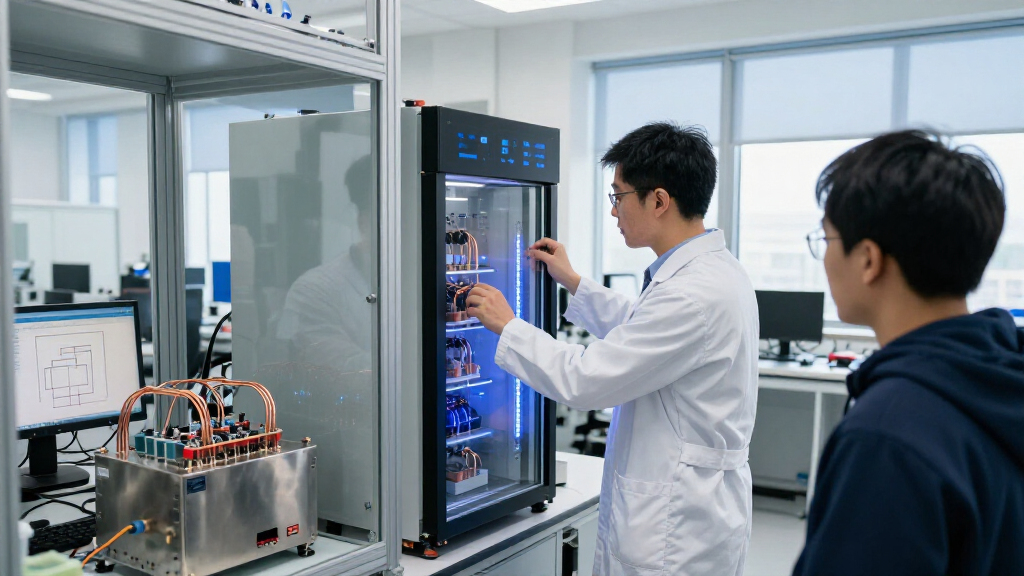
In the episode, 10-year-old host Kai visits three parts of the facility: the materials lab, a clean room and the cryostat lab. Sainiemi guides him through the process, from growing layered materials to patterning tiny devices and cooling completed chips to temperatures near absolute zero for testing. The episode was produced in collaboration with Microsoft and filmed by Bifrost Productions.
Microsoft’s materials process uses molecular beam epitaxy, which deposits material in layers one atom at a time in an ultra-high vacuum. The company combines a semiconductor and a superconductor in a structure it calls a topoconductor, then patterns it into nanowire devices. Microsoft says that following a 2025 expansion, the Lyngby site can fabricate the full core of its Majorana chips.
The finished devices are tested in gold-colored cryostats, which cool them enough for the quantum effects the design depends on to appear. The episode presents the lab workflow as a practical account of how Microsoft’s proposed qubits are made; a facility tour by itself does not establish that the devices meet the company’s scientific or performance claims.
Inside Microsoft’s Topological-Qubit Bet
The episode gives viewers a direct look at the manufacturing work behind a high-profile quantum-computing approach. Microsoft’s strategy aims to encode information in Majorana zero modes—quantum states expected to appear at the ends of specially engineered superconducting nanowires. The company’s theory is that information spread across a device could be less vulnerable to local disturbances than information held in a more localized qubit.
If that protection can be demonstrated and engineered reliably, it could reduce the burden of correcting errors after they occur. That matters because noise and error correction remain major challenges for quantum computers. But the potential benefit is not the same as a demonstrated result: whether Microsoft’s devices achieve the intended topological behavior remains a closely watched scientific question.
The report also says Microsoft unveiled its second-generation Majorana 2 chip in June 2026. Microsoft claims it improves qubit reliability 1,000-fold over Majorana 1 and reports average parity lifetimes of around 20 seconds, attributing the performance to a new lead-based material stack. Those figures are company claims, not independent confirmation presented by the lab-tour episode.
Popular right now

Ninja Mega Kitchen System Blender and Food Processor, 1500W, 72-oz Pitcher, 8-Cup Bowl, Black (BL770)

Ninja CM401 Specialty Coffee Maker with 10-Cup Carafe and Fold-Away Frother

Bose QuietComfort Headphones (2nd Gen), Wireless Over-Ear Noise-Cancelling Headphones, Black
As an affiliate, we earn on qualifying purchases.
From Majorana’s Prediction to Chip Tests
The approach takes its name from Italian physicist Ettore Majorana, who predicted in 1937 a particle that is its own antiparticle. Microsoft’s program concerns Majorana zero modes, which are proposed quantum states in engineered materials rather than a straightforward effort to find the particle in nature. The company is trying to use such states to create topological qubits.
In broad terms, a topological qubit would store information across a device in a way intended to make it harder for a small disturbance to corrupt. The concept is one route toward reducing hardware errors, but building a suitable material and showing that it behaves as predicted are difficult experimental tasks. The Lyngby tour traces the chain from material growth to device fabrication and cryogenic testing without resolving those scientific questions.
The video is part of The Quantum Kid, a YouTube channel and video podcast in which Kai asks researchers and technology leaders to explain quantum technology. The show is produced by Tesseract Quantum, a Swiss educational nonprofit, and the source report identifies it as a partner of The Quantum Insider.
“The company says Majorana 2 improves qubit reliability 1,000-fold over Majorana 1, with average parity lifetimes of around 20 seconds.”
— Microsoft
Scientific Validation Still Under Debate
The episode shows how the chips are produced and tested, but the source material does not establish that Microsoft has conclusively demonstrated topological qubits. Physicists continue to debate what evidence is needed to confirm that the devices exhibit the intended topological behavior.
The source report does not include independent test results for Majorana 2, details of the methods behind the stated 1,000-fold reliability comparison, or a breakdown of how the average parity lifetime was measured. It also does not provide a direct quotation from Sainiemi, or specify the episode’s publication date beyond the report’s November 2026 timing. Microsoft’s stated performance and development targets should therefore be read as company-reported claims.
Microsoft’s 2029 Development Target
The source report says Microsoft has brought forward its target for a scalable quantum computer to 2029. It does not specify a nearer public milestone or provide a detailed schedule for demonstrating the Majorana 2 results independently.
The next substantive test for the program will be whether Microsoft can provide further experimental evidence that its devices behave as topological qubits, alongside measurable progress toward scaling them. For now, the episode offers an accessible view of the manufacturing effort; the scientific case and the path from laboratory chips to a scalable system remain developing.
Key Questions
What does The Quantum Kid’s new episode show?
It follows host Kai through Microsoft’s Lyngby, Denmark, quantum lab, where Lauri Sainiemi guides him through materials growth, clean-room fabrication and cryogenic testing of Majorana chips.
What is a Majorana qubit?
Microsoft is pursuing a topological qubit based on Majorana zero modes, proposed quantum states expected at the ends of specially engineered superconducting nanowires. The design aims to make stored information less sensitive to local disturbances.
Has Microsoft proved its qubits are topological?
The source material does not establish that. It says physicists continue to debate how to confirm that the devices are truly topological, so the company’s approach remains subject to scientific scrutiny.
What performance does Microsoft report for Majorana 2?
Microsoft says the June 2026 chip improves qubit reliability 1,000-fold over Majorana 1 and has average parity lifetimes of around 20 seconds. The figures are company claims; the source report supplies no independent verification or measurement details.
When does Microsoft expect a scalable quantum computer?
The source report says Microsoft brought forward its target to 2029. It does not provide a more detailed timeline or define the milestones still required to reach that target.
Source: thequantuminsider.com