TL;DR

Get the latest gadgets delivered free with Prime
- Fast, free delivery on millions of items
- Prime Video, Amazon Music and more included
- Member-only deals all year
An updated AI model for the CORVUS ISR synthetic tracker demonstrates a 42% reduction in object identity switches. This improvement enhances the reliability of wide-area motion imagery tracking systems, with implications for defense and surveillance applications.
The latest AI-enhanced version of the CORVUS ISR tracker has achieved a 42% reduction in identity switches in synthetic benchmarks, according to published test results. This development, confirmed by the benchmark data, indicates a significant improvement in tracker stability, which is critical for wide-area motion imagery (WAMI) systems used in defense and surveillance. The update underscores the impact of AI on object tracking performance in synthetic environments, as detailed in the original analysis.
The CORVUS ISR benchmark, which uses a synthetic scene with perfect ground truth, compares two tracker models: the baseline ‘greedy nearest-neighbour’ and the new ‘confirmed-track auction’ model. In tests with 150 moving objects at 2 frames per second, the new model reduced identity switches from 2,042 to 1,183 per minute, a 42.1% decrease. Similar improvements were observed in denser scenarios with 400 objects, where switches fell from 14,032 to 8,040, a 42.7% reduction.
These results were confirmed across various stress conditions, including lower frame rates, occlusion scenarios, and degraded image quality with jitter and low contrast. The benchmark emphasizes that detection rates are identical for both models, as detection is a sensor property. Despite improvements, both models still experienced thousands of identity errors per minute under stress, but the new AI model shows marked progress in tracker stability.
Impact of AI on Tracker Reliability in Synthetic Benchmarks
The 42% reduction in identity switches demonstrates that AI advancements can significantly improve the robustness of wide-area motion imagery tracking systems. This progress enhances the potential for more accurate and reliable surveillance, reconnaissance, and defense operations, especially in complex or high-density environments. The transparent benchmarking approach also promotes open validation, fostering trust and further development in the field.
As an affiliate, we earn on qualifying purchases.
Background on CORVUS ISR Benchmark and Tracker Development
CORVUS ISR is a synthetic demonstration platform designed to evaluate multi-object tracking algorithms in a controlled environment with perfect ground truth. The benchmark compares different tracker models using identical scenes, seed values, and metrics, ensuring consistent performance evaluation. The initial baseline model, ‘greedy nearest-neighbour,’ served as a performance floor, while the current v2 model introduces advanced features like track confirmation, auction-based association, velocity gating, and confidence decay. These developments aim to improve tracking stability, especially under challenging conditions.
The benchmark results, published by Thorsten Meyer, show that AI-driven improvements can halve the number of identity switches, a critical metric for tracking accuracy. The synthetic environment allows for precise measurement, but it remains to be seen how these gains translate to real-world scenarios.
“The 42% reduction in identity switches indicates a meaningful step forward in tracker stability, especially under synthetic stress conditions.”
— an anonymous researcher
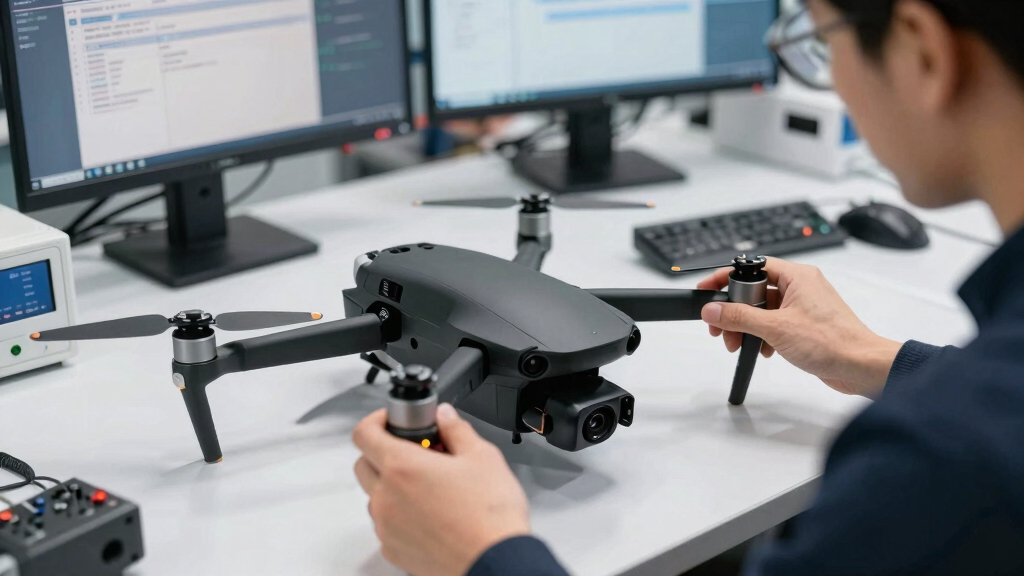
surveillance system with AI tracking
As an affiliate, we earn on qualifying purchases.
As an affiliate, we earn on qualifying purchases.
Uncertainties About Real-World Application of Results
It is not yet clear how these synthetic benchmark improvements will translate to real-world tracking scenarios, which involve unpredictable variables such as sensor noise, environmental conditions, and occlusions. The synthetic environment offers perfect ground truth, but real-world data remains more complex and less predictable. Further testing on actual sensor data is needed to confirm the AI model’s effectiveness outside the synthetic benchmark.
As an affiliate, we earn on qualifying purchases.
Next Steps for Tracking System Validation and Deployment
Researchers and developers are expected to conduct real-world tests to evaluate the AI model’s performance in operational environments. Additionally, future benchmark releases may incorporate more complex scenarios, including partial ground truth and dynamic environments. Ongoing transparency and open benchmarking will be critical to validate whether these synthetic gains lead to tangible improvements in practical applications.
As an affiliate, we earn on qualifying purchases.
Key Questions
What does a 42% reduction in identity switches mean for tracking systems?
This indicates a significant improvement in the stability of object tracking, reducing errors where the system incorrectly switches the identity of tracked objects, thus increasing reliability.
Are these benchmark results applicable to real-world scenarios?
The results are from synthetic tests with perfect ground truth; real-world conditions are more complex, and further testing is necessary to confirm applicability.
What features does the new AI model include?
The AI model incorporates track confirmation, auction-based association, velocity gating, and confidence decay, all designed to improve tracking stability.
Will this improvement affect operational deployments?
Potentially, but real-world validation is required before operational deployment can confidently incorporate these advancements.
How does synthetic benchmarking help the development of tracking AI?
It provides a controlled, reproducible environment with perfect ground truth, allowing developers to measure improvements precisely and openly compare different models.
Source: ThorstenMeyerAI.com
Halloween Picks
halloween
As an affiliate, we earn on qualifying purchases.