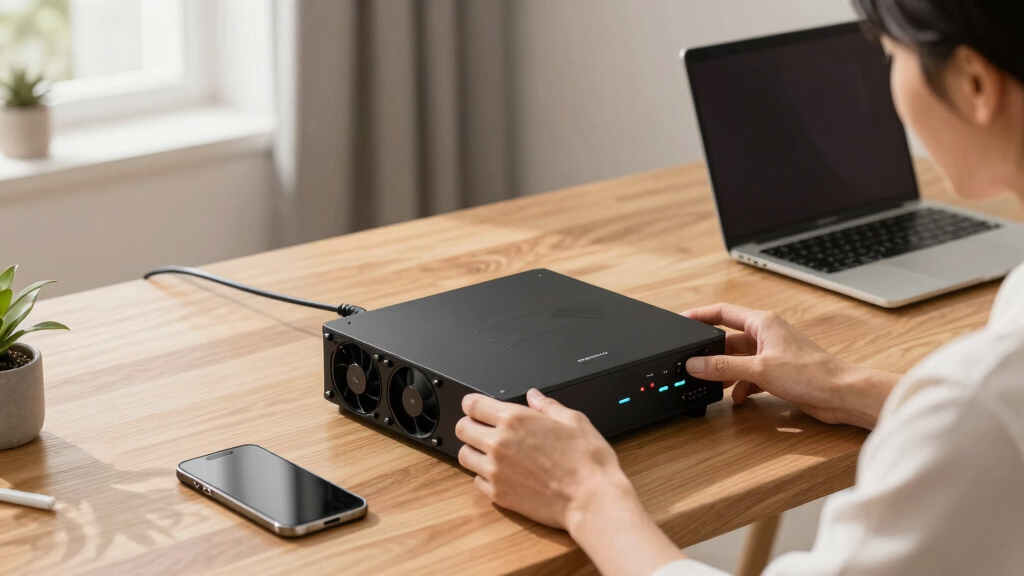

📊 Full opportunity report: The Real Cost of a Local-Inference Rig in 2026 on ThorstenMeyerAI.com — validation score, market gap, and execution plan.

Get the latest gadgets delivered free with Prime
- Fast, free delivery on millions of items
- Prime Video, Amazon Music and more included
- Member-only deals all year
TL;DR
In 2026, owning a local inference rig for large language models involves significant costs, primarily driven by VRAM needs and hardware choices. The most cost-effective options are older GPUs like the used RTX 3090, while high-end cards like the RTX 5090 are expensive but limited in value for inference. This analysis clarifies the real expenses and strategic choices for local AI deployment.
In 2026, the cost of building a local inference rig for large language models (LLMs) is primarily determined by VRAM capacity rather than raw compute power, with older GPUs like the used RTX 3090 offering the best VRAM-per-dollar ratio. This shift in hardware economics makes local deployment more accessible and strategic for certain users, especially those prioritizing privacy and cost control.
The core factor in local inference hardware is the VRAM cliff: models must fit entirely within the GPU’s video memory for optimal speed. Models like the 70B require approximately 43GB of VRAM at full precision, meaning a single RTX 5090 (32GB) can run it at high speed, but larger models demand multi-GPU setups or larger memory pools.
Contrary to intuition, the cost-effectiveness of a GPU for inference is largely determined by VRAM per dollar. Used RTX 3090s (24GB) offer five times better VRAM-per-dollar than the latest flagship cards, making them the best value for most inference tasks. Multiple 3090s can be pooled via NVLink to handle larger models efficiently.
High-end cards like the RTX 5090, priced around $2,000, deliver top speed but are often not the best value for inference, especially when older hardware can suffice for many models. The hardware tiers align with model sizes: entry-level for models below 14B, mid-tier for 26–32B, pro for 70B, and advanced multi-GPU rigs for 100B+ models.
The real cost of a local-inference rig
Owning beats renting for steady AI work — so what does a local rig cost in 2026? The unintuitive, good news: the most expensive build is almost never the smartest one. It all comes down to one rule.
The difference is only whether the weights fit. LLM inference is memory-bandwidth-bound — VRAM capacity is the hard limit you build around. Compute specs are mostly noise.
The squeeze reframes the rig like everything else in this series: discipline beats maximalism. VRAM is exactly the memory under most pressure, so over-buying it is the 128GB-“to-be-safe” trap, only worse per gigabyte. Take the cheap, high-value step to 24GB (the gateway to the 30B class), reach for used 3090s and MoE models, and use quantization to climb a tier without buying silicon. Sized right, the rig pays for itself against the cloud’s ever-rising hidden bill. Next: Apple Silicon’s quiet memory advantage.
Cost-Effective Hardware Strategies for Local AI Deployment
Understanding the actual costs and hardware options in 2026 is critical for organizations and individuals aiming to own their inference infrastructure. The emphasis on VRAM capacity over raw compute shifts spending patterns, making older GPUs a cost-effective choice. This impacts how users plan their AI deployments, balancing performance and budget.
Moreover, the availability of multi-GPU setups and the emergence of Macs with large unified memory expand the possibilities for local inference, reducing reliance on cloud APIs. These developments could reshape the cost dynamics and accessibility of large language models.
used NVIDIA RTX 3090 GPU for AI inference
As an affiliate, we earn on qualifying purchases.
As an affiliate, we earn on qualifying purchases.
Hardware Evolution and Model Size in 2026
By 2026, the hardware landscape for AI inference has shifted from compute-centric to memory-centric considerations. The VRAM cliff has become the defining constraint, with models ranging from 7–8B that fit on standard GPUs to 100B+ giants requiring multiple high-memory GPUs or large Macs.
Historically, newer GPUs offered better compute and VRAM, but for inference, VRAM-per-dollar has become the key metric. Older, used GPUs like the RTX 3090 provide exceptional value, especially when pooled via NVLink, which allows pooling VRAM across multiple cards.
Additionally, Apple Silicon’s unified memory architecture offers a new pathway for large models, blurring the lines between traditional GPU and system RAM, and potentially reducing hardware costs further.
“Pooling multiple used GPUs via NVLink can provide a scalable, budget-friendly solution for larger models, making high-memory setups more accessible.”
— Hardware expert Jane Doe
high VRAM graphics card for large language models
As an affiliate, we earn on qualifying purchases.
As an affiliate, we earn on qualifying purchases.
Remaining Questions About Future Hardware and Costs
It is not yet clear how rapidly new hardware will evolve beyond the current options, especially regarding VRAM capacity and price reductions. The impact of upcoming GPU generations or alternative architectures like Apple Silicon on inference costs remains uncertain. Additionally, the long-term durability and availability of used GPUs like the RTX 3090 could influence their value.
multi-GPU NVLink bridge for AI training
As an affiliate, we earn on qualifying purchases.
As an affiliate, we earn on qualifying purchases.
Next Steps for Building Cost-Effective Inference Rigs
As 2026 progresses, expect continued price trends favoring older GPUs for inference, alongside potential innovations in multi-GPU pooling and unified memory architectures. Buyers should monitor GPU market prices, especially for used hardware, and consider multi-GPU configurations for larger models. Further developments in hardware efficiency could shift the cost landscape again.
As an affiliate, we earn on qualifying purchases.
Key Questions
Why is VRAM capacity more important than GPU speed for inference?
Inference is bandwidth-bound, meaning the speed is limited by how fast data can move in and out of VRAM. If a model fits entirely in VRAM, inference runs faster; spilling into system RAM causes drastic slowdowns, making VRAM capacity the critical factor.
Are older GPUs like the RTX 3090 still a good investment in 2026?
Yes, especially for inference tasks, as they offer excellent VRAM-per-dollar and can be pooled via NVLink for larger models. They are a cost-effective alternative to expensive new flagship cards.
How does multi-GPU pooling affect inference costs?
Pooling multiple used GPUs like 3090s can provide large VRAM pools at a fraction of the cost of high-end single GPUs, enabling larger models to run efficiently without significant performance loss.
Will Apple Silicon Macs replace dedicated GPUs for inference?
Potentially, as their unified memory allows large models to run without traditional VRAM constraints. However, the practical performance and software support are still evolving, making them an alternative rather than a complete replacement in 2026.
Source: ThorstenMeyerAI.com
Columbus Day / Indigenous Peoples' Day Picks
long weekend sales
As an affiliate, we earn on qualifying purchases.