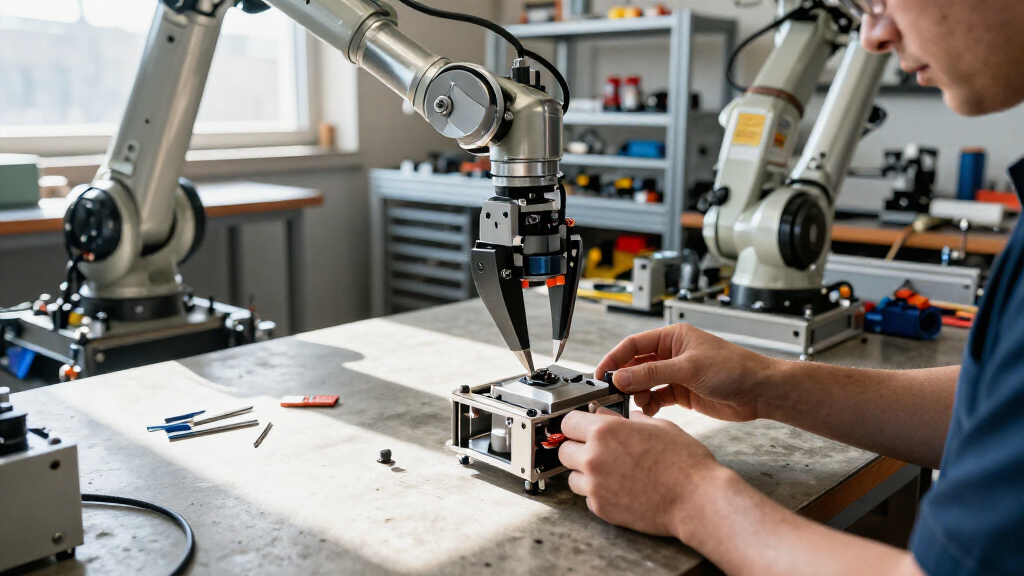
When I compare the best gripper robots, I look beyond whether a device has a claw: the useful differences are what it can pick up, how much control it offers, and whether it is a toy, a building project, or a technical platform. The reBot B601-DM is my pick for robotics development because its assembled 6+1 DoF arm and software compatibility suit hands-on programming. For families who want a build-and-play experience, the TSONER 3-in-1 Robot Arm combines a gripper with a drill and bucket, while the Dingdongwu Robot Dog skips construction and adds mobile play and voice control.

Get the latest gadgets delivered free with Prime
- Fast, free delivery on millions of items
- Prime Video, Amazon Music and more included
- Member-only deals all year
Those strengths come with clear tradeoffs. A completed research arm asks for more technical knowledge than a toy, while the two 975-piece kits take patience to build and are aimed at children. The robot dog is the easiest to start using, but its gripper is meant for small objects rather than serious manipulation. I’ve ranked these options by how well their gripping function serves their intended buyer, not by treating every product as the same kind of robot.
Complete the kit



Key Takeaways
- The reBot B601-DM is the strongest fit for programming and robotics work, with an assembled 6+1 DoF arm and compatibility with LeRobot, Python SDK, and ROS frameworks.
- The TSONER and Suplanet kits share a 975-piece tracked design and three tools; TSONER lists both remote and app programming without a specified battery requirement, while Suplanet lists a 9V battery.
- The Dingdongwu robot dog needs no assembly and adds voice commands, Mecanum-wheel movement, and up to 50 minutes of play, but its gripper is intended for small objects.
- Choose a building set if construction is part of the activity; choose the assembled reBot if you want an arm platform ready for technical work rather than a block-building project.
- The product descriptions do not state gripper payload or precise object-size limits, so I would not choose any of these for a task that requires a verified lifting capacity.
| reBot B601-DM Assembled Robotic Arm Kit with Gripper, 6+1 DoF Open-Source Robot Arm |  | Best for robotics development | Model: reBot B601-DM (SO-ARM101) | Degrees of freedom: 6+1 DoF | Connectivity: Bluetooth, Ethernet, USB, and Wi-Fi | VIEW LATEST PRICE | See Our Full Breakdown |
| 3-in-1 Programmable Robot Arm Building Set with RC and App Control |  | Best overall buildable gripper robot | Brand: TSONER | Model: 96122 | Pieces: 975 | VIEW LATEST PRICE | See Our Full Breakdown |
| Smart Robot Dog with Gripper, Voice and Remote Control |  | Best for easy, interactive play | Brand: Dingdongwu | Model: 8050 | Control modes: Remote control and voice commands | VIEW LATEST PRICE | See Our Full Breakdown |
| Suplanet 3-in-1 Programmable Robot Arm Building Set with Remote Control |  | Best alternative build kit with explicit battery details | Brand: Suplanet | Model: K96112 | Pieces: 975 | VIEW LATEST PRICE | See Our Full Breakdown |
| gripper robot | Model | Dimensions | Brand | Pieces |
|---|---|---|---|---|
| reBot B601-DM Assembled Roboti | reBot B601-DM (SO-ARM101) | 16.41 × 9.88 × 27.16 inches | — | — |
| 3-in-1 Programmable Robot Arm | 96122 | 38 × 20 × 29 cm (14.96 × 7.87 × 11.42 inches) | TSONER | 975 |
| Smart Robot Dog with Gripper | 8050 | — | Dingdongwu | — |
| Suplanet 3-in-1 Programmable R | K96112 | 14.96 × 7.87 × 11.42 inches (38 × 20 × 29 cm) | Suplanet | 975 |
More Details on Our Top Picks
reBot B601-DM Assembled Robotic Arm Kit with Gripper, 6+1 DoF Open-Source Robot Arm
The reBot B601-DM is the most purpose-built arm in this group. It arrives assembled and offers 6+1 degrees of freedom, making it a better match for users exploring coordinated arm movement than either tracked block kit. Its stated compatibility with LeRobot, Hugging Face, Python SDK, ROS1, and ROS2 also gives technically minded buyers a clearer path into robotics software and experimentation.
That capability comes with a steeper entry requirement. The description positions this arm for AI robotics, education, and research, and full use calls for Python or ROS knowledge. The other three picks offer a more direct play route through a remote, app, or voice control; the reBot makes most sense when software access and an articulated arm matter more than simple operation. Improved wiring and leader-follower functionality add to its development focus, but they do not turn it into a beginner toy.
I would also distinguish “assembled” from “ready for every project.” It avoids the 975-piece construction process of the TSONER and Suplanet kits, but the listed compatibility and connectivity still imply a technical setup. The supplied details do not state payload, gripper dimensions, or object-handling limits, and they note that optimized motors matter to performance. Buyers who need a known lifting capacity should seek that information before choosing. For a learner or maker seeking an open-source arm platform, though, it is the clearest fit here.
Pros:- Assembled design avoids the long block-building process required by the TSONER and Suplanet kits.
- 6+1 DoF configuration is suited to exploring more articulated arm movement.
- Lists compatibility with LeRobot, Hugging Face, Python SDK, ROS1, ROS2, and Nvidia Jetson.
- Bluetooth, Ethernet, USB, and Wi-Fi connectivity offer multiple integration paths.
Cons:- Full use calls for technical knowledge of Python and ROS.
- 3D-printed parts are not included.
- No gripper payload or object-size capacity is specified in the provided details.
Best for: Robotics learners, makers, and developers who can work with Python or ROS and want an assembled arm with named open-source framework compatibility.
Not ideal for: Young children, casual users seeking a simple remote-controlled toy, or buyers who need a documented payload and precise gripping limits.
- Model:reBot B601-DM (SO-ARM101)
- Degrees of freedom:6+1 DoF
- Connectivity:Bluetooth, Ethernet, USB, and Wi-Fi
- Compatibility:LeRobot, Python SDK, ROS1, ROS2, and Nvidia Jetson
- Operating systems:Linux, macOS, ROS1, ROS2, and Windows
- Processor brand:Seeed Studio
- Memory storage capacity:16 GB
- Dimensions:16.41 × 9.88 × 27.16 inches
Our verdict“I rank the reBot first for buyers who want an assembled, software-oriented gripper arm and are prepared to handle its technical learning curve.”
3-in-1 Programmable Robot Arm Building Set with RC and App Control
The TSONER 3-in-1 Robot Arm earns my buildable-kit recommendation because its gripping function is part of a broader tool set. The arm can use a gripper, drill, or bucket, giving a child more ways to change the machine’s role than a gripper-only toy. Its tracked base and remote control support direct play, while app programming lets users set up action sequences rather than only steering each movement by hand.
Against the Suplanet kit, the main proposition is strikingly similar: both list 975 ABS pieces, a tracked base, three attachments, and remote plus app control. TSONER’s supplied details identify the 975-piece construction and recommended age of 8 and up, but do not give a battery requirement. Suplanet, by contrast, specifies a 9V battery and an age range of 8–14. I would not claim that one has better gripping strength or programming depth; neither description provides those measurements.
The kit is a better choice for a child who enjoys building as much as operating the robot. Its illustrated, step-by-step instructions offer a defined route through a large assembly, but 975 pieces still demand time and attention. That makes it less suitable when the goal is an immediate, ready-to-play robot. It is also a less direct technical platform than the reBot: the app programming is framed around custom action sequences, not broad compatibility with robotics frameworks.
I place TSONER ahead of the robot dog for buyers specifically seeking a robot-arm building activity, because its attachments make the gripping feature more configurable. The dog wins for quick start-up and mobility, while this kit offers a more involved construction project. My recommendation comes with a practical check: battery needs are not specified in the provided details, so I would confirm what is required before planning a session.
Pros:- Three attachments—a gripper, drill, and bucket—vary the robot’s play tasks.
- Remote control and app-based custom action sequences provide two control approaches.
- Tracked base and gear-driven joints are described as supporting stable movement.
- Illustrated, step-by-step instructions guide a substantial hands-on building project.
Cons:- Assembly requires building from 975 pieces and may take patience.
- Battery requirements are not specified in the supplied product details.
- No rated payload or exact gripper size is provided.
Best for: Children aged 8 and up who want to assemble a tracked robot arm, swap between tools, and try app-based action programming.
Not ideal for: Buyers who want a robot ready to use without assembly, need verified lifting capacity, or prefer an arm designed for Python or ROS development.
- Brand:TSONER
- Model:96122
- Pieces:975
- Material:Acrylonitrile Butadiene Styrene (ABS)
- Attachments:Gripper, drill, and bucket
- Control:Remote control and app programming
- Dimensions:38 × 20 × 29 cm (14.96 × 7.87 × 11.42 inches)
- Weight:3.7 pounds
- Recommended age:8 years and up
Our verdict“I recommend TSONER as the strongest all-around buildable pick for children who want a gripper arm with multiple attachments and programming-style play.”
Smart Robot Dog with Gripper, Voice and Remote Control
The Dingdongwu Robot Dog is the simplest route into gripper-robot play for a buyer who does not want a building project. It requires no assembly, accepts remote and voice commands, and includes more than 30 built-in actions. Its adjustable three-section gripper adds a small-object pickup activity, while Mecanum wheels let the dog move sideways and rotate 360 degrees—mobility the tracked TSONER and Suplanet arms do not describe.
This is a play-first choice, not a substitute for a dedicated robotics arm. The reBot offers a more relevant base for development with its articulated arm and named software compatibility; the robot dog instead bundles its gripper into a character-driven, mobile toy. The product description is clear that the claw is intended for small objects, but it gives no size or payload limit. I would choose it for interactive movement and simple action programming, not for tasks that require repeatable handling of a particular object.
Its rechargeable 1200 mAh battery charges through Type-C and provides up to 50 minutes of playtime. That convenience is a notable contrast with the two block kits, which require construction and have different battery details. Still, playtime is finite, so sessions may need a recharge break. The voice-control feature adds another way to interact, while programmable sequences offer a gentle introduction to ordering actions without asking a young user to work in Python or ROS.
I rank it below the two buildable arms because its gripper appears to play a supporting role, rather than defining the whole product. For a child who values a ready-to-go robot with movement and personality, that is a strength. For a buyer whose main goal is assembling or studying a robotic arm, the TSONER or Suplanet set provides a more focused construction activity, and the reBot is the more technical platform.
Pros:- No assembly is required, unlike the two 975-piece arm kits.
- Remote and voice control complement more than 30 built-in actions.
- Mecanum wheels support sideways movement and 360-degree rotation.
- Rechargeable Type-C battery offers up to 50 minutes of playtime.
Cons:- The gripper is intended for small objects, with no rated payload listed.
- Playtime is limited to up to 50 minutes per charge.
- Its play-focused feature set is less suited to technical arm development than the reBot.
Best for: Children aged 6 and up who want a ready-to-play mobile robot with voice control, varied movement, and a gripper for small objects.
Not ideal for: Buyers seeking a buildable arm, advanced software compatibility, or a gripper with a stated lifting capacity.
- Brand:Dingdongwu
- Model:8050
- Control modes:Remote control and voice commands
- Built-in actions:30+
- Movement:Forward, backward, sideways, and 360° rotation
- Drive system:Four-wheel Mecanum
- Gripper:Adjustable three-section robotic gripper
- Battery and charging:1200 mAh; Type-C charging
- Playtime and age:Up to 50 minutes; recommended age 6+
Our verdict“I would choose the Dingdongwu for accessible, mobile robot play, but not when gripping performance or arm programming is the primary requirement.”
Suplanet 3-in-1 Programmable Robot Arm Building Set with Remote Control
The Suplanet 3-in-1 Robot Arm offers the same basic appeal as the TSONER set: a 975-piece tracked robot arm with a gripper, drill, and bucket, controlled by remote or app. I see it as a close alternative rather than a fundamentally different machine. Its most useful point of distinction is that the product details specify one 9V battery, which gives buyers clearer preparation information than TSONER’s listing provides.
That detail helps at the planning stage, but it does not establish better gripping or more capable programming. Both kits describe app-based action sequences and the same three interchangeable tools. TSONER includes illustrated, step-by-step instructions and gives a recommended age of 8 and up; Suplanet specifies an age range of 8–14 years and describes the tracked base as suitable for indoor and outdoor use. Neither listing supplies a payload rating, so I would not pick between them based on assumed lifting strength.
The set suits a child who wants construction to be part of the activity. Building from 975 pieces can be a satisfying hands-on project, and the interchangeable attachments let the finished robot do more than grip. But the assembly burden is also its clearest drawback: unlike the Dingdongwu dog, this is not ready for play straight out of the package. It also sits well below the reBot in technical scope; app sequences are a different proposition from framework compatibility with ROS, Python, and LeRobot.
I rank Suplanet fourth only because its supplied details reveal fewer distinguishing advantages within this particular lineup. It remains a sensible option when the listed battery requirement and stated age range better match the buyer’s needs. If assembly instructions are the deciding factor, the provided description gives TSONER more detail about its illustrated steps. If outdoor use is a priority, Suplanet explicitly describes its tracked base for indoor and outdoor use, though the description does not define conditions or terrain limits.
Pros:- Includes gripper, drill, and bucket attachments, matching the functional variety of the TSONER kit.
- Remote control and app programming allow direct operation and action sequences.
- The product description specifies one 9V battery.
- Tracked base is described as suitable for indoor and outdoor use.
Cons:- Assembly from 975 pieces requires time and patience.
- No gripper payload or precise object-size limit is provided.
- Its distinguishing features versus the similar TSONER kit are limited.
Best for: Families choosing a 975-piece gripper-arm building set who want the battery requirement stated and prefer an age range of 8–14.
Not ideal for: Anyone who wants immediate use without assembly, a documented payload, or the software integration offered by a development-oriented arm.
- Brand:Suplanet
- Model:K96112
- Pieces:975
- Material:ABS plastic
- Attachments:Gripper, drill, and bucket
- Controls:Remote control and app programming
- Dimensions:14.96 × 7.87 × 11.42 inches (38 × 20 × 29 cm)
- Battery:One 9V battery
- Recommended age:8–14 years
Our verdict“I recommend Suplanet when its explicit 9V battery detail or 8–14 age range fits the buyer better than the otherwise similar TSONER kit.”
How We Picked
I ranked these four options by how useful their gripper and control setup are for the buyer each is built to serve. A gripper robot can mean a child’s buildable machine, a mobile interactive toy, or a programmable arm for development. Comparing them as though they perform the same job would obscure the most important choice: whether the buyer wants to build, play, or work with a robotics platform.
For the buildable kits, I weighed the three attachments, tracked movement, remote operation, and app-based action programming against the time and patience required to assemble 975 pieces. The two kits are very similar on paper, so I looked for concrete differences rather than assigning them separate strengths based on assumptions. TSONER lists remote and app control but does not specify battery needs; Suplanet names a 9V battery and describes the tracked base as suitable for indoor and outdoor use.
For the robot dog, I considered how its adjustable gripper fits into a broader play experience. Voice control, a range of built-in actions, sideways travel, and rechargeability set it apart from the stationary-arm format, but the stated gripping use is limited to small objects. For the reBot, I gave weight to its assembled state, multiple degrees of freedom, and named software compatibility. Those features make it the most development-oriented choice, but the required Python or ROS knowledge can be a barrier.
I used the supplied product details only and did not infer lifting capacity, precision, durability beyond the descriptions, or performance on particular objects. Since payload specifications are absent, none of these should be treated as a verified solution for lifting a defined weight. My order reflects fit and usefulness for each likely buyer: technical arm first, adaptable build kit next, easiest ready-to-play option after that, and the closest alternative kit last because its described differences are narrower.
| gripper robot | Brand | Material |
|---|---|---|
| reBot B601-DM Assembled Roboti | — | — |
| 3-in-1 Programmable Robot Arm | TSONER | Acrylonitrile Butadiene Styrene (ABS) |
| Smart Robot Dog with Gripper | Dingdongwu | — |
| Suplanet 3-in-1 Programmable R | Suplanet | ABS plastic |
Factors to Consider When Choosing Best Gripper Robots
I would start by deciding what “gripper robot” means for your household or project: a robot arm to build, a mobile toy with a claw, or a programmable platform for robotics work. These picks differ enough that comparing attachment counts alone will not settle the choice.
Choose the right kind of gripper robot
A dedicated arm and a mobile robot with a gripper serve different purposes. The reBot B601-DM is the arm-oriented choice, built around 6+1 DoF and software-framework compatibility. TSONER and Suplanet are tracked construction kits where the arm is one part of a larger build. Dingdongwu places a small gripper on a mobile robot dog, so the experience centers on motion, commands, and play.
For picking up small items during play, the robot dog may fit better than a more involved arm kit. For a child who enjoys making the machine before operating it, either block set makes more sense. For learning how software can control an articulated arm, the reBot is the relevant option—provided the user is comfortable with a more technical setup.
Treat payload as an unanswered question
The product details do not give a rated payload for any of these grippers. Dingdongwu says its gripper can pick up small objects, but does not define their size or weight. The TSONER and Suplanet descriptions name a gripper attachment without a capacity figure, and the reBot information likewise provides no lifting limit. If a project depends on handling an object of a particular weight, request manufacturer specifications before choosing.
Also think about what the gripper must do. A play claw can add a fun pickup activity without offering the repeatability or capacity required for a practical job. The available descriptions support comparing controls and intended use, not making precise claims about grip force or accuracy.
Decide whether building is a benefit or a barrier
Both construction sets contain 975 pieces, so they suit buyers who want assembly as part of the activity. TSONER lists illustrated, step-by-step instructions; Suplanet gives an age range of 8–14 and calls for a 9V battery. Neither is the best fit for someone who wants to start operating a robot immediately. The robot dog needs no assembly, and the reBot is described as assembled.
Building can make the project more involved, but it also adds setup time and requires patience. If the recipient mainly wants interactive play, a ready-to-use option is a more direct match. If building is the point, compare adult support, age guidance, and the listed battery information before settling on a kit.
Match controls to the user’s comfort
The control options form a useful ladder. The Dingdongwu offers remote and voice commands plus built-in actions, while the TSONER and Suplanet kits pair remote control with app-based action programming. These controls suit play and simple sequences more directly than writing code. The reBot lists Python SDK and ROS compatibility, which offers a more technical route but assumes greater familiarity with software.
Do not equate the word “programmable” across every product. A sequence of app actions is not the same as an open software framework. Choose based on whether the user wants to arrange preset or simple movements, explore a coding environment, or simply operate a robot with a remote.
Compare the two similar building sets carefully
TSONER and Suplanet share the same core configuration in the supplied details: 975 ABS pieces, a tracked base, three attachments, and remote plus app control. The practical differences are modest. TSONER lists illustrated assembly instructions and recommends ages 8 and up; Suplanet specifies one 9V battery and gives an age range of 8–14. Suplanet also describes its base for indoor and outdoor use, without defining terrain limits.
I would choose between them using those stated details, not an assumed difference in grip strength or build quality. If assembly guidance is the priority, TSONER’s instructions are explicitly described. If knowing the battery requirement before starting matters more, Suplanet’s listing is clearer. Confirm any additional power needs and included components if those affect your setup.
Check where and how long the robot will operate
The robot dog is the only option here with a stated playtime: up to 50 minutes on its rechargeable battery, with Type-C charging. That gives buyers a practical session-length reference, though actual use may vary and the description does not state charging time. The two building sets list tracked movement but do not supply comparable runtime details in the provided information. The reBot names several connectivity options, but operating time is not specified.
For indoor play, consider available floor space and small objects that are appropriate for the gripper. For outdoor use, Suplanet says its tracked base is suited to indoor and outdoor operation, but there is no defined terrain or weather guidance. I would not assume that any of these products is suitable for rough surfaces or exposure to water without manufacturer instructions.
Set expectations around age and adult involvement
The product descriptions give different audiences: Dingdongwu is listed for ages 6+, TSONER for 8 and up, and Suplanet for 8–14. The reBot is framed for education, research, and AI robotics rather than a child’s toy age band. Age guidance can help narrow the choices, but the building kits still involve many pieces, and the reBot calls for technical skills.
For a younger child, the no-assembly dog may be the simpler starting point, with adult supervision suited to the child and activity. For a child ready to build, choose one of the block kits and plan time for assembly. For students or makers working with software frameworks, judge the reBot by the user’s coding background and project needs rather than by its assembled form alone.
Frequently Asked Questions
Which gripper robot is best for a beginner?
For a beginner who wants immediate interactive play, I would start with the Dingdongwu Robot Dog because it needs no assembly and offers remote and voice control. A beginner interested in construction may prefer TSONER or Suplanet, though each requires building from 975 pieces. I would reserve the reBot for someone ready to work with a more technical platform and its Python or ROS learning curve.
Which of these robots has the strongest gripper?
The supplied descriptions do not provide comparable grip force or payload figures, so I cannot identify a strongest gripper from this lineup. Dingdongwu is described as picking up small objects, while the other products list gripper attachments without stating a lifting capacity. If strength matters for a specific task, ask the manufacturer for a rated payload and any object-size or material limits before buying.
Are the TSONER and Suplanet robot arm kits different?
They are very similar in the details provided: both use 975 pieces, a tracked base, gripper, drill, and bucket attachments, and remote plus app control. TSONER explicitly mentions illustrated, step-by-step instructions and recommends ages 8 and up. Suplanet specifies one 9V battery, gives an age range of 8–14, and describes indoor and outdoor use. I would make the choice based on those practical details rather than expecting a stated difference in gripping performance.
Which option is best for learning robotics programming?
The reBot B601-DM is the strongest fit for software-oriented robotics learning because it lists compatibility with LeRobot, Hugging Face, Python SDK, ROS1, and ROS2. Its 6+1 DoF arm is also more clearly positioned for development than the play-focused alternatives. The TSONER and Suplanet kits offer app-based action sequences, which may suit an earlier introduction to programming-style control but are not presented as equivalent framework platforms.
Do any of these gripper robots require assembly?
The TSONER and Suplanet sets are building kits with 975 pieces, so assembly is part of the experience. The Dingdongwu robot dog requires no assembly, and the reBot is described as fully assembled. That makes the dog the clearest choice for ready-to-play use, while the reBot avoids block construction but still may require technical setup for software or connectivity.
Conclusion
My recommendation depends on the job you want the gripper robot to do. For programming, robotics education, or development, choose the assembled reBot B601-DM if the user is comfortable with Python or ROS and does not need an unlisted payload rating. For a child who wants a substantial build with multiple tools and app-based action sequences, I would pick TSONER; choose Suplanet instead when its explicit 9V battery requirement or 8–14 age range is the better fit. For a younger user or a family seeking the quickest route to interactive play, the Dingdongwu Robot Dog is the easiest starting point, with the limitation that its claw is for small objects. Whichever option you choose, verify capacity and power details when those specifications affect the intended task.