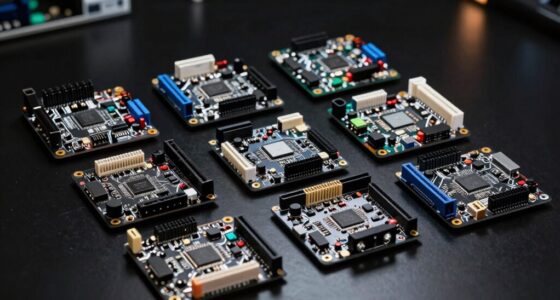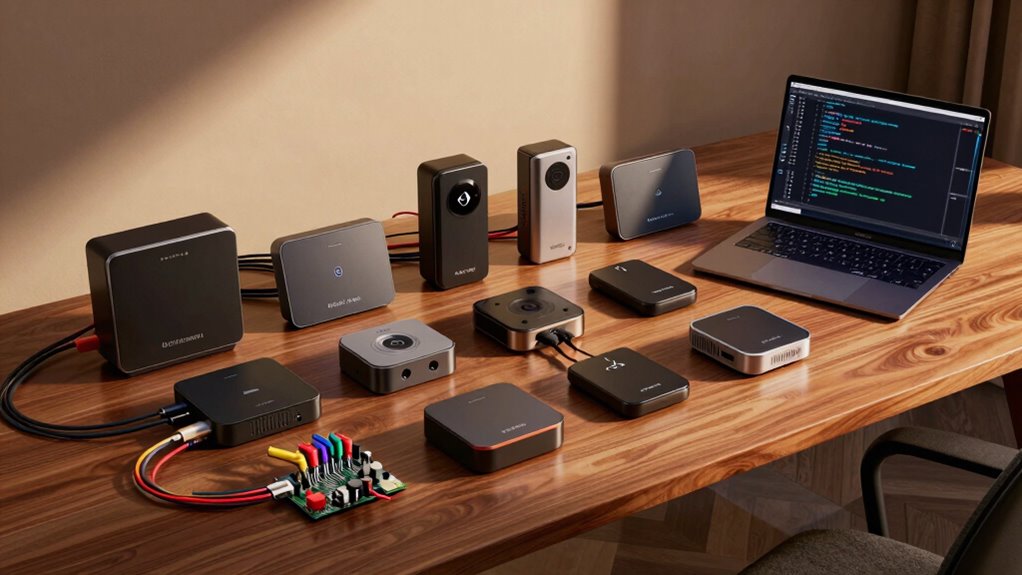

Choosing the right AI development kit can be challenging given the variety of options tailored for different needs. The AI Starter Kit for Jetson Orin Nano stands out for its balanced performance and user-friendly design, making it ideal for those new to AI projects. The Waveshare Jetson Orin NX offers robust capabilities for embedded systems, while the ELECROW CrowPi3 provides a versatile learning environment for Raspberry Pi enthusiasts. Each option involves tradeoffs between power, complexity, and price, so understanding your specific project needs is key. Continue reading for a detailed comparison to help you make an informed choice.

Get the latest gadgets delivered free with Prime
- Fast, free delivery on millions of items
- Prime Video, Amazon Music and more included
- Member-only deals all year
Complete the kit



Key Takeaways
- Top picks balance processing power and ease of use, catering to both beginners and experienced developers.
- Many kits include educational resources or preloaded software to streamline onboarding.
- Edge computing and IoT-focused kits are emerging as a major trend, with integrated sensors and connectivity features.
- Higher-end kits tend to offer more RAM and storage, but at increased cost and complexity.
- Compatibility with popular hardware like Raspberry Pi and NVIDIA Jetson is a common factor in versatile AI kits.
| AI Starter Kit for Jetson Orin Nano with 11.6″ IPS Screen |  | Best Overall for Learning and Robotics Development | Display: 11.6-inch 1366×768 IPS | Camera: 8MP with dual-servo gimbal | Storage: 128GB SD card | VIEW ON AMAZON | See Our Full Breakdown |
| ELECROW Crowpi3 AI Learning Kit for Raspberry Pi 5, Basic Kit |  | Best for Beginners Exploring AI and Coding with Raspberry Pi | Operating System: Linux | Processor Brand: ARM | Compatible Devices: Computers, Keyboards, Speakers | VIEW ON AMAZON | See Our Full Breakdown |
| SunFounder AI Fusion Lab Kit for Raspberry Pi 5/4/3B+/Zero 2W, LLMs ChatGPT/Gemini/Grok, YOLO & OpenCV, MediaPipe, Python, Video Courses for Beginners |  | Best for Multi-Modal AI Projects with Extensive Framework Support | Connectivity Technology: CSI, USB | Operating System: Linux | Compatible Devices: Raspberry Pi cameras, 10-axis (10DOF) module, displays, sensors | VIEW ON AMAZON | See Our Full Breakdown |
| Yahboom Jetson Orin NX 16GB AI Edge Development Kit with Power Supply and Wireless Network Card |  | Best for High-Performance Edge AI and Robotics | AI Performance: 157 TOPS | GPU: 1024-core N-VI-DIA Ampere with 32 Tensor Cores | CPU: 8-core Arm Cortex-A78AE v8.2 | VIEW ON AMAZON | See Our Full Breakdown |
| ELECROW AI Starter Kit for Jetson Orin Nano, 30 Sensors, 38 Python Lessons |  | Best for Beginners and Educators in Edge AI Projects | Memory Storage Capacity: 128 GB | Processor Brand: NVIDIA | Item Dimensions: 8.66″L x 4.13″W x 11.81″H | VIEW ON AMAZON | See Our Full Breakdown |
| LoRa ESP32-S3 Board – 915MHz W10 AIOT Development Kit with GPS, Bluetooth, WiFi, and LoRaWAN |  | Best for Complex IoT and Industrial Applications | Processor: 32-bit LX7 dual-core, up to 240MHz | Connectivity: WiFi, Bluetooth, LoRa, GPS | Frequency Range: 850-930MHz | VIEW ON AMAZON | See Our Full Breakdown |
| UNIHIKER K10 AI Coding Board for STEM & Beginners – Computer Vision, Offline Voice Recognition, TinyML, 2.8″ Display, IoT Project Kit |  | Best for Beginners Exploring AI and IoT | Memory Storage Capacity: 16 MB | Connectivity Technology: Bluetooth, USB, Wi-Fi | Operating System: MicroPython | VIEW ON AMAZON | See Our Full Breakdown |
| T5AI-Board Voice AI Development Kit with WiFi, BLE, 3.5″ TFT Display & Camera |  | Best for Voice and Visual Interaction Prototyping | Display: 3.5″ TFT | Camera Support: DVP Camera | Microphones: 2 built-in microphones | VIEW ON AMAZON | See Our Full Breakdown |
| AI Starter Kit: A Beginner’s 9 Step Guide to Using Artificial Intelligence Confidently at Work and in Life |  | Best for AI Beginners Seeking Practical Guidance | VIEW ON AMAZON | See Our Full Breakdown | |||
| Waveshare Jetson Orin Nano AI Development Kit with 8GB Memory and 256GB NVMe SSD |  | Best for High-Performance AI Edge Computing | Memory: 8GB | Storage: 256GB NVMe SSD | AI Performance: 20 TOPS | VIEW ON AMAZON | See Our Full Breakdown |
| Waveshare Jetson Orin NX AI Development Kit for Embedded and Edge Systems with 16GB Memory |  | Best Overall for High-Performance Edge AI | Memory: 16GB | Storage: 128GB NVMe SSD | Wireless: Bluetooth 5.0, dual-band Wi-Fi | VIEW ON AMAZON | See Our Full Breakdown |
| CrowPi 3 AI Learning and Development Station with Raspberry Pi 5 16GB Board |  | Best for Learners and Educators in AI and STEM | Processor: Raspberry Pi 5 16GB | Display: 4.3-inch capacitive touchscreen | Camera: 2MP | VIEW ON AMAZON | See Our Full Breakdown |
| LAFVIN AI Chatbot Kit for ESP32-S3 with Preloaded OpenAI & Deepseek Voice Assistant Projects |  | Best for Quick-Start Voice AI and IoT Projects | Memory: 16MB | Storage Capacity: 16MB | Connectivity Technology: Bluetooth, Wi-Fi | VIEW ON AMAZON | See Our Full Breakdown |
More Details on Our Top Picks
AI Starter Kit for Jetson Orin Nano with 11.6″ IPS Screen
This comprehensive kit stands out for its all-in-one approach, combining a Jetson Orin Nano module, an 11.6-inch IPS display, a versatile 30-in-1 sensor board, and a high-quality 8MP camera with gimbal. Compared with the Yahboom Jetson Orin NX, it offers a more portable and beginner-friendly package with extensive tutorials, making it ideal for learners and hobbyists. The setup requires some technical familiarity, especially with configuring sensors and the display, which might challenge complete novices. Its support for AI vision, voice, and robotics makes it highly versatile, but the display resolution could limit detailed visual tasks. This pick is perfect for learners and makers who want a comprehensive, portable platform with guided resources.
Pros:- All-in-one kit with sensors, camera, and display
- Supports AI vision, voice, and robotics projects
- Portable design with carrying case and extensive tutorials
Cons:- Requires some technical skill to set up and operate
- Display resolution may limit detailed visual tasks
Best for: Students and hobbyists seeking a complete, portable AI development experience with robotics capabilities
Not ideal for: Professional developers needing maximum processing power or pre-installed systems for rapid deployment
- Display:11.6-inch 1366×768 IPS
- Camera:8MP with dual-servo gimbal
- Storage:128GB SD card
- Sensors:30-in-1 sensor board including temperature, humidity, ultrasonic, gas, motion sensors
- Expansion interfaces:I2C, UART, IO
- Included accessories:Sensor board, camera, gimbal, SD card, carrying case
- Tutorials:38 guided Python tutorials
Our verdict“This kit is best suited for learners and hobbyists aiming for an all-in-one, guided AI development experience.”
ELECROW Crowpi3 AI Learning Kit for Raspberry Pi 5, Basic Kit
This entry-level STEM kit is designed to introduce newcomers to AI and coding with the Raspberry Pi 5, featuring a 4.3-inch touch display, a 2MP camera, and a rich set of 41 sensors and modules. Unlike the more advanced SunFounder AI Fusion Lab, it focuses on fundamental skills and step-by-step lessons, making it accessible for absolute beginners. However, the Raspberry Pi 5 itself is not included, which adds to the overall cost and setup complexity. The kit supports a variety of basic AI and sensor projects, but its limited components and lack of the actual Raspberry Pi may restrict more ambitious applications. This makes it ideal for learners who want a straightforward, beginner-friendly platform to start experimenting with AI and electronics.
Pros:- Includes a variety of sensors and modules for versatile projects
- Comes with detailed step-by-step lessons for beginners
- Supports multiple development boards including Raspberry Pi 5
Cons:- Raspberry Pi 5 is not included in the kit
- Limited to basic components in this version
Best for: Students and beginners who want a guided, all-in-one Raspberry Pi-based AI learning experience
Not ideal for: Experienced developers seeking high-performance AI hardware or pre-installed systems
- Operating System:Linux
- Processor Brand:ARM
- Compatible Devices:Computers, Keyboards, Speakers
- RAM Memory Technology:LPDDR3
- Processor Count:1
Our verdict“This kit offers a beginner-friendly, guided introduction to AI and electronics with Raspberry Pi but requires additional investment in the core board.”
SunFounder AI Fusion Lab Kit for Raspberry Pi 5/4/3B+/Zero 2W, LLMs ChatGPT/Gemini/Grok, YOLO & OpenCV, MediaPipe, Python, Video Courses for Beginners
This all-in-one kit transforms multiple Raspberry Pi models into a comprehensive AI platform, supporting advanced frameworks like YOLO, OpenCV, and LLMs, with guided video lessons that cover vision, voice, and motion tracking. Compared to the ELECROW CrowPi3, it offers more flexible project options across different Pi models and a broader range of AI capabilities. The setup can be complex, especially for newcomers, and it requires you to have compatible Raspberry Pi hardware already. The inclusion of various sensors and modules enables diverse projects, but the reliance on external Pi boards and Linux ecosystems could be barriers for absolute beginners. This kit suits those who want to learn cutting-edge AI frameworks across multiple Raspberry Pi models with structured support.
Pros:- Supports multiple Raspberry Pi models and AI frameworks
- Includes sensors, cameras, and accessories for diverse projects
- Provides structured video tutorials and active community support
Cons:- Requires Raspberry Pi (not included) to operate
- Setup may be challenging for absolute beginners
Best for: Intermediate to advanced students and hobbyists interested in multi-modal AI projects and frameworks
Not ideal for: Complete beginners or users without existing Raspberry Pi hardware or Linux experience
- Connectivity Technology:CSI, USB
- Operating System:Linux
- Compatible Devices:Raspberry Pi cameras, 10-axis (10DOF) module, displays, sensors
- RAM Memory Technology:LPDDR4, LPDDR3
- Processor Count:1
- Total USB Ports:4
Our verdict“This kit is well-suited for learners ready to explore multi-modal AI and advanced frameworks across various Raspberry Pi models.”
Yahboom Jetson Orin NX 16GB AI Edge Development Kit with Power Supply and Wireless Network Card
This kit offers 16GB RAM and an impressive 157 TOPS AI performance, making it ideal for demanding edge applications like autonomous robots and high-end AI inference. Its compact size and support for external NVMe storage provide flexibility, but the need for users to supply their own NVMe SSD and install the OS can be daunting for newcomers. Unlike the Jetson Orin Nano-based kits, this offers more processing power, but at the cost of increased setup complexity and no included pre-installed system. It’s best suited for professionals or advanced hobbyists aiming for high throughput and real-time AI processing in robotics or edge deployments, rather than casual experimentation.
Pros:- Exceptional AI performance with 157 TOPS
- Supports external NVMe SSD for expanded storage
- Compact, energy-efficient design
Cons:- Requires user to provide NVMe SSD and install OS
- No pre-installed system or software included
Best for: Advanced AI developers and robotics engineers needing high-performance edge computing
Not ideal for: Beginners or users seeking plug-and-play solutions without hardware setup
- AI Performance:157 TOPS
- GPU:1024-core N-VI-DIA Ampere with 32 Tensor Cores
- CPU:8-core Arm Cortex-A78AE v8.2
- Memory:16GB LPDDR5, 102.4GB/s
- Storage:Supports external NVMe SSD (at least 256GB)
Our verdict“This kit is tailored for experienced users demanding high throughput and flexible storage options for advanced AI edge applications.”
ELECROW AI Starter Kit for Jetson Orin Nano, 30 Sensors, 38 Python Lessons
This starter kit emphasizes accessibility, offering 30 sensors and an 8MP gimbal camera, all designed for building edge AI projects with Python without soldering. It complements the Jetson Orin Nano, unlike the Yahboom NX that targets high-performance applications, by focusing on ease of use and educational value. The setup may still be complex for absolute newcomers, especially since the Jetson Orin Nano board isn’t included, but the included sensors, camera, and tutorials make it a strong choice for teaching and experimenting. Its portability and rich sensor array support a wide variety of projects, making it ideal for educators and learners who want a comprehensive, solderless platform.
Pros:- Includes extensive sensors and modules for diverse projects
- No soldering needed, ideal for beginners
- Rich set of Python lessons and tutorials
Cons:- Jetson Orin Nano board not included, increasing overall cost
- Setup complexity may challenge absolute beginners
Best for: Beginners and educators seeking a complete, solderless edge AI learning platform
Not ideal for: Advanced developers needing high processing power or pre-configured systems
- Memory Storage Capacity:128 GB
- Processor Brand:NVIDIA
- Item Dimensions:8.66″L x 4.13″W x 11.81″H
Our verdict“This kit offers a beginner-friendly, educational edge AI experience with a comprehensive sensor set, ideal for teaching and experimentation.”
LoRa ESP32-S3 Board – 915MHz W10 AIOT Development Kit with GPS, Bluetooth, WiFi, and LoRaWAN
This development kit stands out for its dual-core LX7 processor and extensive connectivity options, including WiFi, Bluetooth, LoRa, and GPS, making it ideal for smart city, industrial, and advanced IoT projects. Compared with the Waveshare Jetson Orin Nano, which offers raw AI power, the LoRa ESP32-S3 prioritizes connectivity and sensor integration, though its firmware ecosystem is less mature, and setup can be intricate. Its onboard sensors and multimedia interfaces support versatile sensor data collection and processing, but the complex configuration may challenge beginners. This kit is best suited for developers needing a robust, multi-communication IoT platform, willing to navigate a steeper learning curve for advanced features.
Pros:- Powerful dual-core LX7 processor for complex data processing
- Supports multiple communication protocols including LoRaWAN and GPS
- Includes onboard sensors for environmental and motion monitoring
- Arduino compatibility for expanded project options
Cons:- Firmware for meshtastic not yet available, limiting initial functionality
- Setup process can be complex and may require advanced technical skills
Best for: Engineers and researchers working on large-scale IoT deployments or smart city projects requiring integrated GPS, LoRaWAN, and multimedia capabilities
Not ideal for: Beginners or hobbyists seeking plug-and-play solutions due to its complex setup and firmware development requirements
- Processor:32-bit LX7 dual-core, up to 240MHz
- Connectivity:WiFi, Bluetooth, LoRa, GPS
- Frequency Range:850-930MHz
- Sensors:IMU, temperature-humidity sensors
- Display Interface:LCD, OLED
- Camera Interface:OV2640, OV5640
Our verdict“This kit is best for experienced developers aiming to build integrated, multi-modal IoT systems with advanced connectivity needs.”
UNIHIKER K10 AI Coding Board for STEM & Beginners – Computer Vision, Offline Voice Recognition, TinyML, 2.8″ Display, IoT Project Kit
The UNIHIKER K10 makes the most sense for newcomers to AI and coding, offering pre-loaded models and an intuitive platform that simplifies AI projects. While the Waveshare Jetson Orin Nano delivers high-end AI performance suitable for intensive applications, the K10 emphasizes ease of use and quick setup, albeit with limited storage and a small display that may hinder complex or data-heavy projects. Its offline voice recognition and support for TinyML allow learners to experiment with real AI capabilities without needing cloud services, but advanced users may find it restrictive due to storage constraints. This board is ideal for students and educators who want a straightforward, hands-on AI learning experience without deep technical barriers.
Pros:- Pre-installed AI models for immediate experimentation
- Supports offline voice recognition and TinyML for local AI processing
- User-friendly with graphical and MicroPython programming
- Built-in sensors and wireless connectivity for diverse projects
Cons:- Limited storage capacity for larger AI models or extensive data
- Small display size restricts detailed visualizations
- Requires some technical knowledge for advanced customization
Best for: STEM students, educators, and hobbyists beginning their AI journey with limited technical background
Not ideal for: Advanced developers or professionals needing high computational power or large storage for complex AI models
- Memory Storage Capacity:16 MB
- Connectivity Technology:Bluetooth, USB, Wi-Fi
- Operating System:MicroPython
- Compatible Devices:Sensors, Actuators, Storage Devices
- Processor Count:1
- Item Dimensions:2.03″L x 2.03″W x 0.43″H
Our verdict“This kit is perfect for beginners and educators seeking an accessible platform to learn and experiment with AI and IoT concepts.”
T5AI-Board Voice AI Development Kit with WiFi, BLE, 3.5″ TFT Display & Camera
The T5AI-Board excels in voice and visual interaction projects, featuring dual microphones, a speaker, and a 3.5-inch TFT display, making it well-suited for smart home, robotics, and educational demos. Its support for DVP cameras and multiple connectivity options offers extensive hardware flexibility. Compared to the UNIHIKER K10, which emphasizes simplicity, the T5AI-Board targets prototyping for more sophisticated voice-activated or visual AI applications, though it requires more technical skill to set up and program. Its GPIOs and expansion options open many possibilities, but as a development kit, it’s not designed for end-user product deployment. It’s best for developers testing voice and vision AI in a flexible, hardware-rich environment.
Pros:- Supports advanced voice interaction with dual microphones and speaker
- Hardware expansion with display and camera support
- Multiple connectivity options including WiFi and BLE
- Generous GPIOs for custom peripherals
Cons:- Requires technical expertise for setup and programming
- Not aimed at end-user product deployment, more for testing and development
Best for: Developers and students prototyping voice-controlled or visual AI applications in smart devices or robotics
Not ideal for: Complete beginners or those seeking a ready-to-use end product, due to setup complexity
- Display:3.5″ TFT
- Camera Support:DVP Camera
- Microphones:2 built-in microphones
- Speaker:1 speaker
- Connectivity:WiFi 2.4GHz, Bluetooth LE 5.4
- GPIOs:56 GPIOs
- MCU:ARMv8-M (M33)
- Memory:16 MB RAM, 8 MB Storage
Our verdict“This kit is best for prototyping and testing voice and visual AI features in custom projects and research environments.”
AI Starter Kit: A Beginner’s 9 Step Guide to Using Artificial Intelligence Confidently at Work and in Life
This book offers a straightforward, 9-step approach to understanding and applying AI in daily work and life, making it an excellent resource for complete novices. Unlike physical kits like the Waveshare Jetson Orin Nano, which focus on hands-on technical development, the AI Starter Kit emphasizes conceptual understanding and confidence building. It lacks technical depth and does not include any hardware or software tools, so it’s not suitable for those wanting to build or code AI projects directly. Instead, it provides practical insights and clear explanations that help demystify AI for non-technical audiences. It’s best for individuals seeking a gentle introduction to AI principles without the complexity of immediate programming or hardware setup.
Pros:- Clear and easy-to-follow 9-step framework
- Suitable for complete beginners with no prior experience
- Provides practical insights applicable to daily work and life
Cons:- Lacks technical details or hands-on coding
- No supplementary materials or interactive content
Best for: Beginners and professionals needing a conceptual foundation in AI for work or daily use
Not ideal for: Experienced developers or those looking for hands-on hardware projects or coding tutorials
Our verdict“This guide is ideal for newcomers seeking a confident, non-technical understanding of AI concepts and applications.”
Waveshare Jetson Orin Nano AI Development Kit with 8GB Memory and 256GB NVMe SSD
This kit targets users demanding high AI processing power, featuring the Jetson Orin Nano module with 8GB RAM and a 256GB NVMe SSD, enabling complex AI workloads up to 20 TOPS. While the UNIHIKER K10 is geared toward beginners, the Jetson Orin Nano excels in deploying advanced AI models, robotics, and computer vision tasks with minimal latency. Its high-performance hardware and extensive peripheral support make it suitable for professional AI development, but it requires significant setup and additional hardware to be fully operational. Unlike the LoRa ESP32-S3, which emphasizes connectivity over raw AI performance, this kit delivers substantial compute capacity for intensive applications, at the cost of complexity and upfront setup.
Pros:- High-performance AI with up to 20 TOPS
- Includes a large 256GB NVMe SSD for fast storage
- Rich set of peripheral interfaces for versatile connectivity
- Built-in wireless options for network integration
Cons:- Requires additional setup and configuration, not plug-and-play
- No built-in storage in the module itself, needs external drives
Best for: AI researchers and developers working on demanding vision, robotics, or edge AI projects requiring substantial processing power
Not ideal for: Hobbyists or learners seeking simple or low-cost AI solutions due to its complexity and hardware requirements
- Memory:8GB
- Storage:256GB NVMe SSD
- AI Performance:20 TOPS
- Wireless:Wi-Fi 6, Bluetooth 5.0
- Includes:5 items
Our verdict“This kit is best for professional AI developers demanding top-tier performance and extensive peripheral options in edge applications.”
Waveshare Jetson Orin NX AI Development Kit for Embedded and Edge Systems with 16GB Memory
This kit stands out for its impressive processing power, supporting up to 100 TOPS, making it ideal for demanding AI applications on the edge. Compared with the Jetson Orin Nano-based kits, it offers significantly higher performance, but this comes with increased size and cost. The inclusion of a 128GB NVMe SSD ensures fast data access, which is critical for real-time AI tasks. However, it lacks built-in storage, so users must add their own drive, and the appearance of the SSD may differ from images, leading to potential compatibility issues. This kit is best for developers needing robust, high-speed AI processing on embedded systems, especially in industrial or research settings.
Pros:- Supports up to 100 TOPS AI performance for intensive tasks
- Includes a high-speed 128GB NVMe SSD for rapid data handling
- Supports multiple wireless (Bluetooth 5.0, Wi-Fi) and peripheral connections
Cons:- No built-in storage, requiring additional setup
- Appearance of SSD may vary from product images, affecting compatibility
Best for: AI researchers and industrial developers requiring high-top-end performance for embedded AI projects
Not ideal for: Hobbyists or educational users seeking a budget-friendly or compact solution without extensive hardware setup
- Memory:16GB
- Storage:128GB NVMe SSD
- Wireless:Bluetooth 5.0, dual-band Wi-Fi
- Includes:Jetson Orin NX Module, JETSON-IO-BASE-B base board
Our verdict“This kit is best suited for advanced users needing high-powered edge AI with extensive connectivity options.”
CrowPi 3 AI Learning and Development Station with Raspberry Pi 5 16GB Board
The CrowPi 3 makes this list as a comprehensive, hands-on platform that combines hardware and guided learning, suitable for users new to AI or STEM projects. Unlike the more powerful Jetson-based kits, it emphasizes education and experimentation through its integrated sensors, touchscreen, and wide range of supported platforms like Arduino and micro:bit. With over 200 courses, it offers a structured approach to building AI and IoT skills, but its complexity might overwhelm true beginners without prior hardware familiarity. The Raspberry Pi 5’s 16GB RAM ensures decent processing for educational projects, yet it may fall short for intensive AI workloads. This kit makes the most sense for students or hobbyists eager to explore AI in a tactile, guided environment.
Pros:- Includes over 200 guided courses for hands-on learning
- Supports multiple platforms like Raspberry Pi, Arduino, and micro:bit
- Built-in sensors, touchscreen, camera, and microphone for real-world AI projects
- All-in-one design simplifies hardware integration
Cons:- May be too complex for absolute beginners without prior tech experience
- Requires familiarity with hardware setup and programming
- Price is not specified, which could be a barrier for some users
Best for: Students, educators, and hobbyists looking for an all-in-one AI and STEM learning kit
Not ideal for: Professional developers requiring high-performance embedded AI for commercial applications
- Processor:Raspberry Pi 5 16GB
- Display:4.3-inch capacitive touchscreen
- Camera:2MP
- Sensors & Modules:41 onboard sensors and modules
Our verdict“Ideal for learners and educators seeking a versatile, guided platform to develop AI and STEM skills.”
LAFVIN AI Chatbot Kit for ESP32-S3 with Preloaded OpenAI & Deepseek Voice Assistant Projects
This kit earns its spot by offering preloaded voice AI projects based on OpenAI and Deepseek, allowing users to rapidly prototype voice interaction systems. Compared to the more powerful Jetson or Raspberry Pi kits, the ESP32-S3’s 16MB RAM and limited storage of 16MB restrict complexity but make it an accessible choice for small IoT applications. Its built-in Wi-Fi and Bluetooth make it straightforward to connect to other devices and networks, while the user-friendly design with a color display simplifies setup. The main tradeoff is the need for users to supply their own API keys for OpenAI, and the limited memory constrains the complexity of projects that can be developed. This platform is perfect for hobbyists or developers focusing on embedded voice assistants and IoT integrations.
Pros:- Preloaded with OpenAI and Deepseek voice projects for easy deployment
- Built-in Wi-Fi and Bluetooth enable flexible connectivity
- Rich interfaces and GPIOs allow customization and expansion
- Compact, modular design for easy integration into projects
Cons:- Limited storage (16MB) restricts project complexity
- Requires user-provided API keys for OpenAI functionality
- Limited RAM may hinder running multiple or large AI models simultaneously
Best for: Hobbyists and developers wanting quick, simple voice AI projects with minimal setup
Not ideal for: Advanced AI developers or commercial projects needing extensive processing power or large storage capacity
- Memory:16MB
- Storage Capacity:16MB
- Connectivity Technology:Bluetooth, Wi-Fi
- Operating System:ESP-IDF
Our verdict“Best suited for hobbyists and small-scale IoT projects focused on voice AI with quick setup and flexibility.”

How We Picked
Our evaluation focused on a combination of performance, versatility, build quality, and usability. We prioritized kits that offer a clear path to deploying real AI applications, whether for education, prototyping, or embedded systems. Ease of setup and availability of learning resources were also key factors, particularly for beginners. Cost was considered relative to features offered, with a bias toward products that deliver value for both newcomers and experienced developers. The ranking reflects a balance of technical capability and practical usability for various user profiles.Factors to Consider When Choosing Ai Development Kits
When selecting an AI development kit, it’s vital to consider your intended use case, technical skill level, and future scalability. The right kit should match your project’s complexity without overwhelming you with unnecessary features. Cost is also a significant factor—investing in a more powerful kit makes sense if you need high performance, but for learning or prototyping, a more affordable option may suffice. Compatibility with existing hardware and preferred software ecosystems can streamline your development process. Here are some key considerations to guide your decision:Performance and Processing Power
Assess the computational capabilities of the kit, especially if your project involves deep learning or real-time processing. Kits with more GPU or CPU cores and higher RAM enable handling larger models and datasets more efficiently. However, higher performance often comes with increased cost and power consumption, so match these specs to your project’s demands.
Ease of Use and Learning Resources
For beginners, look for kits that include comprehensive documentation, tutorials, and preloaded software. Some kits come with GUI tools or visual programming options that simplify development. Advanced users can prioritize customization options and open-source support to tailor the environment to specific needs.
Connectivity and Expandability
Check the available interfaces such as USB, HDMI, WiFi, Bluetooth, and GPIO pins. These features are essential if your project involves sensors, cameras, or IoT devices. Expandability options like additional GPIO headers or USB ports can extend the kit’s lifespan and versatility.
Price and Value
Balance your budget against the features offered. Higher-priced kits often provide more power and expandability but may not be necessary for simple tasks or learning. Consider what features are essential for your current project and whether a less expensive option could meet your needs.
Compatibility and Ecosystem
Ensure the kit supports your preferred hardware platforms and software frameworks, such as TensorFlow, PyTorch, or OpenCV. Compatibility with popular ecosystems like Raspberry Pi or NVIDIA Jetson can reduce setup time and improve community support.
Frequently Asked Questions
Can I upgrade the hardware components of these AI kits later?
Many AI development kits are designed with upgradeability in mind, especially those with modular components or accessible expansion ports. For example, some kits support adding more RAM, additional sensors, or external storage. However, the ability to upgrade depends on the specific model; integrated systems like the Jetson Orin Nano have limited upgrade options compared to more open platforms like Raspberry Pi-based kits. Carefully review each kit’s specifications to determine how much you can expand or modify it over time.
Are these kits suitable for real-time AI applications?
Most of the higher-end kits, especially those with dedicated GPUs like NVIDIA Jetson series, are well-suited for real-time AI tasks such as object detection, video analysis, or robotics. Kits with integrated accelerators and ample RAM tend to perform better under demanding workloads. For less intensive applications or prototyping, even more modest kits can handle real-time processing, but expect some limitations in speed and complexity.
What software frameworks are compatible with these AI kits?
Most of these kits support popular AI frameworks like TensorFlow, PyTorch, OpenCV, and MediaPipe. NVIDIA Jetson-based kits, in particular, come with pre-installed support for CUDA and TensorRT, which optimize performance for deep learning models. Raspberry Pi-based kits typically rely on lighter frameworks or require manual setup but are compatible with many open-source AI libraries. Compatibility with your preferred framework is key to smooth development.
How much technical expertise do I need to set up these kits?
The setup complexity varies widely. Beginner-friendly kits often include step-by-step instructions, preloaded software, and user-friendly interfaces, making them accessible to novices. More advanced kits may require familiarity with Linux, command-line tools, and hardware assembly. If you’re new to AI hardware, prioritize kits with comprehensive tutorials and active community support to reduce the learning curve.
Are there kits specifically designed for IoT or edge computing?
Yes, several kits in this lineup target IoT and edge AI applications, often featuring integrated sensors, wireless connectivity, and low power consumption. Examples include the LoRa ESP32-S3 Board and UNIHIKER K10. These kits are ideal if your project involves deploying AI models on resource-constrained devices or in remote locations. Be sure to verify the processing capabilities to ensure they meet your application’s requirements.
Conclusion
For those starting out in AI development, the ELECROW CrowPi3 offers an accessible platform with educational resources. Professional developers seeking high performance and expandability will find the Waveshare Jetson Orin NX to be a powerful choice. Budget-conscious hobbyists can opt for Raspberry Pi-based kits, while embedded system designers will appreciate the flexibility of the Yahboom Jetson Orin NX. The AI Starter Kit for Jetson Orin Nano strikes a balance between ease of use and capability for most users, earning the spot of best overall pick. Choose based on your project scope, experience level, and future growth plans.