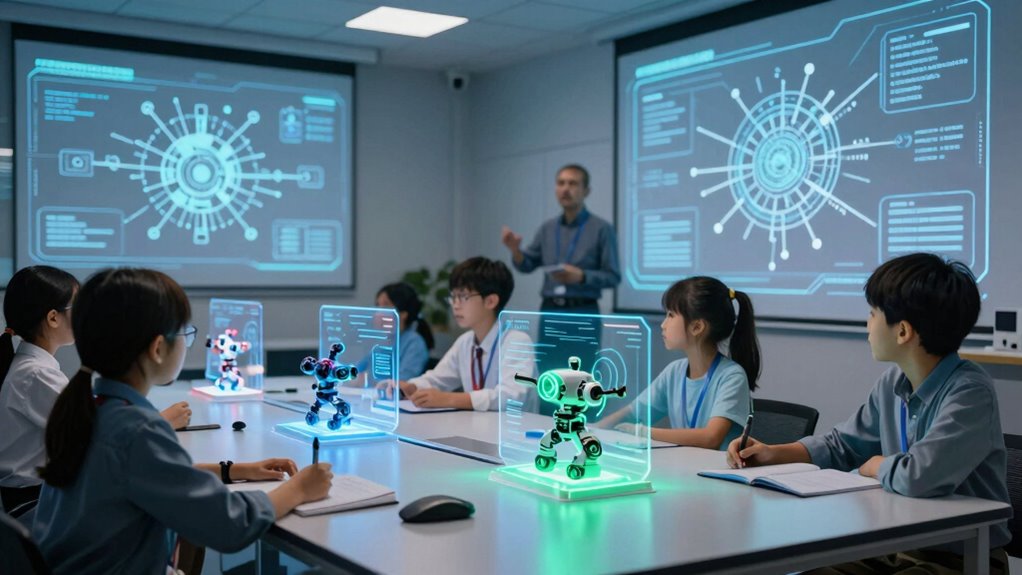

The education system is beginning to adapt to the nanotech era with increased funding, innovative teaching tools like virtual labs, and digital technologies such as AR, VR, and AI. However, challenges remain, including costs, access disparities, and the need for specialized training for educators. While progress is promising, fully preparing students for a future shaped by nanoscale science requires ongoing efforts. Stay with us to explore how education can fully embrace nanotechnology’s potential.
Key Takeaways
- Many schools incorporate nanotech through hands-on experiments and digital tools, but widespread adoption remains limited by resources.
- Significant investments in nanotech research and education funding are driving curriculum development and technological integration.
- Emerging technologies like AR, VR, and AI are beginning to transform nanoscale learning experiences and student engagement.
- Challenges such as high costs, safety concerns, and digital divides hinder equitable access and full readiness.
- Educator training and curriculum standards need enhancement to effectively prepare students for the nanotech era.
nanotechnology educational kits for students
As an affiliate, we earn on qualifying purchases.
As an affiliate, we earn on qualifying purchases.
Current Integration of Nanotechnology in Educational Settings

Nanotechnology is increasingly becoming a part of educational settings, especially at the high school and college levels. You might notice nanoparticle-based experiments in chemistry classes or interactive lessons using smart materials that engage students in STEM. Surveys of 200 participants, including educators and students, reveal that integrating nanotech correlates with better learning outcomes. Schools are adopting hands-on activities and lab instruction focused on nanoscience and nanomaterials, fostering curiosity and practical skills. Pre-college programs dedicated to nanotechnology have surged, supported by millions in funding over the past decade. These initiatives aim to introduce students early to nanoscale concepts, making complex topics more accessible and inspiring future careers in nanotech fields. The trend highlights a growing commitment to embedding nanotechnology into education. Understanding projectors and related visual tools can significantly enhance the delivery of these complex subjects by making them more tangible and engaging for students. Additionally, incorporating educational resources tailored to nanotech can further improve comprehension and spark interest among learners. The integration of digital learning tools can also support teachers in effectively demonstrating nanoscale phenomena and concepts.
AR VR nanoscale science learning tools
As an affiliate, we earn on qualifying purchases.
As an affiliate, we earn on qualifying purchases.
Market Trends and Investment in Nanotech Education

The rapid growth of the nanotechnology market reflects significant investments in education and research, signaling strong global commitment to advancing this field. With the market projected to hit $125.88 billion by 2024, funding for nanotech education continues to surge. Governments and institutions prioritize nanoscience, with the U.S. requesting over $2.2 billion in FY25 and cumulative funding exceeding $45 billion since 2001. Education sectors are embracing advanced tech, integrating nanomaterials into curricula. This table highlights key investment areas:
| Investment Focus | Impact |
|---|---|
| Research Funding | Accelerates innovation |
| Education Programs | Builds workforce readiness |
| Infrastructure Development | Ensures access and growth |
These trends demonstrate a clear push towards preparing you for a nanotech-driven future. The emphasis on advanced tech in educational institutions reflects a strategic move to equip students with cutting-edge skills necessary for the evolving industry. Additionally, nanomaterials incorporation into classroom settings is transforming how students engage with science and engineering concepts, fostering innovation and preparing a new generation of innovators. Furthermore, the integration of interdisciplinary approaches is fostering a more comprehensive understanding of nanotechnology’s applications across various fields. Recognizing the importance of educational infrastructure, institutions are investing in state-of-the-art laboratories and digital resources to support hands-on learning experiences.
digital nanotech lab experiments for schools
As an affiliate, we earn on qualifying purchases.
As an affiliate, we earn on qualifying purchases.
Benefits and Impact of Nanotech on STEM Learning Outcomes

Integrating nanotech into STEM education considerably boosts student engagement and enhances learning outcomes. When you incorporate nanotechnology experiments and digital tools, you create more interactive, hands-on experiences that make abstract concepts tangible. Students become more curious and motivated as they visualize nanoscale phenomena using virtual and augmented reality. This approach fosters critical thinking and problem-solving skills essential for future careers. Furthermore, nanotech integration supports interdisciplinary learning, connecting chemistry, physics, biology, and engineering seamlessly. As a result, students develop a deeper understanding of complex scientific principles. Surveys show that these methods improve retention and conceptual clarity. Ultimately, nanotechnology enriches the educational environment, better preparing students for the evolving STEM landscape and future innovations.
educator training nanotech curriculum
As an affiliate, we earn on qualifying purchases.
As an affiliate, we earn on qualifying purchases.
Challenges and Barriers to Incorporating Nanotechnology in Schools

While nanotech offers exciting opportunities to enhance STEM education, implementing these innovations faces significant obstacles. Safety concerns, high costs, and limited access pose major barriers. Schools often lack the proper regulatory frameworks and training programs to guarantee safe handling of nanoscale materials. Additionally, the expense of equipment and materials makes widespread adoption difficult, especially in underfunded districts. The digital divide further limits equitable access to the necessary infrastructure, leaving some students behind. Furthermore, there’s a shortage of accurate, accessible information to support teachers and students in understanding nanotechnology’s applications. Without proper resources and guidance, integrating nanotech into curricula becomes challenging. Developing safety standards and comprehensive training programs is essential for overcoming these issues. Addressing these barriers requires coordinated efforts to develop standards, increase funding, and promote inclusive access to nanotechnology education. Building awareness and understanding of nanotechnology principles among educators and policymakers is critical for fostering long-term integration. Moreover, fostering teacher training programs focused on nanotechnology can help bridge the knowledge gap and ensure effective instruction. Establishing curriculum guidelines tailored to nanoscale science can facilitate smoother adoption across diverse educational settings.
Curriculum Development and Innovative Teaching Strategies

You can enhance learning by integrating nanotech concepts into existing curricula, making abstract ideas more tangible. Embracing digital technologies like virtual reality and AI can transform how students explore nanoscale phenomena. To succeed, you’ll need to focus on training educators effectively, ensuring they’re equipped to deliver these innovative strategies confidently. Incorporating responsible use and privacy into lessons can also foster critical thinking and resourcefulness among students. Additionally, fostering a scientific literacy mindset is essential for students to navigate the complexities of nanotechnology responsibly and ethically. Understanding filtration and other clean-home systems can serve as practical analogies to help students grasp nanoscale processes.
Integrating Nanotech Concepts
Incorporating nanotechnology concepts into curricula requires innovative teaching strategies that make nanoscale science accessible and engaging. You can do this by integrating hands-on experiments with nanoparticles in chemistry classes, which boost student interest and understanding. Using real-world applications, like smart materials and virtual labs, helps students visualize nanoscale phenomena and see their relevance. To enhance learning, consider incorporating interdisciplinary projects that blend nanotech with biology, physics, or engineering. You might also leverage digital tools such as augmented reality to provide immersive experiences. These approaches foster curiosity and develop critical STEM skills, preparing students for future careers. Overall, the key is blending interactive, practical methods with innovative content to make nanotech concepts approachable and inspiring for learners.
Embracing Digital Technologies
Embracing digital technologies transforms how you develop curricula and implement innovative teaching strategies in nanotechnology education. You can leverage virtual labs, augmented reality, and AI-powered tools to create immersive learning experiences. These technologies enable students to visualize nanoscale phenomena and conduct experiments virtually, reducing costs and safety concerns. To illustrate, consider the table below highlighting key digital tools shaping the future:
| Tool | Application | Benefit |
|---|---|---|
| Virtual Labs | Simulate nanotech experiments | Safe, cost-effective learning |
| AR/VR | Visualize nanoscale structures | Enhances comprehension |
| AI Tutors | Personalize instruction | Adaptive learning |
| Interactive Apps | Engage students with real-time feedback | Improves retention |
| Data Analytics | Track progress and tailor curricula | Data-driven improvements |
Training Educators Effectively
To effectively implement digital tools in nanotechnology education, educators must be equipped with targeted training that enhances their curriculum development and teaching strategies. You need to stay current with rapid technological advances and integrate hands-on, interdisciplinary approaches. This involves understanding how to use virtual labs, AR/VR, and AI-driven platforms to engage students actively. Additionally, staying informed about nanoscience breakthroughs enables educators to incorporate cutting-edge content into their lessons. Developing programs that offer continuous professional development in nanotech concepts and digital tools is essential for maintaining educator expertise. Collaborate across disciplines to create adaptable, real-world projects aligned with evolving industry needs. Incorporate inquiry-based learning and problem-solving methods to foster critical thinking and innovation. Furthermore, understanding educator training methods rooted in current educational research can significantly improve the effectiveness of professional development initiatives.
Future Directions and Technological Advances in Nanotech Education

Advancements in technologies like augmented reality (AR), virtual reality (VR), and artificial intelligence (AI) are poised to transform nanotech education in the coming years. You’ll see immersive simulations that make nanoscale concepts tangible, personalized learning powered by AI, and interactive experiments accessible virtually. These tools will bridge gaps in understanding, foster engagement, and enable hands-on experiences without expensive lab equipment. As shown below, the integration of these innovations will shape future curricula:
| Technology | Impact on Education |
|---|---|
| AR | Visualizes nanoscale structures |
| VR | Creates immersive lab environments |
| AI | Customizes learning pathways |
| Data Analytics | Tracks student progress effectively |
| Digital Labs | Provides safe, accessible experimentation |
Furthermore, the adoption of educational technology will facilitate scalable and cost-effective learning solutions across diverse educational settings. Incorporating interactive tools such as virtual labs and simulations will make complex nanoscale phenomena more accessible to learners worldwide.
Frequently Asked Questions
How Can Teachers Effectively Incorporate Nanotechnology Concepts Into Existing Curricula?
You can effectively incorporate nanotechnology by integrating hands-on experiments, like nanoparticle demonstrations, into your lessons. Use digital tools such as virtual reality to visualize nanoscale concepts and connect them to real-world applications. Stay updated on the latest developments through professional development and collaborate with colleagues across disciplines. Emphasize safety, provide accessible resources, and foster curiosity to help students grasp nanotech’s potential in STEM careers.
What Are the Ethical Considerations of Introducing Nanotech in K-12 Education?
You should consider ethical issues like safety, privacy, and equitable access when introducing nanotech in K-12 education. Make sure students understand potential risks and benefits, and promote responsible use. Address concerns about disparities by ensuring all students have fair access. Foster discussions on ethical implications, encouraging critical thinking. By doing so, you help students develop awareness and responsibility as they explore nanotechnology’s promising yet complex role in society.
How Does Nanotechnology Literacy Vary Across Different Socioeconomic and Geographic Regions?
You’ll find nanotechnology literacy varies greatly depending on socioeconomic and geographic factors. In affluent regions with better resources, students often access cutting-edge tools, hands-on experiments, and specialized programs. Conversely, underserved areas face resource gaps, limited infrastructure, and fewer trained educators, widening the digital divide. To bridge this gap, you need targeted investments, accessible curricula, and global collaboration, ensuring all students gain equitable exposure to nanotech concepts and skills essential for future innovation.
What Training Resources Are Available to Help Educators Stay Current With Nanotech Advances?
You can access a variety of training resources to stay current with nanotech advances. Many universities and organizations offer online courses, webinars, and workshops focused on nanotechnology. Additionally, professional societies like IEEE and NANO provide certifications and updates. Educational platforms such as Coursera and edX feature nanotech programs. Participating in conferences and reading the latest research articles also keeps you informed, ensuring you’re equipped to incorporate nanotech into your teaching effectively.
How Will Emerging AI and Ar/Vr Tools Transform Nanotech Education Methods?
Emerging AI and AR/VR tools will revolutionize your nanotech teaching by making complex concepts more accessible and engaging. You’ll use virtual simulations to visualize nanoscale phenomena, enhancing hands-on experiences without physical lab constraints. AI personalizes learning paths, helping students grasp intricate ideas more efficiently. By integrating these technologies, you’ll foster innovation, boost student motivation, and better prepare learners for nanotech careers, creating a dynamic, interactive, and future-ready educational environment.
Conclusion
As you stand at the crossroads of innovation, imagine your education system as a garden ready to bloom with nanotech’s potential. Embracing this tiny frontier can uncover vast worlds of discovery, transforming students into explorers of the infinitesimal. By breaking down barriers and planting seeds of curiosity, you can nurture a future where nanotechnology blossoms into limitless possibilities. The question isn’t just if you’re ready—it’s how you’ll cultivate the next wave of scientific wonder.